
Brentwood outlines draft student device policy to comply with NY law; district readies phased rollout
Get AI-powered insights, summaries, and transcripts
Subscribe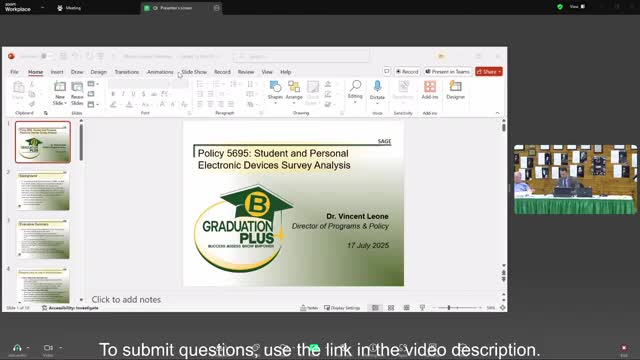
Summary
District officials presented draft policy 5695 in response to New York Education Law requirements that ban student personal internet-connected devices during instructional hours; the draft reflects survey feedback and proposes tiered storage and limited exceptions.
Brentwood — The Brentwood Union Free School District presented a draft student personal electronic device policy, Policy 5695, on July 17 to align with a New York State requirement that public schools prohibit student use of personal internet-connected devices during the school day beginning in fall 2025.
Vincent, a district staff member leading the policy work, told the Board the new state mandate allows “very limited flexibility,” and that the district carried out three stakeholder surveys in June to inform the draft. The district collected responses from 2,228 students in grades 6–12, about 542 professional staff members and roughly 532 parents and guardians, Vincent said.
The surveys found shared priorities across groups: families wanted structured ways to contact students in emergencies, staff emphasized consistent enforcement and limited classroom disruption, and students sought access for mental-health coping tools and music. Vincent said the draft attempts to balance those priorities while complying with the law.
Key provisions in the draft policy include tiered expectations by grade level: elementary schools will continue the district’s existing practice (no personal devices in buildings); middle- and high-school students will be required to silence and store personal internet-connected devices for the school day in lockers, district-provided locking pouches or laptop cases; high-school students may also keep powered-down phones in backpacks. District‑issued internet-enabled devices remain usable for educational purposes.
The district has $96,400 available through Chapter 53 to support infrastructure for storing devices, Vincent said, and he warned that the money will not fully cover a comprehensive rollout. He described the implementation as a phased effort, starting at the high school to build storage infrastructure over time.
Vincent described the proposed enforcement as progressive and restorative: first violations require students to surrender the device to the school office and allow the student to pick it up at the end of the day; subsequent infractions would require a parent to retrieve the device. He emphasized the policy will not subject students to out-of-school suspension for merely violating the device rule.
Policy exceptions in the draft include medically documented needs (for example, students with diabetes who require device access), students whose Individualized Education Programs (IEPs) or 504 plans explicitly reference device use, and non‑internet-connected devices such as certain headphones or fitness trackers (which the district nevertheless discourages bringing to school and would require storing during the day). Vincent said the assistant superintendent for special services, Rhonda Young, confirmed the district would honor IEP/504 exemptions.
The Board heard questions about cost and implementation logistics. When asked for a realistic cost estimate beyond the Chapter 53 allocation, Vincent said he did not have a firm figure and described the rollout as “a staggering, staggering prospect” that will require personnel, infrastructure and time.
The Board is scheduled to consider final adoption of Policy 5695 at its Aug. 21 business meeting; the district plans translations, outreach materials, a video for families and training before implementation. Vincent said district-owned platforms (such as Microsoft Teams, eSchool Parent Portal or ParentSquare) and school offices would remain available routes for family communications during the school day.