Get Full Government Meeting Transcripts, Videos, & Alerts Forever!
Get email alerts on the Student Surveys Sel topic
No spam. Unsubscribe anytime.
District reports gains on student self-efficacy, flags disparities for multilingual and special-education students
Summary
District staff presented spring 2025 student and family survey results showing increases in measures such as supportive relationships and student self-efficacy, while noting lower ratings for school safety and disproportionate negative responses from multilingual students and students with disabilities.
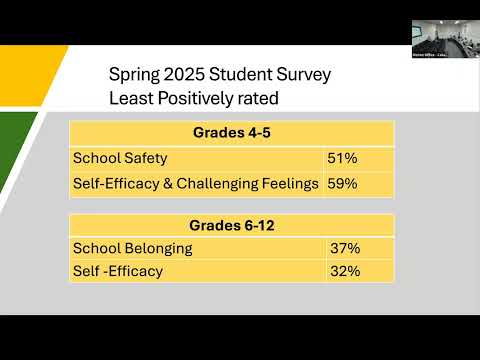
A staff member presented the school district’s spring 2025 student and family survey results, saying the surveys show “really strong favorable ratings” in areas such as staff showing respect and supportive relationships, while also noting some declines and disparities. The presentation, given during a regular School Board meeting, covered family survey highlights, student social-emotional learning measures and subgroup heat maps used to guide school improvement planning. District staff said supportive relationships scored especially high: “91% positive rating” on the grades 4–5 measure of supportive relationships. The presenter said self-management and self-efficacy rose from fall to spring at the elementary level, with one item increasing by five percentage points. At the secondary level, staff reported a nine-point increase on a school-safety question from fall to spring and gains in diversity and inclusion ratings. The presenter also said students still express worry about school violence even when many report feeling mostly safe. In the district’s words, “even though students report that they mostly feel safe at school, they still worry about school violence.” The presentation noted drills and training are in place and observed that such training may increase awareness and anxiety. The district used a “heat map” to compare subgroups and found multilingual students and students with disabilities reported less positive experiences in several areas, especially in secondary grades. The presenter said the district’s DLIT (district leadership/information team) reviewed districtwide results in May and that each school will review its own data with building leadership teams and parent groups and may set school improvement goals based on the results. Board members asked for school-level breakdowns and for the open-ended family comments. The presenter said comments are downloaded to spreadsheets, some translated and some not, and that staff can provide school-level results and the themes generated from comments. Discussion (options and concerns): Board members asked whether school-level results vary and how consistent the survey windows are across schools. The presenter said elementary and secondary windows are different by design (elementary fits teacher schedules; secondary uses advisory classes) and that windows are “pretty close” (within a five-day window), with some variation. A board member asked whether the results vary between schools; the presenter said she could provide that breakdown. Direction/assignment: The presenter said DLIT has reviewed districtwide data; each school will review its own results and use the data to inform school improvement plans. The presenter offered to provide school-level heat maps and comment themes and to send additional materials to the board on request. No formal board vote or policy change resulted from this agenda item. Ending: Board members and student representatives acknowledged the presentation and asked for follow-up materials; staff committed to provide school-level breakdowns and the comment themes for board review.