
Baltimore council committee presses for tighter oversight of recovery homes and substance-use clinics
Get AI-powered insights, summaries, and transcripts
Subscribe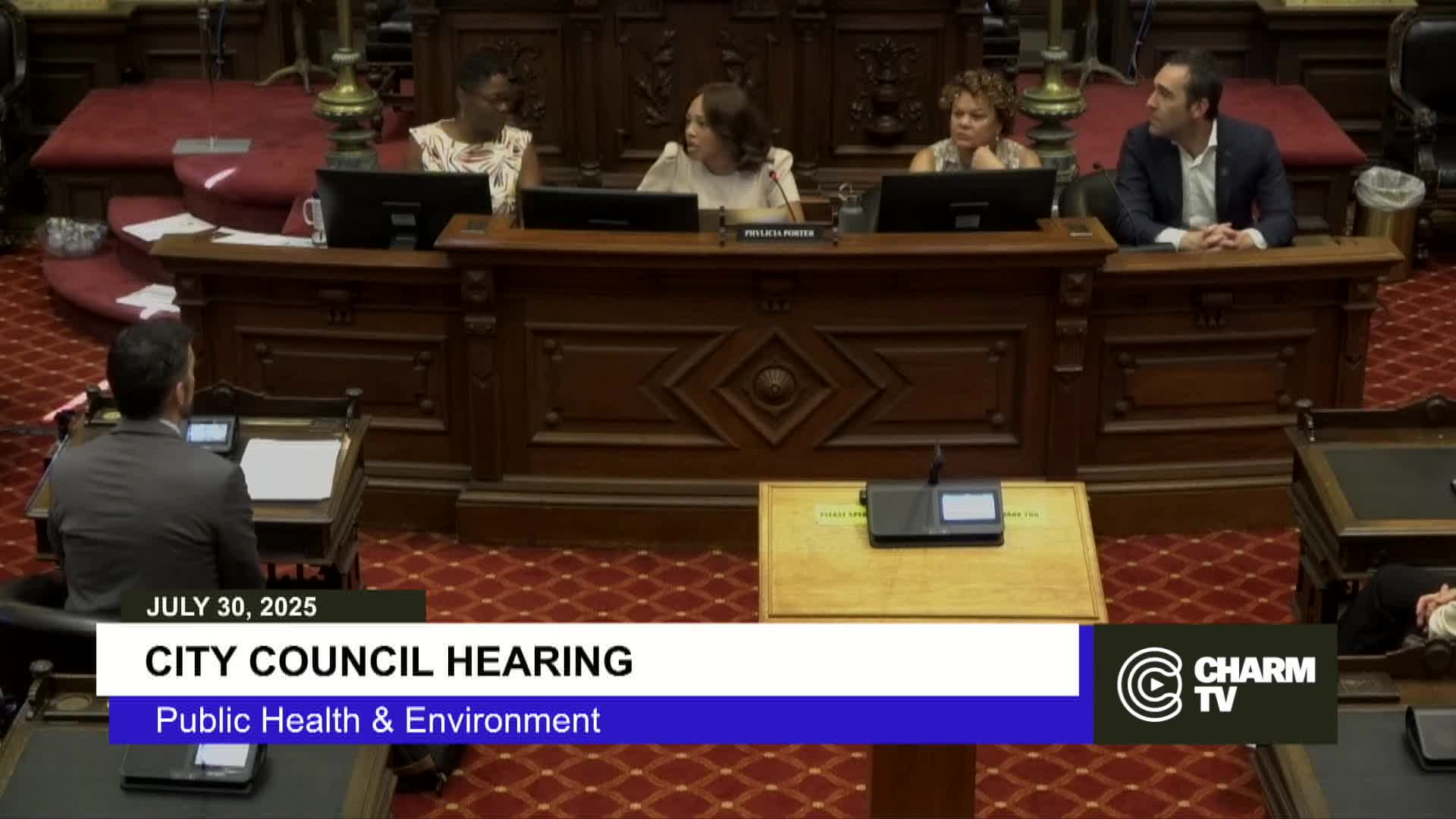
Summary
City council members, behavioral-health officials and providers debated regulation, data gaps and community impacts during an oversight hearing on uncertified recovery homes, proliferation of outpatient programs and a state moratorium on certain Medicaid enrollments.
Councilwoman Felicia Porter, chair of the Baltimore City Council Public Health and Environment Committee, opened a committee oversight hearing on local treatment providers saying, "this is the fourth, oversight hearing related to the opioid crisis, specifically geared towards recovery homes and substance abuse clinics in Baltimore City" to evaluate provider accountability and patient safety.
The hearing drew council leadership, Behavioral Health System Baltimore and providers and centered on three core problems: uncertified recovery homes operating with limited city or state inspection authority; a rapid increase in outpatient program types (IOP/PHP) concentrated in Baltimore; and gaps in data-sharing and follow-up after nonfatal overdoses.
Why it matters: Baltimore officials and providers said oversight gaps can allow predatory or low-quality operations to open near neighborhoods, amplify community harm and undermine established programs. Dan Rabbit, policy director for Behavioral Health System Baltimore, said that certification matters because "If a recovery home is certified, then they can obtain state funding. If they are uncertified then they cannot obtain state funding." BHSB briefed the committee that the state currently lists 37 certified recovery housing programs in Baltimore and that Baltimore has "33 OTPs right now and 9,000 people were served in Baltimore," while overall outpatient service counts and expenditures have risen.
BHSB described how responsibility is split among actors: the Maryland Behavioral Health Administration issues licenses and sanctions; Medicaid’s Administrative Services Organization processes claims and audits billing; the local behavioral health authority (BHSB) investigates complaints and recommends actions to the state; and the city enforces building, zoning and safety codes. BHSB staff said they lack inspection authority over uncertified recovery homes and urged better alignment between state licensing rules (COMAR) and local oversight.
Providers and community witnesses offered contrasting perspectives. Kim Wireman, president and CEO of Powell Recovery Center, outlined data-driven retention improvements at her long-established residential program and urged stronger licensing and laboratory-quality reporting: "If we can keep a client in treatment for 30 days, that client has a 70 percent chance of remaining in treatment for 90 days," she said, and described Powell’s on-the-block staffing, neighborhood cleanups and camera systems as part of its community integration work.
Melissa Vale, clinical manager of Sinai Hospital Addictions Recovery Program (SHARPP), described her program’s outcomes and cautioned about clustering of opioid treatment programs: "In the past 6 months, an average of 86 percent of all the random drug screens of our patients, in treatment for at least 90 days were illicit is illicit opioid free," she said. Vale noted nine OTPs already in the Sinai catchment ZIP codes and said "the tenth OTP is opening within 800 yards of an existing OTP," raising concerns that aggressive client recruitment and many nearby entrants can fragment care.
Several public commenters urged both stronger enforcement and careful targeting of enforcement. Nick Thiem, a Baltimore resident and former reporter, urged better post-overdose follow-up teams and data sharing, saying, "Law interprets HIPAA as preventing EMS from sharing overdose victims' information with the port without the explicit consent of the victim," a position he said limits outreach compared with other jurisdictions. Lisa Hodges Huyken and Minister Christina Flowers testified about regional patient flows and poor housing and safety conditions in some facilities. Yolanda Pulley criticized some clinics sharply: "so called addiction clinics are nothing more than drug mills with a business license," she said, while praising Cornerstone Treatment Center as an example of community-focused recovery.
State action referenced at the hearing included a July pause on new Medicaid enrollment for partial-hospitalization (PHP) and intensive outpatient (IOP) providers; BHSB said that moratorium remains in place in Baltimore through at least the end of the calendar year to give the state time to update COMAR (Code of Maryland Regulations). BHSB staff said a key goal of regulation updates is to require more community engagement, pre-opening assessments of provider density, stronger reporting of lab-based results and clearer local roles for the local behavioral health authorities.
Council members pressed for clearer tools for residents who report problematic facilities and for better intergovernmental coordination. Council Vice President Sharon Green Middleton, Council President Zeke Cohen and other members described the hearings as part of a broader set of actions linking council oversight, state regulation and city code enforcement. Councilwoman Odette Ramos reminded the committee that a city law passed two years earlier requires certain recovery homes to meet building-code standards and rental licensing rules and said she will provide data on implementation.
What was not decided: The committee held no formal votes at the hearing. Witnesses and council members discussed potential next steps including drafting city-level options to use housing and rental codes more aggressively, seeking state changes to COMAR and reintroducing a community-engagement requirement at the state level. Chair Porter said the committee will continue hearings in September.
Looking ahead: The council and BHSB said they will pursue more detailed data from the Medicaid ASO (including resident status of treatment clients), continue to press the state on COMAR changes and consider how city codes and licensing can be used to curtail problematic operations without penalizing established providers. Providers called for investigations targeted at specific bad actors rather than blanket penalties on all programs.