
Milford planners review major rewrite of groundwater protection ordinance tied to soils, maps
Get AI-powered insights, summaries, and transcripts
Subscribe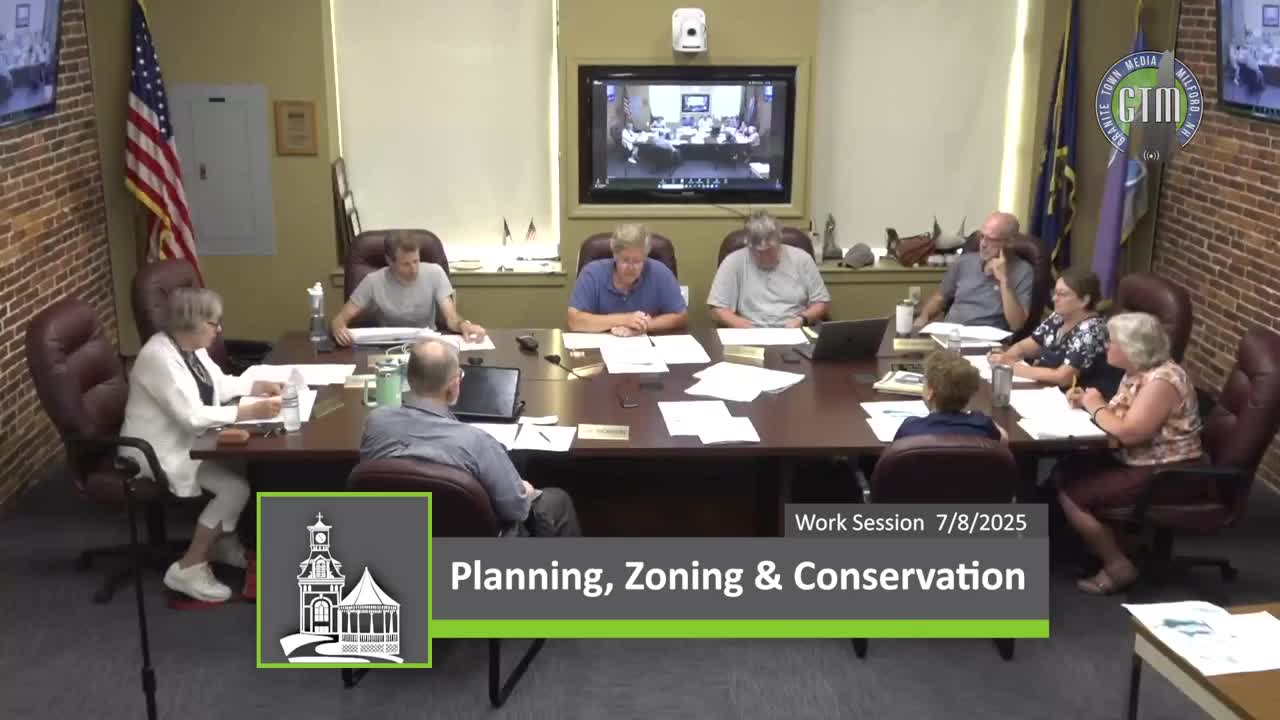
Summary
Planning board, conservation commission and zoning board held a joint session to review a proposed update that would retie Milford's groundwater protection district to transmissive soils and USGS mapping, tighten performance standards, and clarify exemptions; no votes were taken and staff will return with edits and additional data.
Milford — The Planning Board, joined by members of the Zoning Board of Adjustment and the Conservation Commission, spent the July 8 joint work session reviewing a proposed update to the town's Groundwater Protection Ordinance that would change how the protected area is defined, add new performance and storage standards, and clarify exemptions for small home-based uses.
The proposal would replace a map-based definition tied to historic wellheads with a soils-based approach using transmissivity data pulled from USGS hydrology resources and other model maps. Town Planner Terry Dolan said the change aims to "tie it to USGS" maps so the protected area is based on the underlying aquifer and highly transmissive soils rather than the older static wellhead maps.
Why it matters: The update affects where stricter review would apply for new or expanded uses that store regulated substances (including petroleum), where snow is managed, and whether businesses such as car washes or laundromats would be permitted in sensitive areas. Commissioners and staff repeatedly raised questions about how many properties would be newly affected, how exemptions for home-based activities would operate, and who will enforce any new requirements.
Key proposals and discussion
Map basis and district extent: The draft would move the Groundwater Protection District from a static wellhead-overlay approach (the 2002/2003 NRPC map referenced in the original ordinance) to a soils- and aquifer-based overlay built from USGS hydrology mapping. Dolan and other staff said the USGS layers are more researchable and defensible than the older NRPC map; the 2002 ordinance text currently cites a map dated Oct. 24, 2002. The planning group discussed that the soils-based overlay often places highly transmissive areas along the Sallegan River and in other discrete pockets, not uniformly across every lot, though an exchange in the meeting briefly described the "whole town" as recharge in a general sense before panelists clarified the overlay would apply only where transmissive soils are present.
Definitions and technical thresholds: The draft adds definitions from the New Hampshire Department of Environmental Services (DES) model ordinance including "aquifer," "drinking water supply well," "excessively drained soils," and "seasonal high water table." Panelists asked staff to add a clear definition of "recharge/sufficient recharge." The draft also proposes a four-foot vertical separation from the seasonal high water table for certain activities, and references transmissivity values (examples given in the meeting included soils with flow rates described in cubic feet per day).
Exemptions, permitted uses and home-based businesses: The proposed text reorders exemptions and permitted uses, and staff recommended consolidating overlapping sections. The draft would exempt private residences unless a portion of the dwelling operates as a home business. Several commissioners pressed for clarity about whether a small home office or limited household containers (for example, gasoline cans used for yard equipment) would trigger the ordinance's limits. The draft uses a storage-size threshold of 5 gallons: "regulatory substances stored in containers with a capacity of 5 gallons or more" change review obligations. Commissioners discussed scenarios (home day care, home office, small maintenance equipment) and asked staff to make clear whether container volumes used for ordinary household tasks would be treated differently than storage for a business use.
Performance standards and regulated uses: The update would add or tighten performance standards for transfers and storage of petroleum and other regulated substances. Examples discussed included secondary containment, impervious transfer surfaces (pans, concrete pads), and best-management practices (BMPs) for petroleum transfers. Staff noted those standards mirror DES model language; commissioners questioned enforcement feasibility for small construction sites and mobile refueling operations and asked staff to cite practical BMP guidance.
New items flagged from DES model language: The draft includes new items drawn from the DES model ordinance that were not in Milford's 2003 regulations, including clearer rules for on-site snow storage vs. off-site snow dumps, limits or performance standards for new car washes and laundromats (concerns centered on leachate and filtered waste streams), and an explicit four-foot separation to the seasonal high water table for certain excavations. Conservation commissioners and others urged stronger definitions and cross-references so "snow storage" used temporarily on-site would not be conflated with large off-site "snow dumps." Staff agreed to clarify off-site wording.
Conditional use permits and review sequence: The draft borrows DES's phrasing about conditional use permits. Several members asked whether conditional-use review would be required in addition to any Zoning Board variance or special-exception process. Staff explained the intent is an additional level of technical review by the Planning Board (design and BMPs) after any zoning decision, not to replace ZBA authority. Commissioners asked staff to provide language and examples from peer towns showing how DES'style conditional-use triggers were implemented.
Nonconforming uses and intensification: The draft would grandfather existing nonconforming uses but requires repairs, replacements or expansions to meet current BMPs and standards; commissioners asked about reasonable thresholds for intensification and agreed the ordinance must set measurable triggers (for example, defined changes that would require bringing a site into compliance).
Enforcement and resourcing: Multiple board members said the town lacks sufficient inspection resources to audit ongoing BMP compliance and suggested building inspection or periodic reporting requirements into permits if such uses remain allowed. Several panelists noted DES recommends local inspection or maintenance programs; the boards requested staff research on model enforcement language and potential inspection regimens used by comparable towns.
Next steps and information requested: Staff said the water commission (Dale White and others) should be involved going forward and agreed to provide: - A comparison of acreage or parcel counts under the 2003 NRPC/wellhead map vs. the proposed soils-based overlay (commissioners asked staff to quantify how many properties would be newly affected). - Source citations and sample ordinance language from DES and several municipalities that used conditional-use approaches. - Clarified definitions for "recharge/sufficient recharge," "leachate," and "snow dump" and rewritten exemption/permitted-use language to avoid contradictory clauses. - An inventory of referenced authorities (USGS hydrology map, NRPC 2003 map) and an explicit note about which map copy is stored in Planning Department records.
Ending: The boards did not vote on the draft. Staff committed to producing a revised draft that addresses the items above and to involve the water department and town engineer in the next session. The group scheduled further review rather than final action.