
Board adopts 5-year educational facilities plan after growth presentation projecting 11,600-student increase over 10 years
Get AI-powered insights, summaries, and transcripts
Subscribe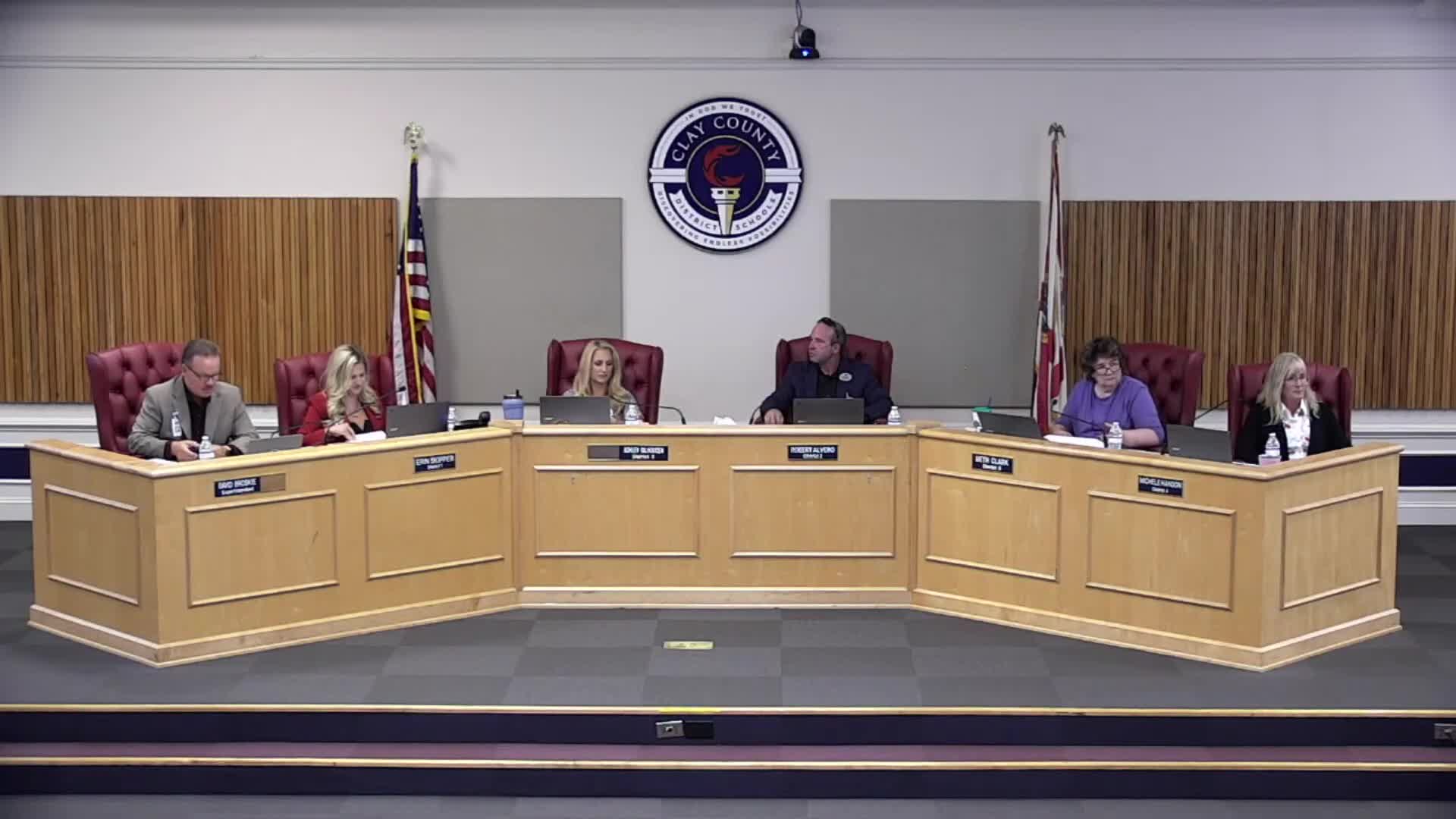
Summary
Operations staff presented a facilities plan and a growth analysis showing concentrated housing growth in Lake Asbury, Oakleaf and Green Cove Springs; the School Board unanimously approved the 2025–30 Educational Facilities Plan and discussed funding limits for new schools.
The Clay County School Board unanimously approved the tentative 2025–30 Educational Facilities Plan (EFP) on July 29 after an operations presentation that outlined housing growth, student-generation projections and potential school sites. Board members voted 5-0 to adopt the five-year plan.
Mister Beeman, operations staff, said the district currently manages 43 district schools and serves about 41,000 students and that staff project an increase of about 11,600 students over the next 10 years tied to an estimated 19,000 new homes. Beeman told the board those student estimates rely on a student-generation rate the district updates every two years and on monthly tracking of certificates of occupancy. “We project that we're going to add at least another two schools in the next 10 years,” he said.
Beeman highlighted hot spots for residential growth concentrated in the county's unincorporated areas — Lake Asbury, Fleming Island, Middleburg and Oakleaf — and displayed maps and certificate-of-occupancy density charts showing heavy recent activity in Lake Asbury. He said some district-owned parcels, including a roughly 96-acre parcel in Lake Asbury, could serve as possible high-school sites; staff also noted that developers in Saratoga Springs and Governors Park had identified potential school sites as part of development agreements.
Board members asked when a new high school might be built; Beeman said timing is uncertain and that the district tries to delay new construction when possible by using rezoning and additions to manage capacity. He presented a multi-year construction plan that includes a Wright Elementary classroom addition expected to open in 2026, a Lake Asbury elementary addition targeted for 2028, a Wilkinson addition targeted for 2030 and a future high school with timing and location still under study. Beeman estimated roughly $240,000,000 in capital costs would be needed to provide new student stations for projected growth.
Staff and board members discussed how growth will be funded. Operations staff and others explained that impact fees, the half-cent sales tax passed in 2020 and capital millage all contribute to capital funding but that each source carries limits: impact fees apply to new growth and are collected as certificates of occupancy are issued; developer conveyances of land are typically credited against impact fees under state statute; and no single developer payment or impact-fee stream typically covers the full cost of a new school. One staff member said that impact fees alone are “never enough to pay for an entire school.” Board members also heard that some land dedicated to the district as part of development agreements must be credited against the developer's impact-fee obligation and therefore reduces future impact-fee receipts until the credit is used.
Operations staff said capital outlay fund projections rely heavily on local capital millage (1.5 mills), estimated sales tax receipts and impact-fee estimates; staff noted the district plans transfers from capital funds to the operating fund for capital-related maintenance and to the debt fund for principal and interest payments. Board members were also reminded that state standards and statutes guide the EFP: the district must submit a financially feasible five-year plan to the Florida Department of Education.
The board approved the tentative EFP and will consider final adjustments in subsequent budget and planning meetings. Staff emphasized the EFP is a living, statutory document that will be updated as building activity, grant awards, state guidance and financial conditions change.