Get Full Government Meeting Transcripts, Videos, & Alerts Forever!
Get email alerts on the Water And Sewer Finance topic
No spam. Unsubscribe anytime.
Nogales officials say unfinished 2020 WIFA projects could require major borrowing, rate increases
Summary
City of Nogales officials presented a staff analysis July 30 showing a 2020 WIFA loan of roughly $15 million produced mostly designs and plans but only four completed projects; staff estimates completing the 2020 projects would require about $38 million more and additional system repairs over the next decade could total another ~$37 million.
City of Nogales officials presented a staff analysis July 30 that shows the city has already borrowed about $15 million through a 2020 WIFA loan for water and wastewater projects and that completing projects from that loan would require additional borrowing in the tens of millions.
Michael Vasquez, the city’s municipal adviser, told the council the 2020 loan—about $10 million for water and $5 million for wastewater—has been nearly expended and produced engineering and plans but only four completed projects. Vasquez said staff ballpark estimates are that completing the projects listed in the 2020 loan would require roughly $38 million more ($30.4 million water, $7.5 million wastewater). He added that, beyond finishing the 2020 projects, the city’s infrastructure would continue to degrade and staff identified roughly another $37 million in needs over the next 10 years (about $22 million water, $14.5 million wastewater).
“The bookend analysis we presented shows three scenarios,” Vasquez said. “Do nothing and let the $15 million amortize; borrow $38 million to finish the 2020 list; or borrow the additional amounts to address a 10‑year wish list.”
City Manager Mitch Kramer and consultant Kevin Burnett framed the estimates as preliminary and sensitive. Kramer said staff intentionally presented “ballpark” numbers so council could begin discussion, and Burnett said the study is flexible and will be adapted as council provides direction. Burnett emphasized that the city cannot “afford” additional WIFA borrowing under current rates unless rate payers pay more: “You can afford [new loans] if the constituents pay more in rates,” he said.
Council members pressed for more accountability and detail about why so few projects were completed after the 2020 loan disbursement. Councilmember Doyle said he had repeatedly raised concerns in the past about whether 32 projects could be completed with the money available and described the situation as “a hard pill to swallow” for residents who expect basic repairs. Councilmember Montiel and others asked staff to produce a back‑accounting of the $15 million—where it was spent and what remains outstanding—before any decision to ask ratepayers for increases.
Staff and consultants discussed how rate changes could be analyzed. Burnett and Vasquez described a preliminary “bookend” rate analysis that, in a scenario staff presented, could require a roughly 113% increase in utility charges to cover the combined borrowing needed to finish the listed projects and stabilize the system (staff characterized that figure as an example in the presentation, not a final recommendation). Councilmembers repeatedly emphasized the social impacts of a large rate increase and asked staff to develop options that stage projects over time and reduce the burden on fixed‑income households.
Vasquez also said the city has been in contact with WIFA and with the WIFA director (Chelsea McGuire); he said some portions of earlier aid remain potentially forgivable under prior agreements but cautioned that grant opportunities are limited and staff cannot rely on large federal grant sums to close the shortfall. Kramer said WIFA officials advised that the city could likely keep the existing 2020 loan in place for engineering work but that additional borrowing would require stronger reserves and demonstrable financial capacity.
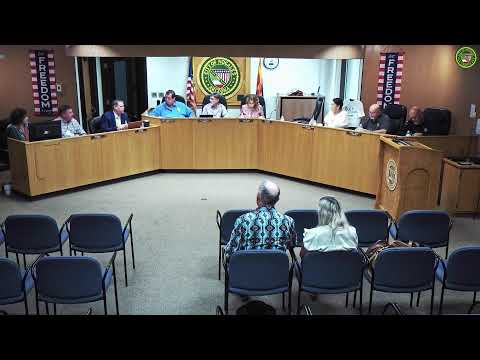
No formal council action was taken; the presentation was given during a study session. Multiple council members requested follow‑up materials: a line‑by‑line accounting of the 2020 WIFA expenditures, a prioritized list of outstanding projects with cost estimates, scenarios that stage borrowing and rate increases over a multi‑year schedule, and an updated rate study using verified line‑item costs rather than ballpark numbers. Kramer said staff will bring updated information to additional study sessions planned for September and October.
Ending: Council members signaled they understood the urgency but expressed concern about the timing and size of any rate increases. Several asked staff to prepare written scenarios and to return with more detailed financial documentation and procurement histories before placing loan authorization or rate changes on a future council agenda.