Get Full Government Meeting Transcripts, Videos, & Alerts Forever!
Get email alerts on the City Finance Midyear topic
No spam. Unsubscribe anytime.
City finance briefing: revenues up year‑over‑year but slightly under budget; personnel and NATO costs lift expenditures
Summary
At a midyear finance briefing, city finance staff reported revenues about $7.9 million (7.5%) higher than last year but roughly $1.2 million (1%) below budget through June; personnel costs and one‑time events including NATO staffing raised expenditures, and staff flagged timing issues that temporarily trigger the city’s circuit‑breaker model.
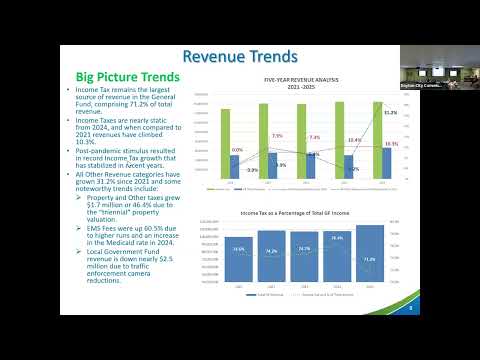
City finance staff told the City Finance Committee at a midyear briefing that revenues through June are about $7.9 million, or 7.5 percent, higher than the same period last year but roughly $1.2 million (about 1 percent) under the adopted budget. Ms. Jones, the finance presenter, said the city’s largest revenue source, income tax, “remains flat compared to 2024.”
The presentation said other revenue categories drove most of the year‑over‑year gain. An interim cash transfer into the general fund occurred this year one month earlier than last year; that timing produced a large increase in the “other revenue” line, which staff said is not recurring. Jeanette, a finance staff member, explained that property tax advances from the county were higher this year as the county’s 2023 revaluation fed increased advance payments in 2025.
Why this matters: the brief front‑loads the risk that timing, not new ongoing receipts, explains much of the apparent revenue improvement. The finance team used a circuit‑breaker model based on a five‑year mean to flag revenue categories that fall below historical expectations; one standard deviation is a warning and two standard deviations calls for corrective action. Ms. Jones said the model currently flags base income‑tax collections and several timing‑sensitive categories, and that the flags should clear once billed revenue arrives.
Most expenditure categories increased compared with 2024, but the city remains under budget overall through June. Total expenditures were reported as roughly $2.8 million under budget for the year‑to‑date period, though $7.9 million higher than last year. Personnel costs were $3.6 million under the year‑to‑date budget but $4.3 million (5.8 percent) higher than in 2024; finance staff attributed the increase to annual wage growth, timing of police and fire recruit classes, a police labor contract adjustment late last year, and NATO‑related overtime and contractual costs.
Staff noted other drivers: contracts, materials and other uses rose year‑over‑year (about $600,000) because of higher supplies and NATO‑related contractual labor; conversely, some transfers and one‑time technology transfers that appeared in 2024 did not repeat in 2025. The presentation also noted that insurance costs were lower this year because a planned mid‑year health‑insurance holiday reduced the city’s premium outlay for June.
The briefing included an update on the city’s $102 million Data Recovery Plan (DRP), of which staff said nearly $90 million in contracts have been approved and about $44.6 million spent to date. Staff reported that 60 projects are included in the DRP and three projects remain without awarded contracts: an improving‑neighborhood housing project (the grantee is reapplying for historic‑tax credits and working with planning), an MBE‑compliance tool under procurement, and a housing‑case management/notification tool that will be funded as an operating cost for ongoing hearings.
On equity and contracting, staff said the DRP has an MBE goal of $22.5 million and that achieved MBE awards total $21.5 million so far (about 96 percent of the stated goal), with more contracting activity expected as projects proceed.
Staff also reviewed longer‑term expenditure trends: comparing 2021 to 2025, personnel and contracts/materials combined rose more than $26.2 million (34.1 percent); personnel alone rose about $17 million (27.5 percent) and contracts/materials rose about $9.3 million (60.8 percent). Finance staff said the spending mix has shifted toward more contracts and materials as the city added services such as a court security contract with the Montgomery County Sheriff’s Office.
Discussion and next steps: staff told commissioners they expect to end the year under budget but will likely use $1.5 million to $2.5 million of reserves by year end (larger than the $1.2 million originally planned) because of inflationary pressures, personnel cost growth and economic uncertainty. Staff recommended continued monitoring and said several circuit‑breaker flags are timing‑driven and expected to correct when reimbursements and billed receipts are posted.