
Board adopts ordinance seeking to bar masked law‑enforcement identification in unincorporated county areas; county counsel warned of likely legal challenge
Get AI-powered insights, summaries, and transcripts
Subscribe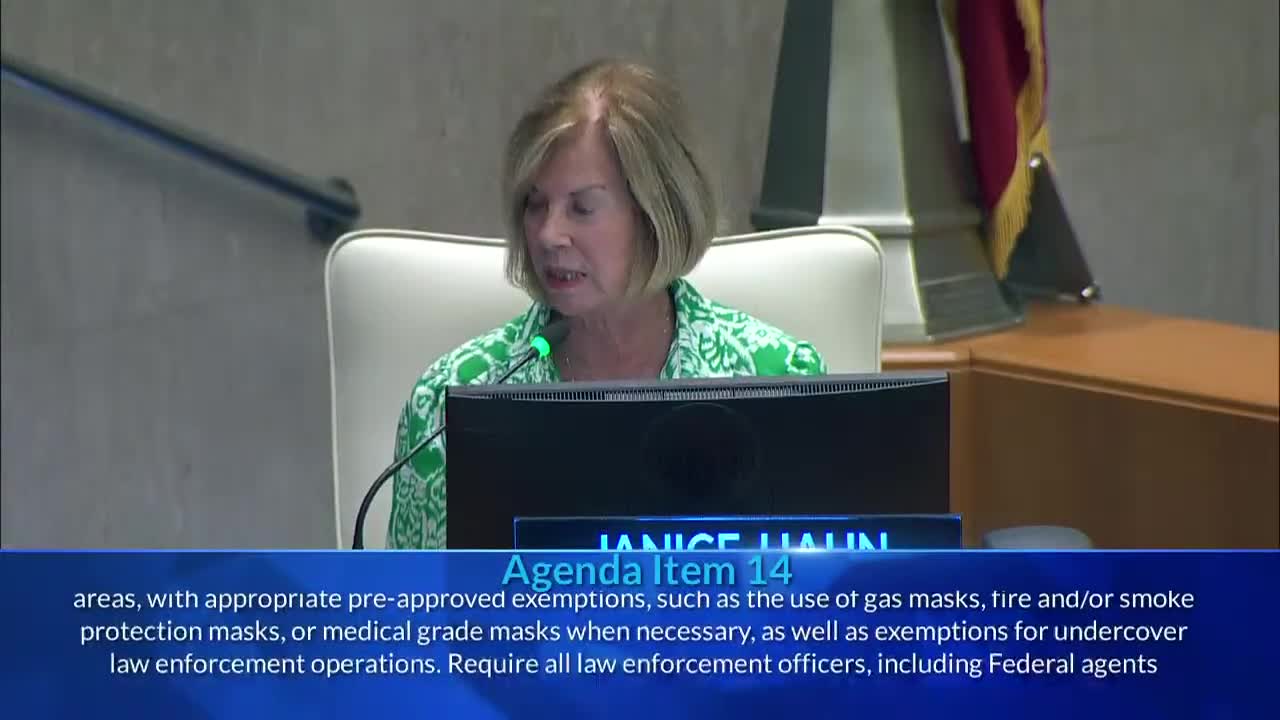
Summary
The Board of Supervisors voted July 29 to direct county counsel to draft an ordinance barring law‑enforcement officers from concealing their identities while interacting with the public in unincorporated Los Angeles County, citing public safety and impersonation risks.
The Los Angeles County Board of Supervisors on July 29 approved an ordinance aimed at preventing law‑enforcement officers from concealing their identities while engaging with the public in unincorporated county areas.
The motion, introduced by Supervisor Janice Hahn and co‑authored by Supervisor Hilda Solis, directs county counsel to draft an ordinance that would prohibit officers from wearing non‑medical face coverings that conceal identity while interacting with residents — with narrowly described exceptions for protective gear that legitimately hides the face (for example, gas masks or medical gear required for safety).
Why it matters: Supervisors and many public speakers said recent incidents — including ICE raids in which agents wore masks and unmarked vehicles — have generated widespread fear in immigrant communities and created a space for impersonators. Supporters argued the ordinance would enhance public safety and accountability by restoring basic expectations: when officials identify themselves, residents can verify authority and pursue legal remedies if needed.
Deliberations and legal questions Sponsor Supervisor Hahn framed the motion as a public safety and accountability measure. “Being forcibly detained by a federal officer in the middle of the day is scary enough. Having it done by someone wearing a face mask or balaclava whose name and badge are completely covered up is even more disturbing,” Hahn said.
Supervisor Solis, who co‑authored the motion, said state and federal bills with similar aims have been introduced and that the county had an obligation to set expectations in its jurisdiction.
County counsel warned the board that an ordinance aimed at federal officers will likely be tested in court. Counsel said challenges will likely cite the supremacy clause and doctrines of intergovernmental immunity, and that enforcing a county ordinance against federal personnel could trigger litigation. The counsel also noted that, even if the ordinance is legally challenged, the policy sends a clear expectation and could help in cases involving impersonators.
Public comment Supporters of the ordinance included elected officials, representatives of immigrant and civil‑rights organizations, and many residents who said masked enforcement has terrorized communities. Speakers described instances of unmarked vehicles, officers who refused to show ID, and alleged impersonators, and they urged the county to act to protect residents.
Opponents and cautionary comments included members of the public who raised procedural or jurisdictional concerns, arguing the ordinance could provoke legal battles and may not be enforceable against federal agents.
Vote and outcome The board approved the motion in a roll‑call vote: four supervisors voted yes; one abstained. Supervisor Hahn moved the ordinance and Supervisor Solis seconded. Supervisor Kathryn Barger abstained. The board directed county counsel to draft ordinance language and return with a report within 60 days.
What the ordinance does and does not do - The draft language will seek to prohibit non‑medical face coverings that conceal identity during interactions with the public in unincorporated county areas, while including limited exceptions for required protective equipment. - County counsel cautioned the board that enforcement against federal agents will be legally fraught and may ultimately be litigated. The county cannot unilaterally control federal law enforcement; the ordinance aims primarily to set local standards and empower prosecutors and community members to identify imposters.
Ending Supporters said the measure is a statement of public safety and civic accountability; skeptics cautioned about federal preemption. The board’s directive to county counsel begins a drafting and legal review phase that county attorneys said would examine constitutional risks and enforcement pathways.