Get Full Government Meeting Transcripts, Videos, & Alerts Forever!
Get email alerts on the Fire Assessment Fee topic
No spam. Unsubscribe anytime.
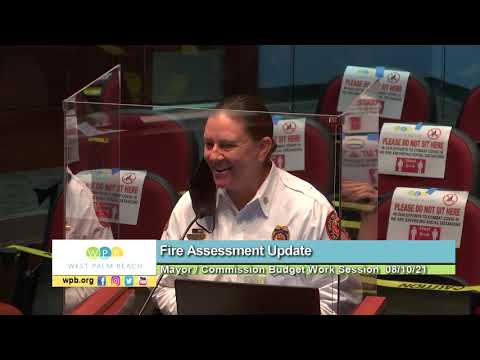
Commission hears FY21 fire assessment spending and proposed FY22 fire-assessment budget
Summary
City staff reviewed uses of FY21 fire assessment fees and presented a proposed FY22 budget funded by approximately $7.0 million in assessment revenue, including personnel, vehicle leases and capital replacements; commissioners pressed for clarity on reserve use and commitments to incremental services.
City budget staff and fire department leadership reported to the commission on how the fiscal 2021 fire-assessment fee was spent and on the proposed uses for fiscal 2022 assessment revenue.
Linda McDermott, the city’s budget manager, summarized third-quarter FY21 collections and expenditures for the fire assessment fund and said year-to-date collections were about $7.0 million. She said FY21 permitted uses included personnel services (the FY21 budget supported 14 positions funded by the fee), materials and services, internal service charges and carryforwards for station repairs and other projects.
McDermott described FY22 revenue on the basis of assessment receipts (about $7.0 million) and related interest, and presented a proposed FY22 budget that includes funding for the same 14 assessment-funded positions, routine station and apparatus maintenance, uniform and bunker-gear purchases for 37 firefighters, vehicle-replacement planning and capital outlay for apparatus identified by fleet replacement schedules.
Chief Diana Maddy said she participated in building the budget and confirmed it reflected department priorities and ongoing equipment and facility needs, noting that some repairs (for example air-conditioning at stations) can supersede other capital priorities due to safety and operational requirements.
Commissioners pressed staff on specific points. Commissioner Schauff asked why $650,000 in fire assessment fund capital outlay appears to support a joint police–fire training facility when the sales-tax penny program also contains funding for the training facility; staff said the penny sales-tax allocation is insufficient to meet the full project cost and that the assessment fund contribution is a permissible use because the facility serves fire operations. Commissioner Shoaff asked whether the approximately $3.6 million in fund balance rollovers would be used to meet earlier commitments to staff and apparatus; staff said the rollover and FY22 revenue will be part of a budget discussion and strategic planning session where the commission will set priorities between replacement vehicles and incremental new capacity.
Commissioners expressed concern about distinguishing debt-service or lease payments that represent previously approved commitments from incremental capacity funded by the assessment. City administration said that the debt service and lease payments shown in the fund are tied to financing or leases approved since the assessment ordinance’s 2008 enactment and that many of the replacement vehicles and leases followed fee increases beginning in 2017–2018. Staff recommended the commission review the FY22 proposed allocations during the fall strategic planning session and confirmed that some reserve-authority changes (a resolution allowing use of reserves for uniforms and an operating vehicle) would appear in future quarterly reports.
Why it matters: the fire-assessment fee is a dedicated special assessment authorized by city ordinance; the fund must be used for permissible fire services, capital and debt-service items. Commissioners sought clarity that the fee funds incremental improvements to service capacity rather than merely shifting preexisting debt service into the assessment fund.
No formal vote was taken during the presentation; staff said discussions on the FY22 proposed fire assessment budget and the rollover uses will continue as part of the fall strategic planning and the FY22 budget adoption schedule.