Get Full Government Meeting Transcripts, Videos, & Alerts Forever!
Get email alerts on the Fire Assessment Fee topic
No spam. Unsubscribe anytime.
West Palm Beach officials review fire-assessment fee use, schedule detailed budget update
Summary
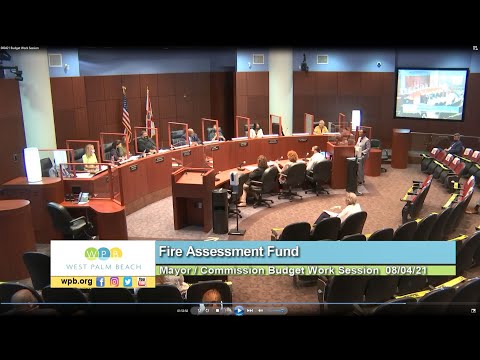
City Administrator Faye Johnson told the City Commission the city has used fire-assessment fees in compliance with Ordinance 4141-08, outlined a discrepancy in 2019 representations about staffing and trucks, and scheduled a detailed budget work session for Aug. 10 to present third-quarter expenditures and proposed FY22 uses.
City Administrator Faye Johnson told the West Palm Beach City Commission that the city has used fire-assessment fee revenue in ways that comply with the city's ordinance and that there has been no misuse of the funds.
Johnson said the presentation had three objectives: "to confirm that the use of the fire fees do in fact comply with the city ordinance governing it, which is Ordinance 4141-08;" to "clear up the discrepancy about the 2019 commitment on the use of the fire fee increase revenue;" and to "clarify the transparency issue related to administration providing quarterly fire assessment fee work sessions." She asked the commission to consider both sides of contested accounts and said she would not risk her career by knowingly misapplying public dollars.
The presentation traced the fee's origin to 2008, when the city engaged Government Services Group (GSG) to design a fire-assessment program and adopted Ordinance 4141-08 and a companion Resolution 212-08 to set rates and the assessment method. Johnson said the ordinance allows fee revenue to fund specific categories of fire-department activity including personnel, materials and services, capital, and debt service, and that the city places assessment revenue in a separate fund (Fund 131) for capital and related uses.
Johnson summarized collections and allocations: during the initial period (FY09'FY18) roughly $20 million was collected, of which about $11.4 million was allocated for capital and about $8.2 million moved to the general fund for fire-related salaries. She said the city also established a line of credit of about $15 million and that debt service is a permitted use under the ordinance. The commission was reminded that emergency medical services are not an eligible use and that "no fire assessment fees has been used in that regard," Johnson said.
She reviewed later rate changes: residential fees were $25 for the first decade, increased to $50 by Resolution 21-18 (effective FY19/FY20), and were raised again to $100 following Resolution 252-19 in 2019. Johnson reported revenue totals used in the presentation as roughly $4.5 million in FY19, $6.9 million in FY20 and about $8.8 million in FY21 (rounded in discussion).
A central issue Johnson raised was what she characterized as a "fallacy" in a 2019 presentation about how the increase was represented to the commission. She said the presentation to the board had represented the increase would support "9 additional firefighters and 2 trucks," but that the math did not support two fully staffed trucks on the incremental revenue cited. Johnson said the budgets presented at the two public hearings in September 2019 did not include additional firefighter FTEs tied to the assessment fund; Linda McDermott, the city's budget manager, confirmed the hearings' draft budgets added no FTEs to the fire-assessment fund.
Johnson said the city staffed Engine 1 back into service using existing personnel and overtime (she said overtime exceeded $1 million). When staff compared overtime costs to the cost of hiring nine firefighters, Johnson said they concluded it was cost-effective to include nine firefighter positions in the FY21 budget under the fire-assessment fund. "That part of the story that's being put out is accurate," she said of staffing with overtime; she added the nine positions were not in the FY20 budget.
Fire Chief Diana Maddie told the commission there remain unmet capital and facility needs, including a trailer-based Station 9, aging Station 1 (built in 1979), and Station 6's limited capacity. "We did get engine 1 back in service downtown," Chief Maddie said, calling that restoration "a big step forward," while also listing remaining needs as the population and call volume grow.
Commission members pressed for clarity about what had been promised in 2019, whether the promises reflected the fire department's operational analysis or union requests, and how the city would fulfill outstanding commitments. Commissioner Shoaff said he had interpreted the whole assessment fund (not just the incremental increase) to underwrite the department's reported needs. Johnson and others clarified that the 2019 presentation included stakeholder input (including union positions) and that some commitments were inherited from prior administrations. Several commissioners urged a multi-year or strategic plan to guide future use of the fee.
Budget manager Linda McDermott outlined fund accounting: Fund 210 covers transfers for principal and interest (debt service), mostly for trucks and buildings; Fund 304 records capital assets purchases. McDermott said the budget office conducts quarterly reviews of all funds.
Next steps and directives recorded at the meeting: the commission will receive a third-quarter report and a proposed FY22 fire-assessment fee expenditure presentation at a budget work session on Aug. 10; the proposed general fund balance and potential fire-fee uses will be presented at the Aug. 23 commission meeting; and public hearings on the budget are scheduled for Sept. 8 and a final hearing on Sept. 23. Johnson told commissioners she accepts responsibility for missed quarterly updates and said staff will provide the quarterly reports going forward.
The presentation included repeated assurances from administration and the deputy city attorney that the city is operating within the ordinance's permitted uses and that the external auditor had not flagged misuse of the assessment fee in annual financial statements. Johnson said detailed, itemized line-item data are available to the board, members of the public and the press.
Commissioners requested a strategic planning session this fall to develop a multi-year capital and staffing plan tied to the fire-assessment fund so future rate changes and allocations are transparent and linked to departmental needs.
Ending: The commission set Aug. 10 for a detailed budget work session that will include the third-quarter fire-assessment fee report and the proposed FY22 uses. Several commissioners emphasized the need to resolve past representations and to produce a clear multi-year plan for capital and staffing funded by the assessment fee.