Get Full Government Meeting Transcripts, Videos, & Alerts Forever!
Get email alerts on the Municipal Budget topic
No spam. Unsubscribe anytime.
City Administrator: FY21 budget balanced amid pandemic; FY22 shows smaller gap but rising costs remain
Summary
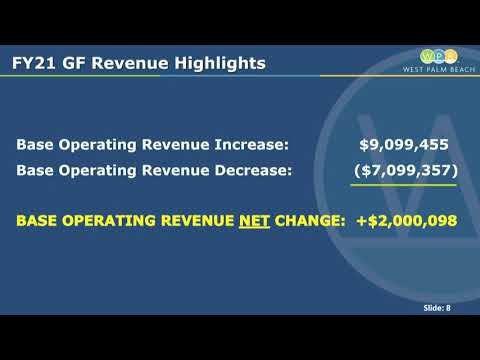
City Administrator Johnson told the commission the city adopted a balanced FY21 general fund budget despite a pandemic-driven $7.1 million revenue loss; projected FY22 revenue growth of about $10.7 million still leaves an estimated $3.5 million baseline gap because operating costs are rising faster.
City Administrator Johnson on July 19 told the City Commission that the city adopted a legally balanced fiscal year 2021 general fund budget while managing ‘‘an unprecedented budget challenge’’ caused by the COVID-19 recession and related market changes. Johnson said the adopted FY21 budget began with a structural change: departments reduced their budgets to remove a built-in $4,200,000 vacancy allowance so the city would not start the year artificially overstated. Even so, she said, the city faced a roughly $7.1 million loss in other general-fund revenue streams during FY21 and an operating-expenditure increase of about $9.9 million, creating an operating gap of about $7.9–8.0 million that the city closed with a mix of cuts and shifts. The measures Johnson listed included significant reductions in material and operating services (travel, training, professional services and small capital outlay), elimination of a $1 million contingency, suspension of education reimbursement and withholding cost-of-living adjustments for many management employees; a 5% across-the-board personnel-service reduction (except police and fire) that removed funding for 43 positions; and targeted transfers of personnel costs to other funds (six public-works positions to the gas tax fund, one position to the fire assessment fund, and shifting about 15 police positions to a grant). She said the adopted FY21 budget preserved existing programs and the workforce and maintained the millage rate at 8.3465. Johnson outlined the FY22 outlook, saying the city’s property values grew 6.66%, producing roughly $5.3 million in additional property-tax revenue, and the city expects about $5.4 million more from other revenue sources — a combined estimated $10.7 million of new base operating revenue. But she also projected base operating expenditures for FY22 to rise by about $14.2 million, driven by market- and personnel-related costs including roughly $1.5 million in market mandates (health insurance and similar items), about $3.2 million in routine personnel-cost increases, about $3.7 million in step/COLA costs for SEIU and PMSA, and about $5.8 million for police and fire market adjustments tied to collective-bargaining results. Those trends produced a projected FY22 baseline gap of roughly $3.5 million before finalizing pending union negotiations. Johnson said negotiations with SEIU and PMSA were underway and that police union activity (captains’ unionization, the executed police agreement and a tentative fire agreement) had been factors in FY21 and would affect FY22, including how overtime budgets are set. She also warned that some items shifted to grant funds or assessment funds in FY21 (for example, about $1.85 million in police position costs) are legally required to be restored to the general fund in later years and will reduce future fiscal flexibility. Commissioners asked for more detail on operational efficiencies implemented during the pandemic, how often revenue forecasts are updated, and how the city will budget for overtime now that some overtime pools were used to meet market adjustments. Johnson said departments adopted process changes (virtual service delivery, drop-box permitting, streamlining procedures) that helped maintain services but acknowledged the changes strained already reduced staffing. She recommended leaving some discretionary decisions until the close of FY21 to see final results before committing unassigned fund balance. The commission was given a schedule of upcoming budget meetings and public hearings (community Zoom meetings, additional work sessions on Aug. 5 and Aug. 11, a preliminary presentation Aug. 23, and the statutorily required September public hearings for tentative and final adoption of the FY22 balanced budget and millage rate).