Get Full Government Meeting Transcripts, Videos, & Alerts Forever!
Get email alerts on the Amphitheater Operational Costs topic
No spam. Unsubscribe anytime.
Staff: Coachmen Park amphitheater could cost Clearwater about $2.1M–$2.4M a year; council seeks more local data
Summary
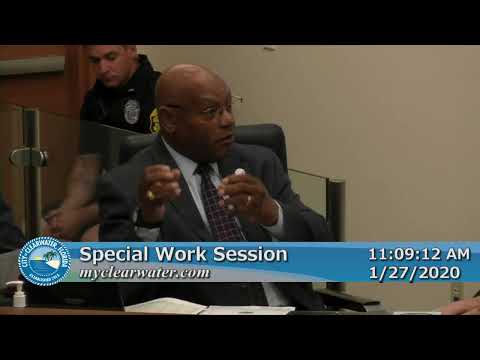
At a special Clearwater City Council work session, staff presented an operational model for the proposed Coachmen Park amphitheater showing annual net costs of roughly $2.1 million–$2.4 million depending on use; council members pressed staff for clearer underlying data, local operator input and staffing detail. No formal vote was taken.
At a special Clearwater City Council work session (date not specified), staff presented an operational revenue-and-expense model for the proposed Coachmen Park amphitheater showing estimated annual net costs to the city of approximately $2,400,000 under a minimal-utilization scenario, $2,300,000 under a conservative scenario and $2,100,000 under an aggressive scenario, Jay Raven, finance director, told the council.
The numbers matter because the amphitheater plan will be built as part of the broader Imagine Clearwater project and will change the city's ongoing operating budget and staffing needs. "One of the reasons we're here primarily is we're getting very quickly towards construction. So, once we get that started, we'll be, we'll be all in," Michael Delk, assistant city manager, told council members, framing the presentation as preparation for incorporating amphitheater costs into future budgets.
Raven said the three modeled scenarios reflect different annual activity levels. The consultant model defined minimal, conservative and aggressive utilization by total use days; the model attempted to include public safety, debt service and an annual set-aside for capital repairs. Raven said the city's current annual support for events at Coachmen Park is about $500,000 and that the new amphitheater would increase the city's annual support by roughly $1.5 million to $2 million depending on utilization.
Council members asked for more transparency in the underlying spreadsheets, questioned some line items and pressed staff to vet assumptions with local operators. Council member Paul Duys said he could not find evidence in the packet that the consultant had reached out to local market operators and called that omission "a critical missing piece of all this data." Duys and several colleagues said they want Webb Management's model validated against local comparables such as Ruth Eckert Hall, AEG and Live Nation or other market operators.
Staff said the consultant (Webb Management) built the model in collaboration with city staff and that some early outreach had occurred, but that the most recent modeling reflected the council's earlier direction (including larger covered seating). Michael Delk said the city can request additional outreach to local operators if the council wants it: "If the council believes that they want these operators consulted in an analysis, then we'll certainly go ahead and do that," he said.
Council debate also focused on staffing and maintenance. The draft model includes a projection of about nine full-time equivalent (FTE) positions for amphitheater operations in one scenario; councilors compared that to other markets (one council member cited a two-FTE example in Tampa) and asked staff to refine the estimate. Staff told the council payroll represented roughly 10% of the budget impact in the aggressive scenario, about 15% in the conservative model and about 25% in the minimal model.
Financing and potential offset revenue streams were also raised. Staff reminded the council that the city previously authorized bond capacity not to exceed $30,000,000 for the larger project and that current estimates foresee roughly $25,000,000 of bonds being issued if the amphitheater is included; staff said other identified revenue sources and local measures ("penny" funds referenced in discussion) are part of that financing picture. Jim Halyos, assistant to the city manager, reviewed naming-rights comparables and told the council, "you'll see anywhere from 300,000 to 400,000 a year on a typical 3 to 5 year term for those, naming rights of the amphitheater," while cautioning that the actual contracts are private and values vary by market.
Council members described three broad policy options presented by staff: (1) "stay the course" and continue with the currently directed design for a covered back-of-house amphitheater; (2) modify the design to reduce operating or capital cost (for example, smaller covered seating or scaled back back-of-house facilities); or (3) revert to the original park-focused plan and postpone the amphitheater or treat portions as a later phase. No formal motion or vote was taken during the work session. Several councilors said they currently lean toward the conservative utilization profile but asked staff for additional validation and for clearer, legible spreadsheets.
Next steps identified during the discussion include providing council members a readable Excel workbook of the model, refining FTE and maintenance estimates for the entire park footprint (not just the amphitheater), and, if the council requests it, commissioning additional outreach to local operators and promoters to validate rental fees, ticketing assumptions and market-specific costs. Staff also reminded the council that referendum language and permitting steps remain to be finalized as the project moves toward construction.
No formal decisions were made at the work session; staff will return with requested clarifications. The council discussed taking up any changes at February meetings and noted the next legislative body will be seated in several weeks, when some final decisions could be revisited.