Get Full Government Meeting Transcripts, Videos, & Alerts Forever!
Get email alerts on the Flood Mitigation Grants topic
No spam. Unsubscribe anytime.
Deltona outlines FEMA mitigation options for homeowners and funds Theresa Basin study
Summary
City staff described FEMA grant options—home elevation, acquisition, and limited demolition/rebuild—and said a $600,000 state-funded Theresa Basin study is now funded as officials and residents pressed for faster, larger drainage fixes.
City of Deltona project manager Kimberly Castro and city staff on Thursday described federal hazard‑mitigation grant options for homeowners and outlined next steps for a newly funded Theresa Basin study, telling residents the process for grants can take years and that larger drainage changes will face permitting and funding hurdles.
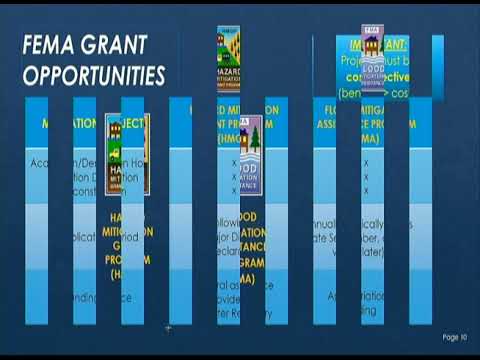
The presentation focused on two FEMA programs: the post‑disaster Hazard Mitigation Grant Program (HMGP) and the Flood Mitigation Assistance (FMA) grant program. "The program is called the Hazard Mitigation Grant Program," Kimberly Castro said, adding staff would explain options and paperwork and accept interest forms from residents who want the city to apply on their behalf.
Why it matters: Thousands of Deltona properties flooded during recent storms, and residents said existing drainage and outfall capacity left neighborhoods isolated for days. The city framed the FEMA programs as one path to reduce future property damage while also saying the Theresa Basin — the large watershed that includes DuPont Lakes and drains toward Lake Bethel and Lake Monroe — needs longer, systemwide work. Phyllis Wallace, deputy director of public works, described permitting and interagency constraints tied to outfalls and the Saint Johns River Water Management Authority.
What the grants cover and how they differ
Staff described three principal homeowner options offered under FEMA programs. "This is the first of 3 options that FEMA provides the homeowner to mitigate for future flooding and this is simply what they call lifting elevating home," staff member David Hamstra said, describing elevation projects that raise a house so interior floodwaters are less likely to enter living spaces and critical equipment.
The second option is acquisition and demolition: FEMA buys a damaged property, demolishes the structure and the land is retained by the city and cannot be redeveloped as another home. Hamstra said the city used acquisition after previous storms in nearby communities and that former lots can become ponds or parks.
A third option — demolition and reconstruction — is limited and generally considered only when a house cannot be elevated for structural reasons. Hamstra said FEMA reviews structural assessments and may fund the third option only if elevation is infeasible.
Cost shares, caps and competitiveness
Staff repeatedly emphasized cost‑share and competitiveness. Hamstra said FEMA will typically fund 75% of an approved project’s cost with a 25% local match, but FMA can offer higher coverage for properties with documented repetitive loss. "If you are in that category, then FEMA will pay anywhere up to 90 or 100% of the cost of the project," Hamstra said. He also warned that for demolition‑rebuild projects FEMA has a program cap (discussed in the meeting as $150,000), which can leave large gaps for homeowners if reconstruction costs exceed the cap.
Hamstra described FEMA’s cost‑effectiveness review (benefit‑cost ratio) and noted HMGP funds are allocated after declared disasters and compete within the state, while FMA is an annual national competition (applications are due each September). For the Hurricane Ian HMGP cycle he cited an August 29 deadline for county ranking; Nicole‑related allocations were not yet announced. He told residents the entire grant timeline can take two to three years from application to completed work.
What homeowners must provide
City staff listed typical documentation homeowners need: a history of flooding and claims, photographs, an elevation certificate (often produced by a surveyor), and a voluntary participation form and privacy release. Hamstra said the city has a three‑page screening questionnaire to help prepare applications and that a structural assessment (roughly $1,000) is used to confirm whether a house can be elevated. "There is some paperwork and some energy we need to coordinate back and forth," Hamstra said.
City process and deadlines
City staff said individual homeowners who want Deltona to pursue grant funding on their behalf should return the city forms; the city requested responses by June 19 so it can include residents in the county ranking when Nicole‑related funds are released. Castro and staff said the city will rank candidate projects with other municipalities in Volusia County before submission to the state and that, if awarded, the city would later solicit contractors to implement work. The city may hire multiple contractors if many homes participate.
Products, immediate protection and limits
Staff told residents FEMA does not fund small, homeowner flood‑proofing products such as removable door barriers. Hamstra said such devices may be available commercially but are not covered by the HMGP homeowner grants; those devices may fall under public‑assistance programs in limited circumstances, but that application window is typically closed.
Theresa Basin study and systemwide drainage issues
Phyllis Wallace and other staff framed the homeowner grant work as complementary to larger basin‑level fixes. The Theresa Basin covers roughly 32 square miles and includes several lake systems that, staff said, lack multiple outfalls to Lake Monroe and the Saint Johns River. "When it rains in these 3 watersheds, the water doesn't get out without pump stations or any other means other than pipes and canals," Wallace said, noting legal and permitting hurdles to adding outfalls.
Wallace told residents the city has secured state appropriations signed by the governor to fund a comprehensive Theresa Basin flood study and public outreach. "We are fully funded for this study right now. We got state appropriations with the governor's signature. We will have $600,000 to conduct this comprehensive study," she said. The study will evaluate constraints, identify improvement options and provide the technical analysis the city expects to use for permit applications and future projects.
Residents press for faster action; city describes tradeoffs
Multiple residents urged faster, immediate drainage work and said waiting for multi‑year grant cycles will not prevent near‑term flooding. One resident who identified himself as a local insurance agent noted significant portions of Deltona lie outside high‑risk FEMA flood zones yet experienced severe flooding; others called for the city to consider emergency or local revenue options rather than rely solely on federal grants. City staff acknowledged those tradeoffs and said commissioners will face political choices such as raising stormwater utility rates to accelerate work versus waiting for grant funding.
What happens next
Castro said staff will collect interest forms and supporting documentation, prescreen candidates and coordinate with county and state partners when funding rounds open. Residents who want city help were asked to take the stack of forms on the table and return them by the city’s stated deadline for inclusion in county ranking. Wallace said staff will continue to coordinate with regional water‑management districts and pursue both grant and state appropriation avenues.
Ending
The meeting closed with staff offering to gather vendor information about flood‑proofing products for residents who wish to consider interim measures while larger projects proceed. "If you just feel like you're at risk, you know, sleep on it and decide whether or not you want the city to pursue the grant on your behalf," Castro said.