Get Full Government Meeting Transcripts, Videos, & Alerts Forever!
Get email alerts on the Public Records Fees topic
No spam. Unsubscribe anytime.
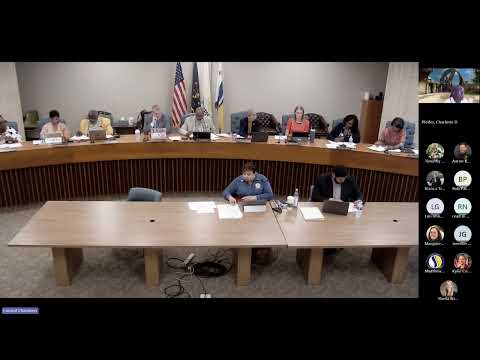
Council delays vote on body‑camera fee ordinance after hours of public comment
Summary
The South Bend Common Council on July 28 postponed action on Bill 43‑25, which would place a fee schedule on public‑records copies of law‑enforcement recordings, after an extended public hearing and questions from council members.
The Common Council on July 28 deferred consideration of an ordinance that would revise the city’s public‑records fee schedule, including a mechanism for recovering the direct costs of reviewing and redacting law‑enforcement recordings.
City attorney Jenna Thoreau told the council Bill 43‑25 updates Section 2‑2‑10 of the municipal code to incorporate a separate fee schedule and to add a statutory option to recover the direct costs associated with producing law‑enforcement recordings. Thoreau said the ordinance would not apply to records delivered electronically by e‑mail when feasible, and she described other exceptions under state law — for example, criminal discovery, subpoenaed records, and inspection rights for people defined as “requesters” by statute (including people depicted in a recording, victims, and certain property owners and occupants).
Key points from the administration: Thoreau and assistant city attorney Kylie Connell said the volume of requests for law‑enforcement recordings has grown since the city began using body cameras in 2018; the legal team reported 611 requests for body‑worn footage since 2018 and said the annual average since 2020 is about 103 requests, rising to an extrapolated average of roughly 151 requests when recent trends are included. Thoreau said more than half of requests in a typical year come from business entities (media, attorneys, insurance companies) rather than individual residents, and she provided counts of requests likely to be classified as victims who may inspect footage without paying: 2023 — 10; 2024 — 12; 2025 (to date) — 11. The legal team estimated about 18 staff hours per week are dedicated to reviewing recordings.
How the fee would work: The proposed schedule bases fees on actual review time (an hourly rate) intended to recover staff time for redactions and related production work; Thoreau said redactions are required under state law for certain categories (juveniles, deceased persons, medical information, certain victim/witness safety concerns, and other confidential information). Connell said municipalities around Indiana have adopted similar fee approaches; the administration identified 16 cities and 5 counties that have comparable schedules. State law directs how fees for law‑enforcement recordings may be used, and Thoreau said the ordinance directs those fees to the law‑enforcement training fund to defray equipment, storage and production expenses.
Council members asked for clarifications: Members asked who qualifies as a statutory “requester,” whether inspection rights allow a person to view a video without paying, how often the same recording is requested more than once, and whether the fees would disproportionately affect low‑income residents. Thoreau and Connell said inspection under the statute is available without charge to qualifying requesters but that copies provided under the public‑records (APRA) process would be charged per the fee schedule; they emphasized an intake process to help narrow requests (for example, by identifying the officer who wrote the report) before full production.
Public hearing and reaction: More than two dozen residents and civic organizations spoke in opposition during a lengthy public hearing. Speakers included parents, advocacy groups (NAACP and Black Lives Matter South Bend), journalists, the Saint Joseph County Libertarian Party, and residents who said the fee structure would be a “tax on transparency” that would prevent marginalized residents from obtaining records. Commenters also urged the council to fund any needed staffing through the city budget rather than charging requesters. Several speakers noted the city and county budgets already pay for the cameras. The South Bend Police chief and assistant city attorneys answered procedural questions and said the intent is to recover direct production costs rather than create a revenue stream.
Decision: After extended public comment and council discussion, a motion to table Bill 43‑25 to the committee of the whole on August 11 (with additional joint committee meetings to continue review) was approved by roll call (9–0). The chair indicated administrative staff will hold at least one informational session before the next council meeting and that the personnel and residential committees will meet jointly to address outstanding questions.
Next steps: The ordinance will be returned to the committee of the whole on August 11 for further consideration; the administration said it will supply additional materials, data and proposed clarifications before the committee reconvenes.