Get Full Government Meeting Transcripts, Videos, & Alerts Forever!
Get email alerts on the Emergency Medical Services topic
No spam. Unsubscribe anytime.
Washington County approves EMS quarterly report after officials detail call volume, revenue and system strains
Summary
The Washington County Commissioners Court approved the Emergency Medical Services quarterly report on July 29, 2025. Presenters reported roughly 2,700 responses in the quarter, nearly $4.9 million in year-to-date revenue, operational stresses tied to fleet availability and plans tied to the 2026 budget to add reserve ambulances.
The Washington County Commissioners Court on Tuesday approved the county Emergency Medical Services (EMS) quarterly report after a presentation detailing call volume, revenue and operational strains.
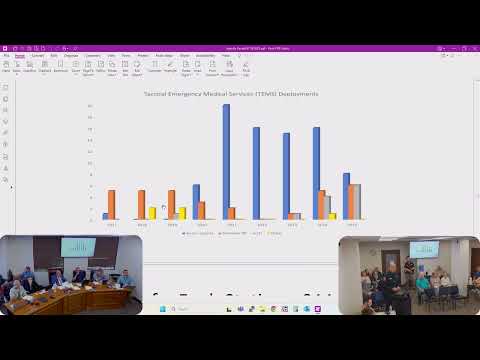
Washington County EMS representative Mister Draymond told the commissioners the service handled “a little over 2,700 total responses, 1,400 critical patients, and about 1,200 what we call priority 3 and 4 patients” in the 90-day reporting period. He said the system had three state deployments totaling 35 days and noted a Phillips 66 donation to replace a boat.
The report matters because it frames budget and operational decisions: Draymond reported roughly $4,900,000 in year-to-date revenue — about $20,000 shy of $5 million — and said projections range around $9.2 million to $9.8 million for the fiscal year. He tied part of recent revenue growth to contract changes with payers: “When we write the contracts to Blue Cross Blue Shield and… Scott and White, we took into account both ground and air revenue,” he said, saying the changes increased ground payments as well as air reimbursements.
Commissioners and staff focused discussion on system status management and fleet availability. Draymond explained the county monitors an internal “level alerts” board and cautioned that level 1 or 2 events indicate limited ambulance availability: “Level 1 means we had a pending 911 call, and an ambulance not immediately available,” he said. He told the court that some spikes reflect event-driven demand or multiple transfers arriving in short time windows and that having reserve ambulances — an item included in this year’s budget discussions — would reduce pending-call incidents.
Operational details in the presentation included response-time tracking by station (Station 5 showed the longest turnout times because employees are also assigned to the county aircraft hanger), monthly trends in blood draws and medical transports, and a breakdown of air-versus-ground revenue. Draymond said most cancelled aircraft launches result from EMS arriving on scene and determining the aircraft was not needed (about 78% of launches), while weather and maintenance accounted for a small share of cancellations.
The court voted to approve the quarterly report; the motion and second were recorded on the floor and the clerk announced the motion carried. Commissioners asked staff to continue coordinating with the county attorney and hospital partners on transfer coordination and operational tracking.
The county will carry the EMS operational issues into budgeting and follow-up staff meetings, particularly around funding for reserve ambulances and improvements to blood-draw procedures.