Get Full Government Meeting Transcripts, Videos, & Alerts Forever!
Get email alerts on the Affordable Housing topic
No spam. Unsubscribe anytime.
Seattle council holds public hearing on 'Roots to Roofs' affordable-housing pilot
Summary
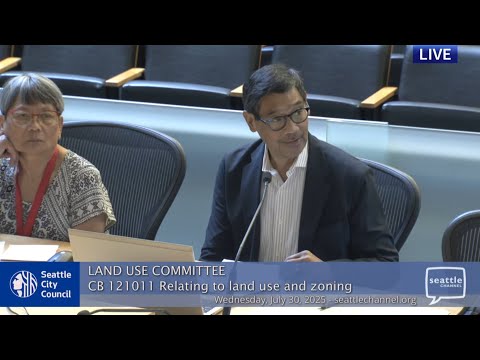
Councilmember Alexis Rink introduced Council Bill 121011, the Roots to Roofs bonus pilot, and the Land Use Committee opened a public hearing July 30 to consider whether to allow community-led developments extra height and floor area in exchange for affordable units and community-serving uses.
Councilmember Alexis Rink introduced Council Bill 121011, a proposed ordinance called the Roots to Roofs bonus pilot program, and the Land Use Committee opened a public hearing July 30 on whether to allow increased height and density for projects led by community-based organizations.
The measure would add new sections to the Seattle Municipal Code (SMC 23.40090–23.40097) to create a time-limited pilot that grants greater floor-area ratio and height to qualifying developments in exchange for affordability and so-called “equitable development uses.” Central staff said the pilot would require at least 25% of units to be affordable and would limit participation to a set number of projects (35) to be reviewed during a specified period.
Why it matters: The proposal aims to help nonprofit and community organizations “pencil” development deals without additional city subsidy, by easing zoning and permitting barriers. Backers said the tool could accelerate affordable-housing projects targeted to BIPOC communities and stretch limited public dollars. Opponents said the tradeoffs — relatively low affordability minimums, limited duration, and design exemptions — risk displacement, loss of trees and yard space, and thin community protections.
Supporters urged the committee to approve the pilot so mission-driven developers can move projects forward that otherwise stall. Jesse Simpson, advocacy director at the Housing Development Consortium, said the pilot “ensures that at least 25% of the homes will be affordable for 50 years” and gives nonprofit developers additional height, FAR, and exemptions from design review and parking requirements to make projects feasible. Representatives from Filipino Community of Seattle, Ethiopian Community in Seattle, Habitat for Humanity, Plymouth Housing, the Filipino Community Village capital campaign and other community development organizations told the committee they have projects that would use the tool to build family-sized and culturally tailored units.
Opponents pressed for stronger protections and changes before the city grants broad zoning bonuses. Tracy Berman of Seattle Residence for Thoughtful Growth said the bill as drafted is “a big gift to developers,” calling out a 25% affordability minimum, the 50-year term, and an 80% AMI threshold as insufficient to protect long-term residents. Tree Action Seattle warned that 75% lot coverage allowed under some proposals would eliminate space for large trees, compounding heat-island and stormwater impacts in neighborhoods that already have lower canopy.
Central staff and technical presenters said portions of the ordinance direct the Seattle Department of Construction and Inspections (SDCI), Office of Planning and Community Development (OPCD) and Office of Housing to adopt rules that will define qualifying organizations, eligible equitable development uses (for example, cultural spaces, child care or affordable commercial space) and the program’s technical standards. Staff emphasized the pilot’s intent to pair community-based organizations with experienced nonprofit or mission-driven developers; they said the bill foresees nonprofit-led partnerships more commonly than market-rate developers entering these partnerships.
Several commenters objected to an extra density bonus tied to parcels historically subject to racially restrictive covenants, arguing that the benefit could further raise property values for current owners rather than directly compensate people harmed by past discrimination. Others urged district-by-district limits on projects and higher affordability minimums targeted to deeper income bands (for example, 0–30% AMI) and to require family-size units.
The committee did not vote on the ordinance during this meeting. Council staff and the bill sponsor said they are continuing to work on amendments and technical fixes, and several councilmembers signaled interest in additional changes, including provisions to protect trees, stronger community-priority rules for allocations, and clearer operational safeguards for nonprofit partners.
Public-comment snapshot: About 21 people testified during the Roots to Roofs public hearing; additional speakers used the earlier open public-comment period to raise the same points. Supporters included non-profit housing developers and community organizations such as the Filipino Community of Seattle, Ethiopian Community in Seattle, Housing Development Consortium, Habitat for Humanity and Plymouth Housing. Opponents included neighborhood coalitions, Tree Action Seattle and unaffiliated residents raising concerns about canopy loss, displacement, and loss of design review.
What’s next: The committee closed the public hearing on the ordinance at the end of the session and invited continued amendment work. Staff said rulemaking by SDCI, OPCD and the Office of Housing would follow any passage to implement eligibility criteria and technical details. Several councilmembers said they want more time to weigh amendments and to coordinate this work with the comprehensive-plan zoning and height conversations scheduled for phase two of the city’s planning process.
Ending note: Proponents framed the proposal as a targeted tool to unblock community-led projects; opponents said the current draft trades long-term protections and neighborhood character for developer entitlements. The committee left the measure open for amendment rather than taking final action at the July 30 meeting.