Get email alerts on the Ev Charging topic
No spam. Unsubscribe anytime.
Council approves BFRW’s EV‑charging table changes for public comment amid debate over readiness and grid capacity
Summary
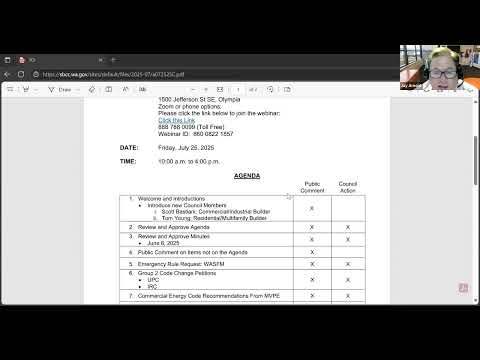
The State Building Code Council voted July 25 to send a revised IBC EV‑charging proposal to CR‑102 public comment after BFRW committee work and mixed public testimony.
The State Building Code Council voted July 25 to send a revised IBC proposal on electric‑vehicle (EV) charging infrastructure to CR‑102 public comment after several hours of discussion and public testimony.
Why it matters: The proposal revises definitions of EV charger, EV‑ready and EV‑capable and changes percentage requirements in Table 429.2 for Group R occupancies. It reduces immediate EV‑ready stall counts and increases EV‑capable conduit provisions. Advocates say the approach balances upfront cost and long‑term deployment; critics say lowering EV‑ready requirements is a step backward and that the council should wait for updated regional modeling.
Roger (council member and BFRW committee lead) summarized the technical work: “There are 3 main areas that we ended up addressing. Number 1 is the definitions ... the EV capable includes raceway and conduit, but not the wire.” He explained the committee used Northwest Power and Conservation Council projections to align percent‑of‑spaces targets with expected EV stock in 2030 and 2045.
Public testimony was mixed. Patrick Hanks of the Building Industry Association of Washington supported the BFRW approach and said it reduces initial electrical service sizing costs: “One thing that this proposal does is it's removing EV capable from the sizing requirements for the electrical panels ... the most expensive cost ... is often the panel sizing and the electrical load, that's gonna go down to just the 10% for the charging stations and the 10% for EV ready.”
King County EV program manager Ross Freeman urged more analysis before publishing: “King County doesn't support the proposal as written, and we don't recommend that it's ready for public comment,” he said, suggesting the council wait for updated modeling from the Northwest Power and Conservation Council and the state transportation electrification plan.
Action taken: Council member Tom Handy moved and Katie Sheehan seconded that staff file a CR‑102 and release the BFRW EV charging proposal for public comment. The motion passed by voice vote with one council member recorded as opposed.
What’s next: The CR‑102 comment period will gather input on definitions, the percentage mix of EV charging/ready/capable stalls, and the approach to counting provided vs. required parking. The BFRW committee and staff will consider public comments and updated regional modeling in preparing any final recommendations for adoption.
Ending: The proposal will go to a public comment process; council members noted the subject will require ongoing coordination with utilities and planners as electrification and grid capacity evolve.
AI generated
The text on this page is AI generated. Summaries, highlights, analysis, and video transcripts are all produced from the original source material.
AI can make mistakes, so if you spot one, and we will fix it for everyone.
Note: the source content is unaltered by us. Any content source we link to, be it a video, an audio recording, or a document, is presented exactly as its publisher released it. That publisher is usually a government body, sometimes an individual official or another organisation.