Get email alerts on the Commercial Energy Code topic
No spam. Unsubscribe anytime.
Commercial energy code package sent for public comment after MVPE review
Summary
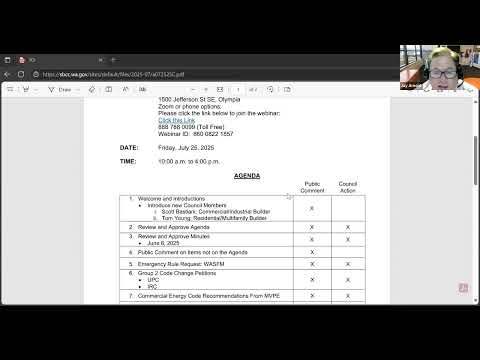
The State Building Code Council on July 25 directed staff to publish the commercial energy code recommendations produced by the MVPE committee and the commercial energy tag for public comment.
The State Building Code Council on July 25 directed staff to publish the commercial energy code recommendations produced by the Mechanical, Ventilation, Plumbing and Energy (MVPE) committee and the commercial energy tag for formal public comment.
Why it matters: The package contains a reworked prescriptive pathway (C406), changes to glazing and envelope requirements, updates to mechanical system pathways and heat‑pump treatments, and modeling work intended to keep Washington on the statutory energy‑savings trajectory to 2031.
Kjell Anderson, chairing the discussion for the commercial energy tag, summarized the work that produced the package. “We had over 14 meetings and about 85 hours of awesome technical discussions on these things through a 163 proposals,” Kjell said, and noted the tag passed 123 proposals while 21 failed and 19 were withdrawn. He described the most notable technical changes: an overhaul of the C406 credit table to put fossil and heat‑pump paths on the same footing; new sub‑tables and credits; a proposed minimum of triple‑glazed windows for a portion of glazing in many buildings; and revised credits for thermal energy networks and load management.
The package also reflects modeling work PNNL is performing for the state. Kjell told the council, “NIEA has funded PNNL to update the total credits required and the amount of credit that each option receives,” and that the modeling will be posted for review on the SBCC website.
Action taken: Council member Angela Haft moved that staff prepare and file a CR-102 to release the commercial energy code recommendations for public comment; Tom Young seconded. The motion carried by voice vote.
What’s next: The CR-102 public comment period will let utilities, builders, designers, local governments and other stakeholders review the proposed changes and submit comments. PNNL’s final modeling results will be made available during the public‑comment window and considered by the council during final adoption.
Ending: Council members thanked the tag and MVPE volunteers for extensive technical work. The council will consider final decisions after the CR-102 comment period and associated modeling and economic analyses.
AI generated
The text on this page is AI generated. Summaries, highlights, analysis, and video transcripts are all produced from the original source material.
AI can make mistakes, so if you spot one, and we will fix it for everyone.
Note: the source content is unaltered by us. Any content source we link to, be it a video, an audio recording, or a document, is presented exactly as its publisher released it. That publisher is usually a government body, sometimes an individual official or another organisation.