Get email alerts on the Fire Safety Emergency Rule topic
No spam. Unsubscribe anytime.
State building code council asks standing committee to study fire marshals' emergency rule request on building separation
Summary
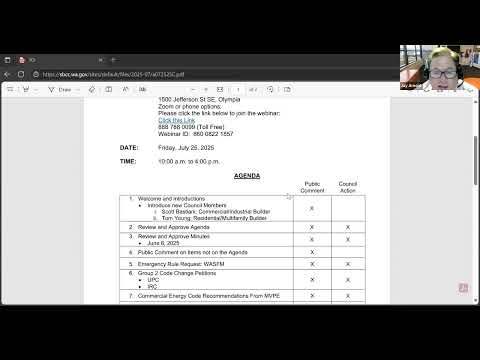
State Building Code Council Vice Chair Jay Arnold opened the council’s July 25 meeting with the introduction of an emergency rule request from the Washington State Association of Fire Marshals and asked staff for background.
State Building Code Council Vice Chair Jay Arnold opened the council’s July 25 meeting with the introduction of an emergency rule request from the Washington State Association of Fire Marshals and asked staff for background. Staff member Dustin (last name not specified) told the council it was an introduction only and “the council is not allowed to take action on an emergency rule request at the meeting where it's introduced.”
Why it matters: The petition would raise minimum exterior separation in some backyard dwelling situations that local jurisdictions and developers say could force redesign of already‑platted lots and reduce the number of units that can be built, while fire officials say the change is needed to ensure safe access for gurneys and ground‑ladder rescue operations.
The petition asks for an emergency rule under RCW 19.270.032. Representative Suzanne Schmidt and several council members said city planning offices and developers had raised concerns that increasing separation from 3 feet to 5 feet could require projects to be redesigned. “If a house has already been platted and this emergency rule takes place, they would have to go back to the drawing board because they’re gonna go from 3 feet to 5 feet,” Representative Suzanne Schmidt said during the public discussion.
Fire officials and private consultants argued the change addresses access problems for rescue operations. Ken Burlet, representing Fire Code Consultant LLC (and formerly of the Seattle Fire Department), cited existing fire code language on required access walkways: “What 504.1 says in the fire code ... is exterior doors and openings required by this code pertaining to the fire code or the International Building Code shall be maintained readily accessible for emergency access,” Burlet said. He described situations where ladders and gurneys cannot be used safely if structures are too close to property lines or each other.
The council discussed process and authority. Assistant Attorney General Derek Meyer Bachtel cautioned members about the new legislative requirement that petitions not be acted on in the meeting where they are introduced; members and counsel debated whether the council could or should refer the matter immediately to a tag or standing committee for additional stakeholder work. Several council members — including Kjell Anderson, Roger (last name in transcript: Haringa) and Dan Young — said more stakeholdering was needed so that both fire‑safety and land‑use consequences could be considered.
Action taken: Rather than make a finding on whether an emergency exists, the council voted to ask the Building, Fire, Residential and WUI (BFRW) standing committee to review the petition, gather additional stakeholder input, and provide the council with a recommendation. The motion to ask the BFRW committee to study the petition was seconded and carried by voice vote.
What’s next: The BFRW committee will review the petition, collect written and oral stakeholder input and report back to the full council at a future meeting. Council members asked that stakeholders, including city planning divisions that have raised concerns, forward written information to staff for distribution to members before the next meeting.
Ending: The council took no emergency action at the July 25 meeting and directed the BFRW committee to study the proposal and return findings and recommendations to the full council before any determination on emergency rulemaking is made.
AI generated
The text on this page is AI generated. Summaries, highlights, analysis, and video transcripts are all produced from the original source material.
AI can make mistakes, so if you spot one, and we will fix it for everyone.
Note: the source content is unaltered by us. Any content source we link to, be it a video, an audio recording, or a document, is presented exactly as its publisher released it. That publisher is usually a government body, sometimes an individual official or another organisation.