Get Full Government Meeting Transcripts, Videos, & Alerts Forever!
Get email alerts on the Historic Preservation Ordinance topic
No spam. Unsubscribe anytime.
Spalding planning commission reviews proposed historic-property preservation ordinance amid objections from property owners
Summary
The Spalding County Planning Commission on a special-call meeting reviewed proposed text amendments to add a historic-property preservation appendix to the county zoning code; staff described reduced acreage and setback requirements and public commenters urged more outreach and procedural clarity.
The Spalding County Planning Commission on a special-call meeting reviewed proposed text amendments to the county zoning code to add an “Historic Property Preservation” appendix that would set procedures and limitations for designated historic properties, including minimum preserved acreage, horizontal setbacks and construction standards.
The commission’s staff presenter, David, said the draft ordinance originally required a 10-acre preserved parcel around a designated principal building and a minimum horizontal distance of 300 feet from the principal building to property lines; those requirements were reduced in the draft to a 5-acre minimum and a 200-foot horizontal distance. He also described Section 109, which would add construction guidelines and allow “more leeway” for repairs and renovations so replacements would be similar in appearance rather than exact physical matches.
The changes, David said, were reflected in a revised copy distributed to the commission in red and followed earlier postponement while a pending rezoning for one affected property — described in meeting remarks as the Geyser Home — was resolved.
Why it matters: the ordinance would create a county-level designation process, set use and subdivision constraints for designated properties, establish a review role for the planning commission (functioning as a historic review committee), and create a certificate-of-appropriateness permit process for proposed renovations. That structure could affect future rezoning and development of land that contains or adjoins designated historic buildings.
During the meeting, a participant identified as Newton provided a supplemental draft that fleshed out a designation procedure: application intake, preliminary review by the planning commission acting as the historic review committee, and a recommendation to the Spalding County Board of Commissioners (BOC) for final designation by resolution. Newton described appeal language that, under his outline, would permit appeals to superior court and observed that a BOC decision would be overturned only for being “arbitrary or capricious.” He also noted the ordinance would make the county eligible to apply to the federal Certified Local Government program and that the draft drew on DNR guidance and the city’s existing ordinance.
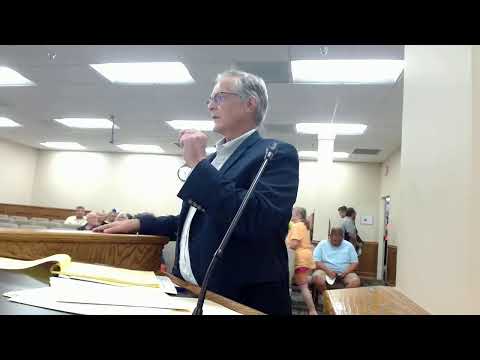
Kirk Feldstuhl, an attorney with the law firm Smith, Gambrell & Russell speaking for property owners identified as the McElroys, urged the commission not to move forward with the draft in its current form. Feldstuhl said the ordinance as written focuses on the property rather than the structure and ‘‘has no other purpose than to try to stop the development,’’ and he asked that the commission delay adoption and hold additional outreach and notice consistent with DNR guidance. Feldstuhl read DNR guidance aloud describing recommended public-notice practices and argued owners had not received draft materials and that the ordinance seemed targeted at three named properties (the transcript identifies those properties as the Old Smokehouse, Double Cabins, and the Geyser/Gaither property).
Feldstuhl identified several specific concerns in the draft ordinance as it then stood: - Use restrictions: Section 106 would place use limits on designated properties “regardless of the current zoning,” and lists permitted supplemental uses such as agricultural tourism, neighborhood commercial and office but omits C-1 commercial zoning that applicant owners had sought, which Feldstuhl said would restrict the landowner’s ability to develop revenue-generating uses on property that can be costly to maintain. - Division/subdivision limits: Section 107 would require preserved acreages (initially 10 acres; changed in the draft to 5) and horizontal setbacks (initially 300 feet; later reduced in discussion to figures referenced as 250 and 200 feet in different remarks). Feldstuhl said at least one of the three properties had less than the original acreage threshold and that requiring 5 or 10 acres around a building would materially constrain development of surrounding parcels. - Adjacent-property buffers and architectural standards: Section 108 adds an extra buffer (an additional 25 feet over an ordinary 15-foot buffer, per discussion). Section 109’s architectural standards, Feldstuhl argued, would apply to adjoining properties, including nonresidential parcels, and could regulate incompatible neighboring uses and designs (he pointed to mobile homes adjacent to a cabin property as an example where architectural compatibility language would be difficult to apply).
Supporters and preservation advocates at the hearing said the county needs a local ordinance and clarified that designation practices and construction standards should be workable for owners. Kirby Sisk, identified as the current and outgoing president of the Griffin-Spalding Historical Society, described the society’s existing plaque-recognition program for private owners and said the society had issued about 30 plaques to recognize properties without imposing restrictions. Sisk told the commission the society has a “preservation committee” that reviews owner applications and makes recommendations to its board.
Drew Payne, who said he would be the incoming president of the historical society in August, added that other municipalities’ guidance pages can be copied as practical starting points and urged the commission to provide clear, accessible guidance for property owners who want to restore buildings.
Staff and a presenter who provided the supplemental draft (Newton) told the commission the draft is intended to implement elements of the county’s community work program and comprehensive plan — specifically items calling for evaluation of historic resources and adoption of a preservation ordinance — and that additional procedural details (definitions, application forms, design review processes and appeal paths) could be included before final adoption.
No ordinance vote was taken at the special-call meeting. The only formal action recorded in the transcript was a motion to adjourn late in the meeting; the motion was seconded and the chair closed the meeting.
Discussion vs. decision: the record shows discussion, staff recommendations and public comment; there was no commission vote to adopt the ordinance or to send a formal recommendation to the board at this meeting.
Authorities referenced: DNR historic-preservation guidance, the Griffin city historic-preservation ordinance, the National Register of Historic Places, and the county’s community work program/comprehensive plan goals for historic preservation. Feldstuhl also cited DNR guidance on hearing notice and recommended an expanded public-notice schedule before designation actions.
Next steps and outstanding issues: commissioners and staff indicated the draft had been updated in red, and speakers — both preservation advocates and property owners’ representatives — asked for additional outreach, clarification of acreage and setback formulas, clearer statement of what uses would be permitted for designated properties, and a transparent designation procedure that includes mailed notice to affected owners. Several speakers also recommended coordination between the county process and existing city and historical-society efforts to avoid duplication.
Meeting action: motion to adjourn (passed).