Get Full Government Meeting Transcripts, Videos, & Alerts Forever!
Get email alerts on the Ccus Coal Assisted topic
No spam. Unsubscribe anytime.
Company says coal-assisted CCUS can be commercial, offers pilot data and tax-credit pathway for Wyoming
Summary
Carbon GeoCapture presented pilots and technical readiness for a coal-assisted carbon capture, use and storage method that dissolves flue gas in coal seam water to store CO2 and produce coalbed methane; presenter said the approach lowers capture costs and can qualify for 45Q credits and voluntary carbon markets.
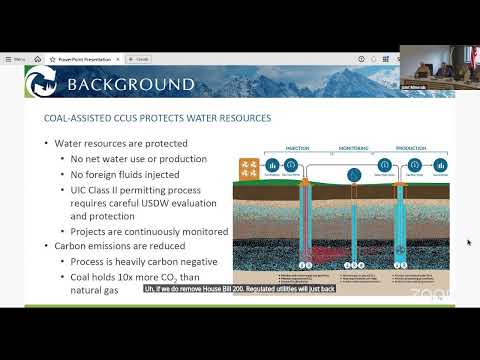
John Pope, CEO of Carbon GeoCapture, told the committee his company has piloted a coal-assisted carbon capture, use and storage (CCUS) method in Wyoming and believes the approach can be commercial at scale under current federal tax incentives. "Economical CCUS is now commercially available," Pope told lawmakers, describing a process in which water from unmineable coal seams is circulated, charged with flue gas or CO2, and re-injected so the coal seam absorbs CO2 while freeing natural gas. Pope said that using coal as the sorbent reduces the expensive gas-scrubbing step required in conventional CCS and that the Internal Revenue Service—s 45Q tax credit for carbon sequestration can make project economics viable. Company pilots included wells drilled near the Neil Simpson complex and a prior demonstration in the Powder River Basin; Carbon GeoCapture said most project components reach a technical readiness level of 8 (near-commercial) after internal testing and third-party review. Pope said the company is developing projects in multiple U.S. states and internationally and that Wyoming has unusually large coal sink capacity and permitting clarity. "Wyoming has, in our view, the only complete, legislative jurisdiction in the world for CCS, CCUS," he said, noting estimates that Wyoming coal sinks could sequester on the order of hundreds of gigatons of CO2. Pope described the process as closed-loop with no net water discharge — water is lifted from the seam and reinjected after CO2 is dissolved in it — and said monitoring and validation protocols (including Raman spectrometers the firm demonstrated) allow project-level measurement required for 45Q qualification and voluntary carbon credits. Committee members asked technical and policy questions: whether the approach liberates methane and if that gas is marketable (Pope said projects typically expect much more CO2 stored than methane produced), how non-CO2 flue-gas components behave (SOx dissolves; NOx less so; separation at the wellhead is managed), and whether house bill 200 (a recent state statute designed to accelerate CCUS) is critical for project development (Pope said HB 200 helped motivate regulated utilities to explore the approach but many project economics rest on 45Q and voluntary markets). Public commenters expressed concern about drone and supply-chain risks for nuclear projects earlier in the hearing; Carbon GeoCapture—s presentation focused on coal sinks and commercial viability of a CCUS pathway that company representatives said protects aquifers and limits produced water. No committee action followed the presentation; members encouraged the company to continue pilots and said they would consider CCUS policy and funding issues in future meetings.