Get Full Government Meeting Transcripts, Videos, & Alerts Forever!
Get email alerts on the Electronics Epr topic
No spam. Unsubscribe anytime.
Massachusetts advisory group compiles data, deadlines for electronics EPR ahead of Sept. 17 commission meeting
Summary
An advisory group preparing recommendations on extended producer responsibility, or EPR, for electronics in Massachusetts discussed data gaps, program design options and next steps during a virtual meeting where members agreed to finalize a background report by Friday, August 29 and present at the commission meeting on September 17.
An advisory group preparing recommendations on extended producer responsibility, or EPR, for electronics in Massachusetts discussed data gaps, program design options and next steps during a virtual meeting where members agreed to finalize a background report by Friday, August 29 and present at the commission meeting on September 17.
The group’s convenor opened by reminding participants that “Finding on electronics EPR should be completed by Friday, August 29,” and said the deliverable should be a fact-based, neutral summary to help the Massachusetts EPR Commission decide next steps. That deliverable deadline and the Sept. 17 commission meeting framed the discussion, which ranged from municipal collection practices and recycler certifications to whether producers should form a producer responsibility organization (PRO).
Why it matters: advisory members said an EPR program could make collection more convenient, reduce municipal costs and create unified education and collection standards across the state. Several participants emphasized that Massachusetts lacks a single industry PRO for electronics and that current services are uneven across the state’s 351 municipalities.
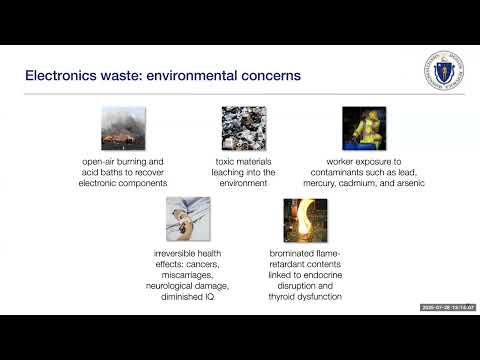
Key facts and data reported in the meeting - The presenter noted an average of “20–24 devices per household” and said there are roughly “3,000,000,000 electronic devices in the United States.” - Massachusetts municipal survey data reported that 276 municipalities accept televisions and computers for recycling and 268 collect other electronics; 214 municipalities reported year‑round collection (out of 351 municipalities statewide). - Municipal user fees for electronics collection were reported to range from $1 to $50 depending on item and collector. John (MassDEP staff) clarified that “those are our fees that municipalities report charging their residents for electronics recycling” and that the department does not have a device‑by‑device fee breakout in the dataset. - The group noted two common recycler certifications in use nationally: R2 (run by Sustainable Electronics Recycling International) and e‑Stewards; participants said certification helps prevent environmentally harmful downstream practices.
Discussion highlights - Scope and definitions: Multiple participants urged the commission to clarify which products would be in scope if Massachusetts pursued electronics EPR. Participants explained that definitions vary by state and by collector: some recyclers accept only items with circuit boards (typical consumer electronics from home office and entertainment centers), while others accept a broader list that can include small appliances. One member summarized the practical test used by many recyclers: whether an item contains a circuit board.
- Collection convenience and municipal burden: Juanita, a municipal recycling coordinator, urged policymakers to note that municipal governments often absorb costs even when fees are visible to residents: “those are user fees because municipal governments, if they're providing this collection, are still paying whether the user sees that or not.” Several town and center operators described practical constraints (space, weather protection for Gaylord boxes or pallets) and said some municipalities run dedicated drop‑off programs while others embed electronics into bulky‑waste collections.
- Industry organization and PROs: Jason (National Center for Electronics Recycling) and other industry representatives said there is currently no single national PRO for electronics in the United States. Jason summarized: “there's no single PRO,” and instead manufacturers and service providers operate a mix of voluntary programs, clearinghouses and state approaches. Members described Illinois and Oregon as examples of clearinghouse or producer‑managed systems; other Northeast states use state‑contracted or state‑overseen models.
- Policy tradeoffs, fees and retailer involvement: Retail and industry representatives argued against an upfront point‑of‑sale fee model. Bill Rennie (Retail Association of Massachusetts) said the retail sector would “be opposed to any upfront or recovery fee,” citing competitiveness, administrative burdens and the risk of dedicated funds being swept. Participants also discussed retailers that currently accept certain electronics voluntarily (for example, Staples and Best Buy) and whether those sites should be integrated into any future EPR convenience network.
Assignments, next steps and areas for further research - Deliverables: Advisory members agreed the group’s background report will be updated and circulated; the presenter reiterated the Aug. 29 deadline for the advisory group’s findings and noted the commission meets Sept. 17. - Additional data requests: Municipal cost and program‑operation data are outstanding. Juanita said a municipal survey was launched with an Aug. 1 response deadline and that 44 municipalities had responded so far; she will continue to collect and analyze municipal cost data and process details. - Suggested follow ups: participants recommended collecting (a) clearer, device‑level data on what municipalities and retailers currently accept; (b) examples of collection‑site best practices and logistics (pallet/Gaylord sheltering, handling of smaller items); (c) state program results (pounds collected, number of sites) from other jurisdictions to show which program elements have produced intended outcomes; and (d) documentation and sources behind slides and lessons summarized by Product Stewardship Institute (PSI).
What participants could not decide at the meeting - No formal policy recommendation was adopted. Group members repeatedly said the commission’s recommendation could vary — from further study to a proposed EPR law — and that the advisory work should feed a commission judgment about goals, scale and timing.
Closing: the convenor said the meeting notes, assignments and requests for additional materials would be circulated and asked participants to submit any supplemental documents within two weeks so the background report could be expanded before the full commission meeting in September.
Ending: The advisory group’s work will feed the Massachusetts EPR Commission’s September meeting; members asked the commission to weigh program goals (convenience, diversion, funding stability) before drafting formal legislative recommendations. The group also recommended that MassDEP and the commission consider sustained staff resources to manage complex, multi‑stakeholder product programs over time.