
Harborview reports financial turnaround, warns of Medicaid cuts; bond program faces parking and permitting risks
Get AI-powered insights, summaries, and transcripts
Subscribe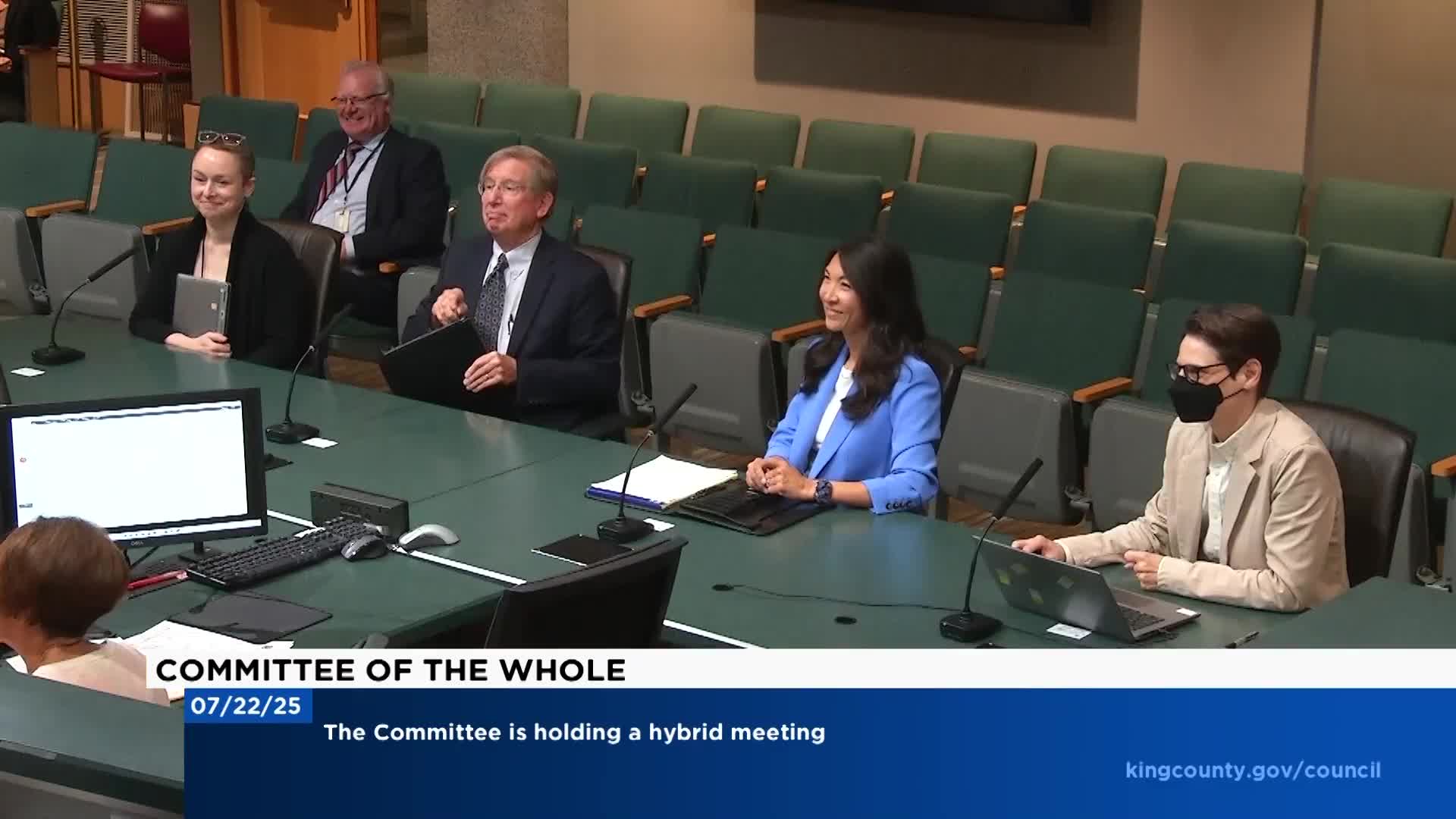
Summary
Harborview reported an 8.3% operating margin for FY25, opened 40 new single-patient beds and raised more than $22 million in philanthropy, but hospital and union leaders warned that federal Medicaid changes and phased reductions to directed payments could remove tens of millions in revenue and increase demand on the county's safety net.
Harborview Medical Center told the King County Council Committee of the Whole on July 22 that the hospital achieved a substantial financial turnaround in fiscal 2025 but faces significant fiscal and operational risks from federal changes to Medicaid and other programs.
Summer Klavana Wally, chief executive officer of Harborview, said Harborview is "coming in this year at an 8.3% operating margin," and that the hospital is carrying "106.2 days cash on hand." Klavana Wally credited operational efficiencies and revenue improvements, as well as state-directed Medicaid payments and nonrecurring state appropriations, for the positive result. She also reported recent capital investments: Harborview opened two new inpatient units during the fiscal year — 20 single ICU beds and 20 single acute-care beds — and raised significant philanthropic support, including $22,250,000 overall and a $6,500,000 single gift for a neuroscience initiative.
Union and frontline staff representatives told the committee they remain concerned about staffing, recruitment and retention. Niru Kor, a respiratory care practitioner who said she has worked at Harborview for 23 years, said her department has "35% travelers working right now," called staffing turnover a "revolving door" and urged continued county investment. Lindsay Grama, legislative director for SEIU Healthcare 1199 Northwest, told the committee the union is in active bargaining and urged council support for finalizing the hospital service agreement (HSA) and for ensuring the HSA and revenue structure remain secure in light of federal changes.
Bridal (Brian) Edwards, president of Wolseley Local 3488, said frontline units such as food service, security and environmental services are also concerned about recruitment and retention. Edwards flagged potential programmatic impacts tied to Medicaid-based funding and said unions are coordinating across bargaining units on issues such as ICE-related workplace policies.
Harborview leadership emphasized how federal policy changes could both reduce revenue and increase demand for care. Klavana Wally said repeal or phase-down of Medicaid-directed payments would remove funding that helped produce the FY25 margin; she told the committee that without those payments Harborview's result would have been a negative margin. She warned that as people lose Medicaid coverage or face new administrative barriers, "we are going to see more demand at Harborview," because the hospital serves as the regional safety net.
Tony Wright, director of Harborview Construction and Infrastructure for King County, briefed the committee on the Harborview bond program and a campus master-planning process. Wright said the county is completing procurement for a progressive design–build team and is negotiating contract terms; he stressed the project's complexity and the need to validate schedule and cost estimates with the selected design–builder. Wright stated plainly that parking is a critical constraint for construction and ongoing hospital operations, saying in the briefing "form follows parking" to underscore how parking shortfalls can cascade into access and patient-care problems. He said the county will submit an environmental impact statement (EIS) and pursue a Major Institution Master Plan (MIMP) amendment with the City of Seattle; those permitting steps are required before full construction can begin.
Dwight Dively, director of the Office of Performance Strategy and Budget, gave a broader federal outlook and contingency-planning suggestions. Dively summarized "five different kinds of risks" from recent federal activity and said state and local planners estimate that 75,000 to 100,000 King County residents currently on Medicaid could eventually lose coverage over two to three years. Dively outlined potential contingency options including a county reserve in the general fund and the MID fund, regional coordination across providers and hospitals, emergency management planning for staff and services, and looking at structural options for behavioral health administration.
Committee members pressed Harborview and county staff on timelines, the size and timing of potential revenue losses, and how the county might fund or phase in responses. Harborview and the unions urged council engagement in bargaining, finalization of the HSA, and planning to protect operations and workforce morale if federal funding is reduced.
The committee asked staff for more detailed program-level reports, including a roadmap showing dependencies, estimated schedule milestones for the bond program, and a clearer breakdown of expenditures to date on bond-related work. Wright said he can provide a fuller timeline and budget detail once the design–build contract is signed and the design-builder validates program and cost assumptions. Dively and Harborview leadership said political engagement and cross-agency coordination at county and state levels will be important tools to limit the most severe impacts.