Get Full Government Meeting Transcripts, Videos, & Alerts Forever!
Get email alerts on the Parking Security Robot topic
No spam. Unsubscribe anytime.
Montgomery County pauses limited rollout of security robot 'Parker' after council questions on privacy, outreach
Summary
Montgomery County’s Department of Transportation briefed the full County Council on plans for a one‑year pilot of an autonomous security robot in Garage 61 in Downtown Silver Spring, and Council members pressed DOT on public outreach, data access and privacy protections.
Montgomery County’s Department of Transportation briefed the full County Council on plans for a one‑year pilot of an autonomous security robot in Garage 61 in Downtown Silver Spring, and Council members pressed DOT on public outreach, data access and privacy protections.
DOT Director Conklin told the council the device is a leased, vendor‑maintained security robot that will “patrol the garage, 24 hours a day, 7 days a week on a regular cycle with a charging interval.” He said the vendor chosen through an open procurement stores video and license‑plate data for 30 days and that “we retain 100% ownership of this data.” Conklin also said, “It was not intended that the program would be announced through an early morning news story,” and apologized for the early media attention.
The device, described by DOT staff as roughly 5 feet tall and about 420 pounds, uses lidar for navigation, records 360‑degree video (DOT said it is not recording audio), and can log the presence of people, groups or vehicles and broadcast pre‑recorded messages. Joe Stomana of MCDOT said the county’s parking camera count has increased from about 280 cameras to roughly 488 systemwide since 2023 and that Garage 61 now has 36 cameras (up from 20).
Why it matters: Council members framed the discussion around public safety, trust and civil‑liberties concerns in a diverse downtown. Council members emphasized that outreach and multi‑language engagement are essential before a pilot goes into service, especially given the county’s large immigrant population. Council member Mink asked whether the device could create more fear than safety; Conklin said public perception will be measured during the pilot, and the county will “monitor information about whether the public likes this robot or feels threatened and intimidated.”
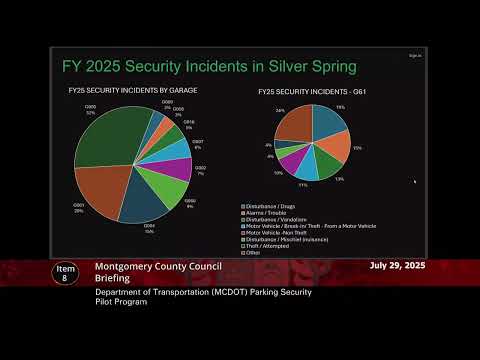
Key points from the briefing - Location and purpose: DOT selected Garage 61 — an outdoor, high‑use facility that serves Veterans Plaza and large event venues — in part because communications work better above grade. DOT said Garage 61 accounts for roughly 20% of incidents in the Downtown Silver Spring Parking Lot District. The primary incident types are property damage, theft and nuisance complaints; DOT said person‑to‑person violence is rare in the garages. - Capabilities and limits: DOT said the robot will capture 360‑degree video, has a license‑plate reader, and “can sense the presence of people or groups of people, but it cannot identify who those people are.” DOT said the robot will not use facial recognition, will not connect to external flagged databases in the pilot, and “is not recording audio.” - Data, ownership and access: Conklin said DOT owns the data; Knightscope (the vendor named in the briefing) can review logs for performance and operational needs but “does not have the ability to use this data for any private purpose.” DOT said footage can be shared with police on request and retained beyond 30 days if an incident requires longer storage or legal preservation (MPIA requests would follow county attorney review). - Vendor and security claims: DOT staff said the vendor is a U.S. public company with FedRAMP‑level certifications for data security and that the county negotiated roughly $90,060 for the one‑year lease, reduced from a higher price. DOT said the vendor is responsible for repair/replacement under the lease and that the contract contains a 72‑hour service‑level guarantee for replacement.
Council questions and concerns Council members asked how often footage is reviewed (DOT said a DOT security manager reviews material as needed and the vendor provides twice‑daily summary reports), who has access (DOT staff and contracted vendor monitoring, with law enforcement access by request), whether company ties to other firms or federal programs raise future privacy risks (DOT said contract provisions and data ownership protections were reviewed but acknowledged the concerns), and what measures the county will use to judge success (reduced incidents, useful investigative footage and public perception).
Council members pressed DOT to expand outreach beyond August, hold meetings in languages spoken in the area (council members requested Spanish and Amharic specifically), coordinate with local service organizations, and publish clear protocols about when footage is shared with police. Several council members said the initial rollout should have included council briefing and public engagement before media announcement; DOT confirmed it will run a community engagement program before deployment and summarize input by late September.
Next steps and constraints DOT said it plans meet‑the‑robot events, listening sessions at multiple times (day/evening) in August and September, a public town hall, and an outreach table with local groups; DOT said it would summarize input near the end of September and finalize operational protocols before launching the pilot in late September or early October. The one‑year contract term runs from the vendor’s start date; DOT said a pause requested by council members has allowed time to extend outreach and refine protocols.
Discussion vs. decision: The council requested a pause in deployment and extensive public engagement and asked DOT to document—before launch—operational protocols and the chain of custody for footage. No formal county vote was taken on the pilot during the briefing; DOT described an internal pause and a public engagement schedule pending council input.
Closing: DOT told the council it will return with a summary of public input and the operational rules it adopts; council members requested written protocols for data sharing, a clear request/response record for law‑enforcement requests, and multi‑language outreach.
Sources: Briefing remarks by DOT Director Conklin; presentation and answers by MCDOT security staff (Joe Stomana); questions and comments from Council members Katz, Fanny Gonzalez, Mink, Friedson, Glass and others during the council work session.