
King County Council approves 0.1% sales tax for criminal-justice and public-safety services
Get AI-powered insights, summaries, and transcripts
Subscribe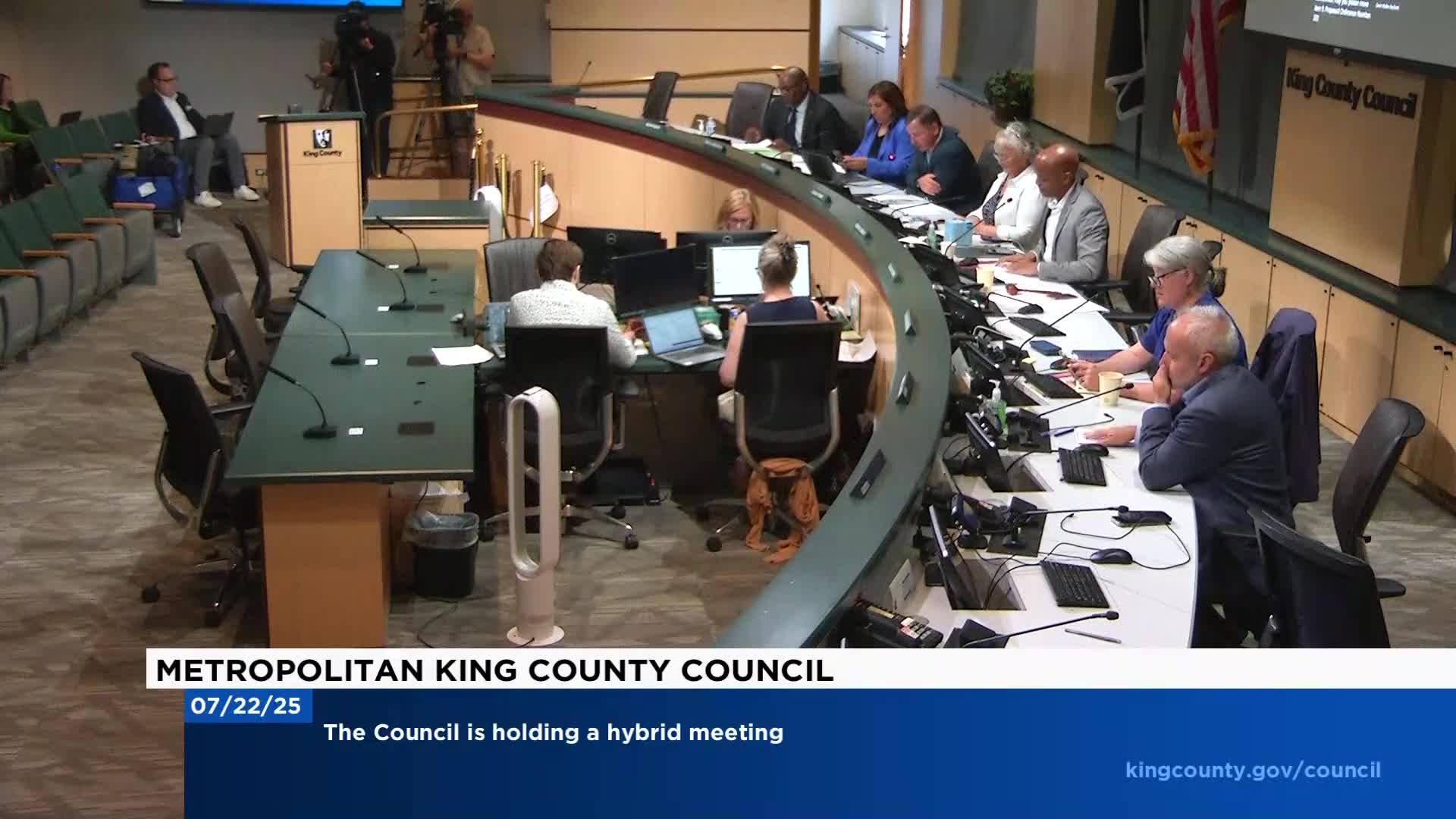
Summary
The Metropolitan King County Council on July 22 approved a one‑tenth of one percent countywide sales-and-use tax authorized by state law to shore up public safety and human services funding starting Jan. 1, 2026. The measure passed 8–1 after council debate and dozens of public commenters urged protecting human services amid federal cuts.
The Metropolitan King County Council voted 8–1 on July 22 to adopt a one‑tenth of one percent countywide sales-and-use tax for criminal-justice purposes, a levy authorized by the state legislature, to begin collection Jan. 1, 2026.
Council Chair Girmay Zahilay and Budget Chair Dave Dombrowski framed the measure as an emergency revenue tool to avoid deep cuts to courts, prosecution, the sheriff's patrols, public defense and a range of human services. Councilmember Joe McDermott cast the sole no vote.
The tax, proposed in Ordinance No. 2025-0169 and authorized by recent state action (House Bill 2015 and the language cited in the county file as "section 201, chapter 350, Laws of Washington 2025"), is forecast by county staff to generate about $95 million in its first year and roughly $193 million over the 2026–27 biennium. Executive staff told the council that proceeds would be deposited into the county general fund and appropriated through the biennial budget process.
Nut graf: Council members and a broad cross-section of community organizations urged the council to adopt the tax as a stopgap to prevent severe reductions in public safety and human services that the county otherwise faces because of an estimated general‑fund shortfall. Public commenters representing victim‑service organizations, homelessness providers, senior services and housing groups told the council that existing local providers are already strained and would be harmed by further cuts.
During the hearing, more than a dozen nonprofit leaders and service providers spoke in favor of the tax while acknowledging its regressive nature. Mary Ellen Stone of the King County Alliance for Human Services told the council, "Our funding has not kept up with inflation. We are struggling with staff turnover. We're struggling with increasing demands." Kate Garvey, CEO of the King County Coalition Against Sexual Assault (CASARC), said the organization faces a $600,000 reduction in state funding this year and urged the council to prioritize stabilizing existing services.
Council debate touched on twin themes: the lack of other revenue tools available to counties and the need to include clear spending principles. Councilmember Dombrowski, who led the budget committee that brought the ordinance forward, said the legislature gave counties a single tool and argued the county must use it to avoid cuts that otherwise would include layoffs and reductions in patrol services in unincorporated areas. "If one of your values is you want patrol services from our sheriff's office, we have to pay for them," he said.
Councilmember Teresa Mosqueda, who supported the ordinance, said the council must adopt firm parameters for how the revenue is allocated. "If we are stepping up and asking for an additional sales tax, that we do the right thing, the moral thing, and that we ensure that the funding goes directly into supporting our most vulnerable community members," she said, and urged a spending plan that prioritizes diversion, reentry, violence-interruption, mental‑health and housing services.
Councilmember Kathy Lambert (recorded as voting Aye) and others noted the tax is regressive but said the alternative — immediate, deep cuts to core public-safety functions and services for survivors and people experiencing homelessness — would be worse. Councilmember Dunn was the lone no vote, saying he opposed raising taxes and arguing for alternative internal reforms.
Formal action: The council adopted Ordinance No. 2025-0169 by roll call (8 ayes, 1 no). Roll-call votes recorded at adoption were: Balducci—Aye; Baron—Aye; Dombrowski—Aye; Dunn—No; Mosqueda—Aye; Perry—Aye; Quinn—Aye; Von Reichbauer—Aye; Chair Zahilay—Aye.
Discussion vs. decision: The council approved the tax concept today; allocation of proceeds was not finalized. Multiple councilmembers and public commenters said the executive and council will develop a spending plan this fall as part of the 2026–27 budget process. Budget staff briefed members that nearly 75% of the county general fund is dedicated to public safety and that the new revenue would help offset a projected general‑fund deficit without yet fixing longer‑term structural shortfalls.
Clarifying details: County central staff reported that collections would begin Jan. 1, 2026; revenue forecasts are approximately $95 million for the first year and $193 million for the 2026–27 biennium; the ordinance number brought forward by central staff is 2025-0169; authorized state law referenced during the meeting includes House Bill 2015 and cited statutory language in the county record as "section 201, chapter 350, Laws of Washington 2025." Speakers asked that a significant portion be set aside to stabilize existing homelessness, domestic‑violence, behavioral‑health and victim‑service providers.
Community relevance: Speakers represented providers across King County, including organizations serving West Seattle, Vashon Island, Snoqualmie Valley and north King County. Commenters repeatedly requested that the county protect low‑income residents from the regressive effects of a sales tax when it allocates proceeds.
What happens next: The ordinance authorizes the tax; the executive will propose a spending plan in the fall biennial budget cycle. Council members pledged additional public engagement and deliberation on the allocation of proceeds before appropriations are finalized.
Sources: Council debate and roll-call votes; public comments delivered during the July 22, 2025 council meeting.