
County CFO: midyear review shows higher reserves now but one-time grants and timing skew outlook for 2025
Get AI-powered insights, summaries, and transcripts
Subscribe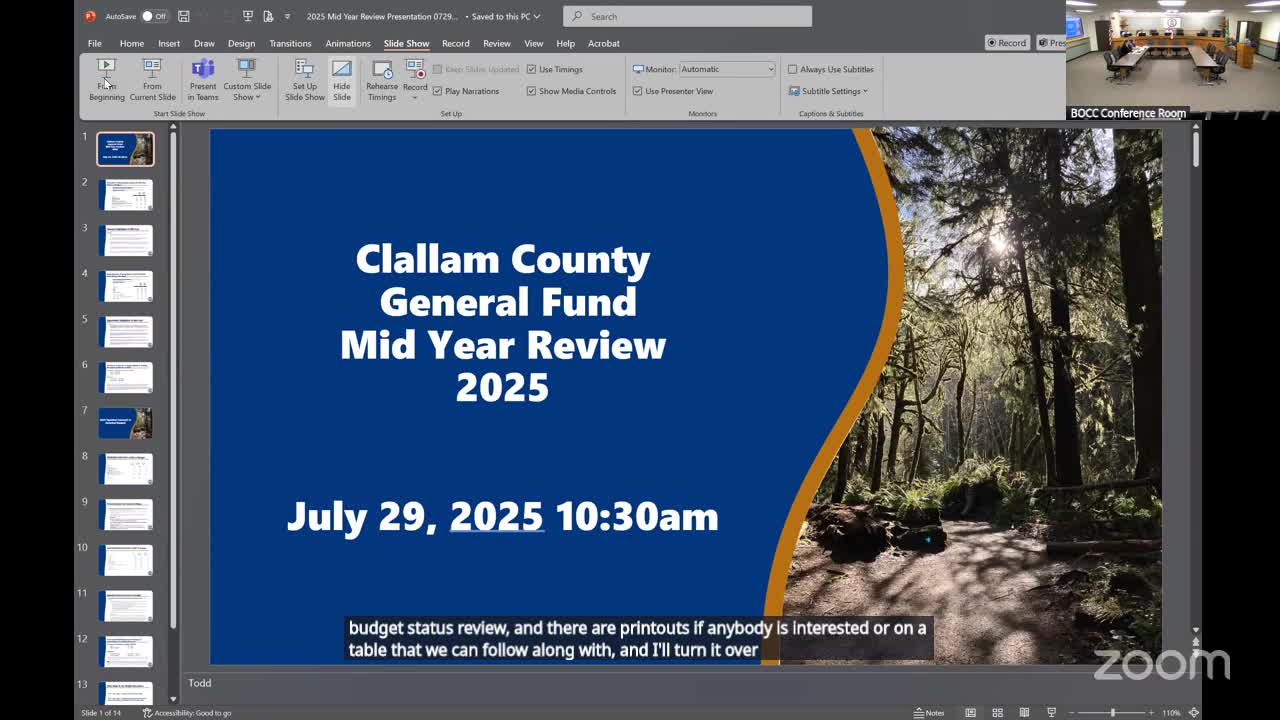
Summary
Clallam County’s midyear budget review on July 29 showed general fund revenues pacing ahead of last year, driven partly by early receipt of large grant milestone payments and strong timber receipts; staff warned those one-time items will be spent later this year and will reduce reserves.
Clallam County’s finance staff told the Board of Commissioners on July 29 that the county’s midyear financial picture looks better than a year ago but is affected by timing of large grant payments and by one-time advances.
Todd, the county’s finance lead, said general fund revenues were pacing at about 54.8% of the annual budget at midyear — ahead of last year’s pace — but stressed the numbers are skewed by advanced grant milestone payments. He told the board that roughly $3.8 million in HCA (Medicaid reentry) grant milestone payments were received earlier than budgeted, temporarily increasing intergovernmental revenue and reserves. Timber excise receipts were also well ahead of last year at midyear but staff cautioned timber receipts can be cyclical.
Staff projected overall revenue will exceed the adopted 2025 budget by roughly $1.78 million (about 3.1 percent), primarily because of grant timing and one-time returns of working capital from a floodplain project. However, administrators cautioned that reserves will decline later in the year as the HCA reentry funds are spent; the county expects much of the reentry grant money to be used for capital and capacity spending in the Clinical Shared Services function before year end.
The board approved two short-term “debatable emergencies” during the meeting: a small district court salary appropriation ($3,650) and $50,000 in Health and Human Services operations from opioid-settlement funds to replace state-supplied harm-reduction supplies that were cut this year. Todd said the opioid-settlement appropriation is intended to buy six months of supplies while the county’s advisory boards develop longer-term spending priorities.
Staff and commissioners also discussed staffing and operational risk. Finance staff said payroll and benefits were running below budget at midyear — partly because of vacant positions and retirements — and projected payroll underspend of about $1.9 million for the year. Commissioners and staff flagged critical staffing gaps in juvenile corrections and the local jail: juvenile correction officer vacancy rates were described as near 50 percent, and the board heard that high turnover and market competition are part of the recruitment challenge. Commissioners said understaffing raises operational risk even when it reduces near-term payroll costs.
Other topics covered in the midyear presentation
- Sales tax revenue: choppy monthly performance; staff said sales tax collections were up 2.7% year-over-year through midyear but trailed the 4% growth assumption used in the 2025 budget and that monthly swings make forecasting uncertain.
- Timber excise: timber receipts were substantially higher midyear (staff cited 194% growth versus the prior midyear) but staff cautioned harvest timing will vary year to year.
- Reserves and forecast: staff estimated a midyear surplus (revenues over expenditures) and projected year-end reserves of roughly $15 million (about 28% of expenditures) if current assumptions hold, but emphasized that the HCA advance and planned capital spending will reduce reserves as the year progresses.
Public comment and commissioner questions
Public commenters linked budget decisions to visible community concerns. Residents pressed the board on homelessness, harm-reduction policy and costs of local programs (one speaker highlighted a faith-based safe-parking pilot and questioned per-site cost). Multiple speakers urged stronger action on forest management and timber removal near power lines; others urged enforcement of animal-control ordinances after repeated dog attacks in a neighborhood.
Commissioners asked staff to include multi-year projections and to return with options for maintaining service levels given the end of one-time grant support in 2026. Staff said they will present three-year projections and that advisory boards will help prioritize opioid-settlement spending going forward.
Ending
Staff framed the midyear numbers as a temporary improvement tied to timing of grant payments and one-time returns. The board approved the short-term budget moves needed to cover immediate gaps and directed staff to continue work on a longer-term fiscal strategy, staffing recruitment and grant implementation.