
Clallam County charter commission deadlocks on water resource specialist amendment; directs committee to draft recommendation
Get AI-powered insights, summaries, and transcripts
Subscribe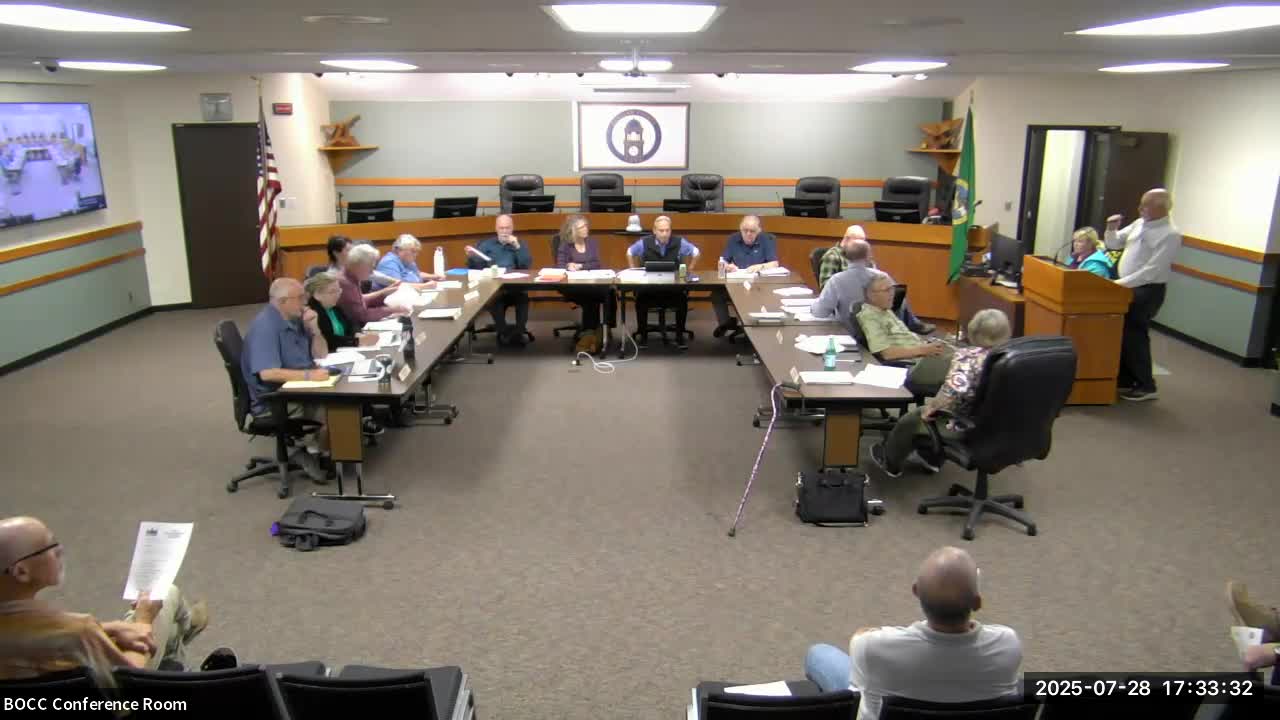
Summary
The Clallam County Charter Review Commission deadlocked 7–7 on a proposal to add a contracted water resource specialist to the county charter and instead instructed its water committee to draft a recommendation to the Board of County Commissioners.
The Clallam County Charter Review Commission on its review-agenda voted but failed to approve a proposed charter amendment that would create a contracted water resource specialist; the motion ended in a 7–7 tie and did not advance. The commission then voted to send the committee’s work and a formal recommendation to the Board of County Commissioners for further consideration.
The amendment would have added a paragraph to Article 4, Section 4.25 of the Clallam County Charter to require the director of the Department of Community Development to retain, by competitive personal-services contract, a water resource specialist to “collect, analyze, and provide water resource data to all entities managing water resources in the county.” Under the draft language read into the record, the specialist would have no regulatory or enforcement authority, bids would be ranked by an ad hoc seven-member committee, contracts would run four-year terms starting no later than July 1, 2026, and the position need not be filled if the winning bid’s annual cost exceeded the annual salary of a county commissioner.
Why it mattered: Commissioners and dozens of public speakers framed the debate around two core tensions — the county’s need for up-to-date, impartial water data amid growing drought and development pressures, and the budgetary and governance implications of embedding that expertise in the charter. Supporters argued a permanent, independent technical resource would close data gaps and improve emergency preparedness; opponents warned that chartering the role would lock spending into a long-term structure and reduce commissioners’ budget flexibility.
Public comment was large and sharply divided. Dozens spoke during the public-comment period, both in favor of and opposed to placing the amendment before voters. Don Eisenbius of Sequim urged the commission to forward the amendment to voters, saying, “I urge you to forward the water specialist amendment to a public vote.” Several speakers described local incidents — including a petroleum spill that temporarily affected drinking-water access — as evidence of the need for clearer, countywide water data. Others opposed embedding a new position in the charter out of concern for cost, overlap with existing agencies (Department of Ecology, PUD, USGS and local water districts were repeatedly named), and possible duplication of work.
Budget questions surfaced repeatedly. Todd Nelke, Clallam County administrator, told the commission the county’s current-expense budget for 2025 is $56,589,541 and that the county’s reserve (ending fund balance) was about $13.4 million in 2024 and is projected to be a bit over $14 million by year end. “There is a surplus for rainy day situations of over $13,000,000,” Nelke said, while cautioning that reserves exist to cover emergencies and that appropriate reserve levels are a policy decision.
Commission debate reflected the split in public comment. Supporters described the proposal as a flexible compromise: the ad hoc selection committee, contract bidding, and the clause allowing rebids if the annual winning bid exceeded a commissioner’s salary were presented as safeguards. Opponents said the charter review commission was not the appropriate vehicle for a position of this kind and urged referral to the Board of County Commissioners, which oversees budgeting and departmental creation.
Votes at a glance: A motion to place the proposed charter amendment on the ballot (motion as read on the agenda) was made by Commissioner Richards and seconded; the roll-call vote produced a 7–7 tie, with yes votes from Commissioners Stauffer, Fane, Noble, Pickett, Richards, Hooley and Sarmiento and no votes from Commissioners Fish, Benedict, Tozer, Morris, Fleck, Hodgson and Waldy. Because a majority was required, the motion failed. Separately, the commission approved a motion from Commissioner Benedict (as amended) directing the water committee to draft a formal recommendation and forward that recommendation to the Board of County Commissioners; that directive passed on a voice vote.
What was decided and next steps: The charter amendment did not pass at this meeting. The commission directed the water committee to prepare a recommendation to the Board of County Commissioners that consolidates the committee’s research, proposed options (including possible advisory structures), and any funding considerations. The water committee was asked to return with a more formal, written recommendation for the commission to transmit to the county commissioners. The commission also discussed possibly pursuing a citizens advisory option in parallel, and members requested additional factual material and comparative examples from other counties.
Context and background: The item drew sustained attention because Clallam County includes both rain-shadow areas (Sequim/Dungeness) and wetter zones (western slopes and coastal areas). Commenters repeatedly cited aging or incomplete water-data sets, local drought episodes, and planned residential developments that they say rely on water projections. The committee and several commissioners noted the proposal attempted to respond to many public concerns by limiting authority, defining bid procedures, and setting a cost threshold for filling the position.
Commissioners and staff underscored limits to local authority and existing data partners: the amendment as written contemplated a contracted specialist who would compile and analyze data, but not supplant existing technical sources such as the Department of Ecology, the Dungeness River Management Team, local public utility districts (PUDs) and federal agencies.
The commission’s next steps are administrative: the water committee will draft the written recommendation and present it at a future CRC meeting; the Board of County Commissioners will be the body to consider any formal departmental or budgetary action or to place alternative language on a ballot for voters. The commission did not change the amendment’s language at this meeting; under its rules, substantive changes would return the proposal to an earlier review step.
(Reporting note: Quotes and budget figures above are taken from the meeting transcript and attributed to speakers who identified themselves on the record.)