
Clallam officials and regional utilities map coordinated plan for power, water, zoning and ports to attract industry
Get AI-powered insights, summaries, and transcripts
Subscribe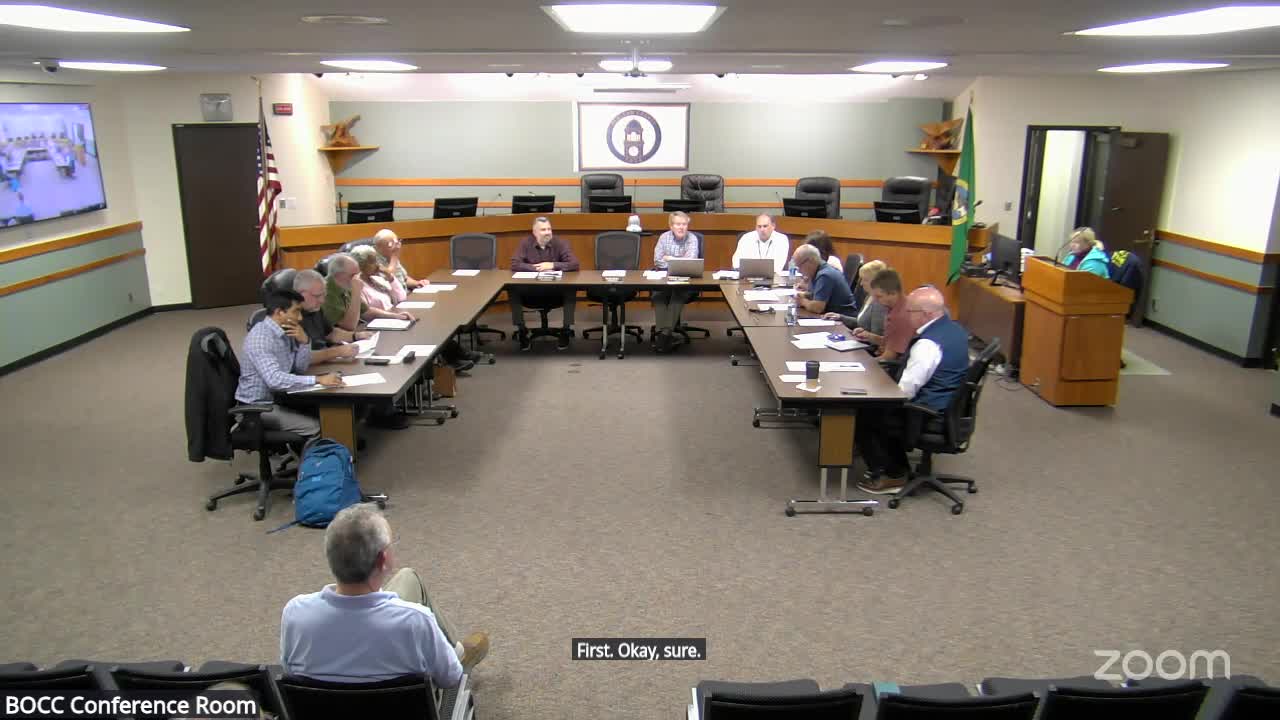
Summary
County commissioners, Port of Port Angeles leaders and the local public utility district discussed coordinated infrastructure projects, grant-funded grid upgrades, constraints from Bonneville Power Administration contracts and a proposed West End urban growth-area swap to create shovel-ready industrial land.
Clallam County elected officials, Port of Port Angeles commissioners and leaders of the local public utility district met Oct. 12, 2025, to discuss aligning power, water, transportation and zoning so the county can pursue larger industrial projects and shore up infrastructure resilience.
The meeting aired longstanding local priorities: improving reliability on the West End’s electrical system, identifying contiguous industrial land with full utilities, clarifying which agency can serve which neighborhoods, and finding state or federal funds to build “shovel-ready” sites that would attract large employers. Participants repeatedly flagged transmission limits imposed by the Bonneville Power Administration (BPA), water-system capacity in remote areas, and Highway 101 and truck-route constraints as barriers to recruitment.
Peninsula PUD officials described a batch of state grants they say will fund undergrounding, pole replacement and substation work to harden the grid in the county’s western service area. Audrey (PUD staff) told the meeting the utility won roughly 40% of the state’s resilience funding the PUD applied for and enumerated projects including targeted undergrounding (Diamond Point Road), transmission pole replacements from wood to fiberglass, circuit switch replacements and substation rebuilds to create more ties and redundancy. "We were able to get undergrounding project for several distribution projects," Audrey said.
Bowen Kendrick, director of water and wastewater for the PUD, said the county’s water supply is diversified overall, but that isolated systems remain vulnerable. "We're pretty well diversified between surface water sources and groundwater sources. Our Port Angeles composite system has 4 primary sources of supply," Kendrick said, and he identified one west-end service area with a single well supply that needs a second source.
On power capacity, PUD leaders and elected officials described three paths that can enable large industrial loads: (1) procure additional BPA tier-1 power under contracts; (2) buy market or tier-2 power (more expensive); or (3) develop local utility-scale generation. PUD staff said BPA contracts are being reset as legacy industrial loads (mills) exited, freeing transmission capacity in some places but reducing the federal “high-watermark” allocations of low-cost tier-1 power; those contract limits are scheduled to be re-evaluated in 2028. The PUD has launched a feasibility study with the Bonneville Environmental Foundation to test local generation options, targeting modular projects that might start at about 5 megawatts and scale to 25–50 megawatts if economic, environmental and social criteria align.
Speakers stressed a distinction between transmission (high-voltage trunk lines) and distribution (lower-voltage lines that serve neighborhoods) and noted that recent mill closures changed local load patterns. PUD staff said projects under BPA’s rebuilding programs (for example, the Shelton–Fairmont rebuild and related fiber work) should improve West End availability over time but will not fully eliminate the need for local generation or creative procurement if a single large new load is proposed.
Land use and permitting constraints were a parallel focus. Port and county officials discussed the Western Port Angeles urban growth area (UGA) and a possible UGA swap or expansion to concentrate industrial acreage near the city’s western limits. County planning staff said they identified roughly 250 acres near Clallam Bay and additional flat parcels south and west of Port Angeles that merit further analysis; a careful process with public outreach and environmental review could take a year or more. "Those requirements are less stringent when it comes to what they call a UGA swap," a county planner said, describing a path that could reallocate acreage to a municipality where urban services can be provided.
Officials emphasized the service-area agreement that defines where the PUD and the city of Port Angeles may serve customers. The PUD noted it cannot extend service outside agreed boundaries without an amendment, and port and county staff urged earlier coordination so capital planning can account for prospective industrial tenants.
Transportation and marine shipping were recurring constraints. Commissioners described how expensive road transport and limited Highway 101 capacity reduce competitiveness for forest-products and other manufacturers; several speakers urged development of maritime shipping alternatives (small coastal barges) and careful zoning for barge-accessible sites. Port representatives said barging can displace hundreds of truckloads for a single shipment and that suitable onshore laydown areas, appropriate zoning and safe navigation are prerequisites.
Funding strategies received practical attention. Speakers described mixed funding approaches pursued elsewhere: federal appropriations, state grants, utility improvement districts, tax-increment financing and multi-party utility agreements. County and port participants cited a recent, large federal appropriation example in another district that combined advocacy and long-range planning; one local official suggested the county produce zoning maps, cost estimates and one-pager project briefs to present to state and federal delegations. Skagit County’s utility improvement district was raised as a model to finance upfront infrastructure investments.
Participants also highlighted non-revenue resilience needs: several elected officials recommended regional planning for emergency fuel supplies and shared diesel depots so generators and heavy equipment can run longer than the few days current stocks allow after a major event.
Discussion produced near-term process steps rather than formal decisions. Staff and elected leaders agreed to continue the conversation and to convene a smaller working group of staff leads for more frequent coordination, with a proposed meeting cadence that includes near-term monthly staff work and quarterly joint elected briefings. The Port, PUD and county endorsed developing a targeted set of candidate sites, a land-capacity and utilities cost assessment, and a coordinated advocacy package for state and federal funding agencies and delegations.
Ending: Officials said the immediate next steps are (1) PUD and city staff to map specific parcels and utility upgrade needs in the Western UGA focus area, (2) the smaller staff working group to draft a short action list and funding strategy, and (3) elected leaders to consider a unified outreach to state and federal delegations for appropriations and grant support. The group set a goal of keeping the effort focused on creating one or more clearly defined, utility-served industrial sites that would be marketable to prospective employers.