
Clallam County committee to draft ethics review commission after reviewing Clark County model
Get AI-powered insights, summaries, and transcripts
Subscribe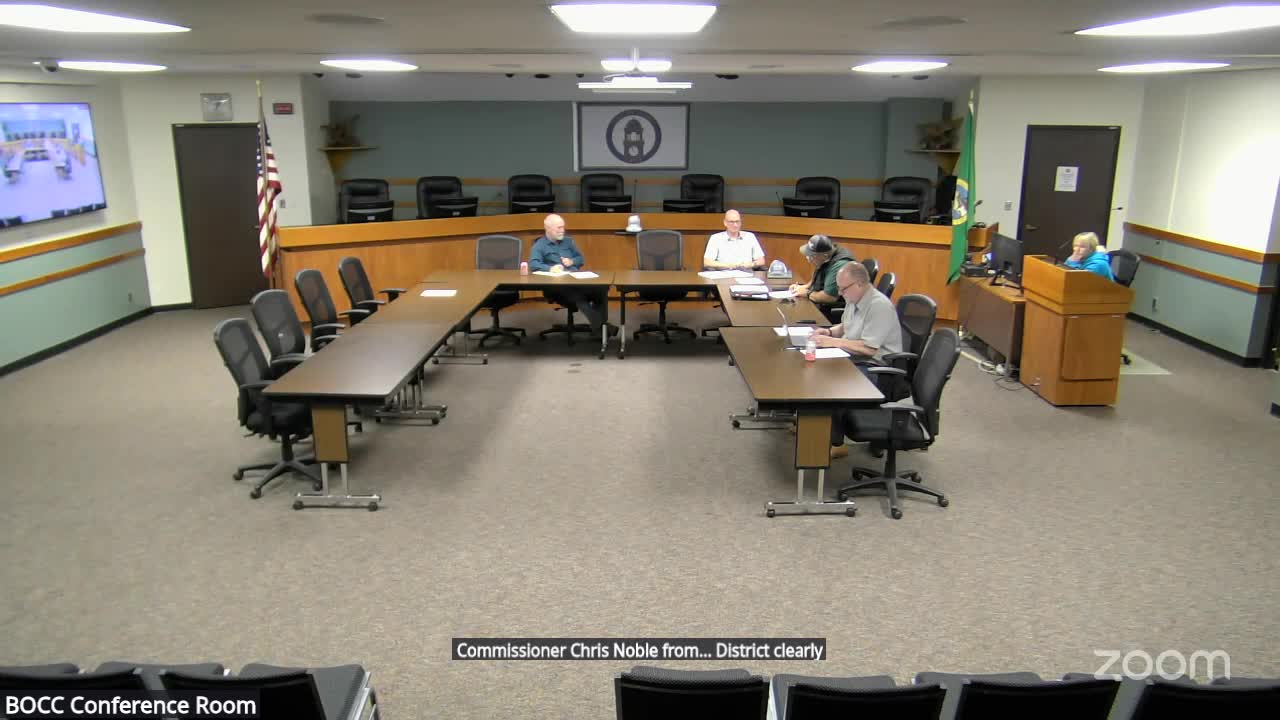
Summary
Clallam County's charter review/ethics committee agreed July 24 to draft language for a voter-facing amendment to create an ethics review commission for elected officials, directing staff to gather Clark County materials and research due-process and cost implications before the next meeting.
Clallam County's Charter Review and Ethics Committee agreed July 24 to develop charter amendment language to create an ethics review commission for elected officials and to gather information from Clark County's recently established system before the committee's next session. Committee members said they want a structure that allows findings or censure but avoids heavy monetary penalties that could trigger large legal bills or complex due-process obligations.
The committee took up the topic after a report from Commissioner Jeff Tozer and a presentation by Dee Bowden, chief civil deputy in the Clallam County Prosecutor's Office, who summarized Clark County's approach and the practical lessons Clark's staff identified. "The single most important thing from her perspective is ... you're gonna need staff to actually put all of these things together," Bowden said, describing Clark County's experience providing staffing through the county manager's office.
Why it matters: Committee members said Clallam County currently lacks a clear enforcement or complaint-processing mechanism for elected officials, and voters asked the Charter Review Commission to address that gap. The committee framed the effort as two discrete steps: (1) create a board or commission by charter amendment so a forum exists and (2) leave detailed bylaws, procedures and complaint forms to staff and the new board to develop.
Key details from the discussion: Bowden said Clark County implemented charter provisions (identified in the meeting as charter sections 8.12 and 8.13 and related code Title 2, chapter 7) that required an ethics office and review commission; she said Clark's process relied heavily on staff work and that the county had only one full hearing since the charter changes took effect. Bowden told the committee that Clark County's hearing process took "more than a year" for the single case that reached a hearing, and that Clark's ordinance leaves a broad menu of remedies ("public admonishment, public resolution of censure, or any action as allowed by law") that committee members worried could be read expansively.
Members contrasted Clark's arrangements with Clallam County's existing code. Bowden noted differences in indemnification and defense provisions in Clallam's code and warned those differences could complicate who pays for outside counsel if multiple parties need representation. "If you're going to have to go to outside counsel to represent the board and retain a different outside counsel to represent the accused and then a completely different outside counsel to represent the county itself," Bowden said, "those are things that should be analyzed under our current code." Committee members asked Bowden and staff to research whether a process limited to nonmonetary remedies (for example, a public finding or censure only) would reduce due-process obligations and the county's exposure to litigation costs.
Committee directions and next steps: The committee asked staff and counsel to collect Clark County's code, bylaws and "business process" documents and to return with a formal legal query that addresses (a) how Clark County staffed and funded its ethics office, (b) how long investigations and hearings have taken there, and (c) the likely cost and due-process implications for Clallam County if the committee limits remedies to nonmonetary findings. The committee also expressed consensus that monetary penalties and recall would not be part of its initial recommendation; the group instead prioritized creating a mechanism to receive complaints and issue findings. The committee scheduled a follow-up meeting for August 12, 1:00'3:30 p.m. to review materials and draft amendment language.
What remained unresolved: Committee members raised several outstanding policy questions they asked staff to analyze: whether Clallam's indemnification clauses would obligate the county to provide counsel in ethics matters; whether an appeals process should be written into code or left to board bylaws; and how to limit remedies to avoid heavy due-process burdens. Bowden offered to help re-contact Clark County staff and to provide copies of the materials she reviewed.
Ending note: Committee members agreed to base initial amendment language on Clark County's structure but to narrow the remedies and clarify staffing, appeals and due-process protections before proposing language to place before voters.