
Clallam County commissioners, planning commission review comprehensive plan updates, raise housing, water and shoreline concerns
Get AI-powered insights, summaries, and transcripts
Subscribe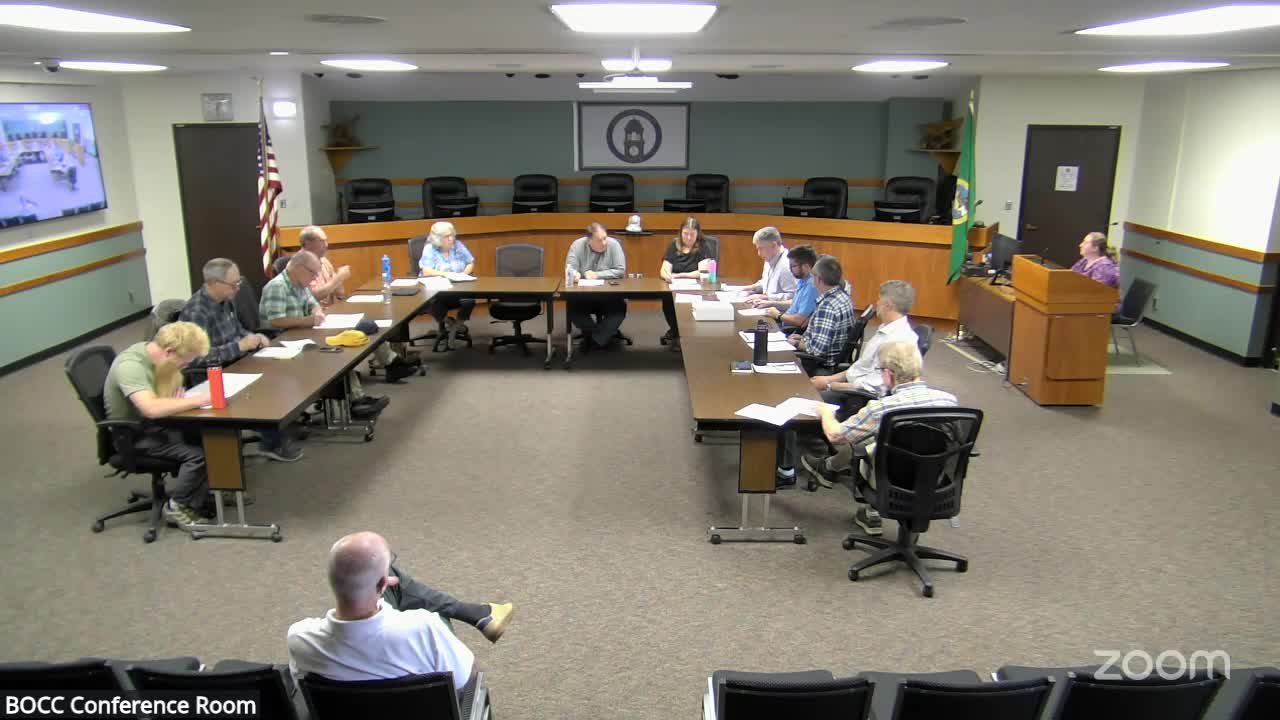
Summary
A joint work session on the countycomprehensive plan update reviewed consultant recommendations on critical areas, climate, economic development and housing, and flagged water availability and shoreline risk as priorities for further study and public outreach.
Clallam County commissioners and the Planning Commission held a joint work session to review consultant deliverables for the county's comprehensive plan update and to outline next steps for public outreach and regulatory follow-up. The session covered required changes to comply with state law, recommendations from two consulting teams on critical areas and climate, and policy options for economic development, housing density and shoreline risk.
The discussion centered on meeting Growth Management Act requirements while also identifying community priorities. Bruce, DCD director, said the update includes work from Cascadia Group on hazard and climate elements and from Facet Northwest on the remaining plan: "The climate element...is a new requirement under the Growth Management Act," he said, summarizing why the county must add policies for flooding, drought, sea-level rise and other climate risks.
Why it matters: the update will drive zoning, critical-area rules and capital-facilities planning that determine where housing and industry can expand, how shorelines and aquifers are regulated, and what infrastructure the county must fund. Commissioners and members of the public flagged housing availability, the scarcity of large industrial parcels and local water limits as immediate implementation challenges.
Most urgent topics addressed
- Critical areas and wetlands: Consultants recommended updating the county's critical-areas ordinance to align with best-available science and state guidance, including adopting the Washington State Wetland Rating System (Western Washington, 2014), revising buffer definitions and adding certification standards for wetland professionals. Bruce said these changes will help keep the county in compliance with state agencies such as the Department of Ecology and Department of Fish and Wildlife.
- Voluntary Stewardship Program and agricultural protections: The consultants suggested establishing or supporting a voluntary stewardship program administered by the conservation district to allow agricultural operations to reduce buffer widths by enrolling in mitigation and stewardship practices. Commissioners noted the program has worked elsewhere in the state but requires funding and farmer buy-in.
- Aquifers and groundwater: The consultants recommended clearer performance standards for critical aquifer recharge areas and adding a table of regulated activities to clarify permitting. Commissioners asked whether the county has sufficient data to set standards countywide; Bruce and others said local basins differ and that some development-regulation work (critical areas code) will follow adoption of the plan so additional study and targeted data collection will be needed.
- Economic development and industrial land supply: The consultant team reviewed regional economic plans and identified maritime, construction, timber products and manufacturing as targeted clusters. County staff and commissioners said businesses are seeking larger, serviced parcels (sewer, water, power) and discussed potential urban-growth-area (UGA) swaps with Port Angeles to assemble larger industrial acreage. Commissioners said such swaps would be complex and likely require environmental analysis extending beyond the current amendment cycle.
- Transfer-of-development-rights program (TDR): The consultants recommended temporarily suspending active promotion of the county's TDR program (adopted 1998) if local market conditions and city participation (Sequim or Port Angeles) do not support its use; they suggested leveraging conservation-funding tools (conservation futures, open-space programs) instead. Commissioners asked for an economic analysis to identify market price points that would make TDR transfers viable.
- Housing capacity and density: The county's land-capacity analysis shows gaps in the amount of higher-density zoning needed to meet state requirements for very low- and extremely low-income housing (0—2% and 30—0% of area median income). Staff recommended expanding higher-density residential zones within UGAs and exploring code changes (0-lot-line, shared-wall duplexes) and site-ready infrastructure to enable smaller, lower-cost units.
- Emergency housing and shelter: The consultants recommended the county identify or create commercial or hybrid zones in UGAs that can accommodate emergency housing and set siting and mitigation standards so shelters are reviewed consistently.
- Shoreline and flooding risks: Commissioners and attendees discussed sea-level rise and coastal inundation. Bruce noted observations of localized sea-level rise and King-tide impacts and said shoreline and frequently flooded-area policies will require more public discussion and likely changes in the Shoreline Master Program and critical-areas code. Several commissioners urged clearer notice and risk communication to property owners in exposed areas.
Public input and outreach
The county previewed a schedule of community open houses and solicited public comment; staff said public meetings will run through the end of the month and feed into draft policy options for August work sessions. Ed Bowen, a resident of Clallam Bay, told the commission: "I really don't wanna be here tonight," and said he opposes the comprehensive-plan product as drafted. Bowen later raised procedural concerns and said he felt excluded from discussion on transportation (arterial flow).
Next steps and schedule
Staff said required development-regulation changes (except those limited to ADUs) will follow adoption of the comprehensive plan: the critical areas code and other implementing regulations are scheduled for completion within the statutory six-month window after plan adoption. The commission and board will hold additional work sessions in August, a public hearing in early September, and may need supplemental environmental review (SEIS) if proposed zoning increases (for example, in Clallam Bay / Sekiu) increase likely significant impacts.
Action taken at this meeting
The commission approved minutes from a prior meeting earlier in the agenda (motion, seconded; vote recorded as "aye"). No formal decisions were made on the comprehensive plan at this session; the meeting was a review and direction-setting work session.
What remains unresolved
Commissioners asked for: more detailed economic analysis regarding TDR viability; targeted groundwater studies for basins lacking data; further discussion with Port Angeles and Sequim on potential UGA swaps and sewer extension costs; and clearer draft language on shoreline and frequently flooded areas before formal adoption. Staff said they will incorporate consultant recommendations, coordinate with cities and resource agencies, and return with draft regulatory language and maps in follow-up work sessions.
The county will hold multiple public open-house sessions over the coming weeks and expects to present a draft policy package to the Planning Commission at the first August work session and a public hearing in September. The comprehensive plan update process will include separate follow-up work on the critical areas code and other implementing regulations after plan adoption.