
Commissioners remand proposed open-space code changes after assessor flags compliance language
Get AI-powered insights, summaries, and transcripts
Subscribe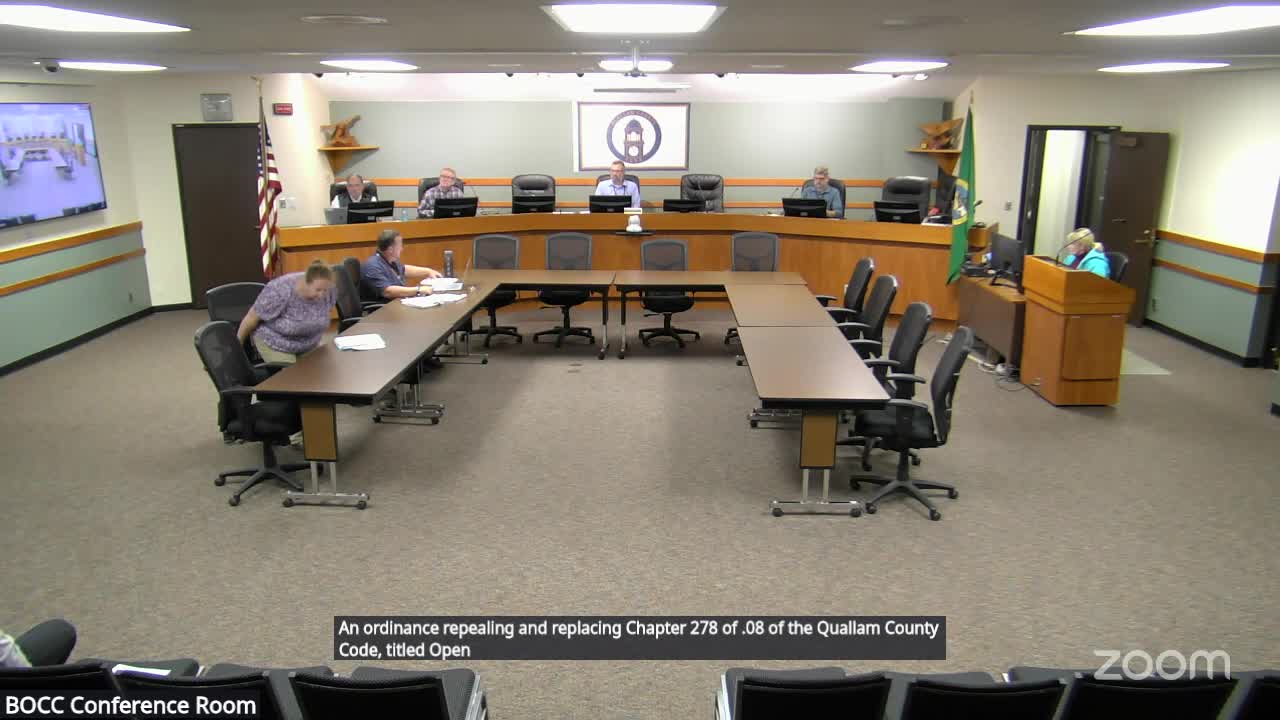
Summary
The board held a public hearing on revisions to Chapter 27.08 (open space) of county code, heard public testimony on parcel-size and conversion issues, and remanded the ordinance back to staff to add assessor-recommended language requiring current compliance for reclassification.
Clallam County commissioners on July 22 opened a public hearing on a proposed repeal and replacement of Chapter 27.08 of the county code — the open space and public benefit rating system — and remanded the ordinance to staff for additional edits after the county assessor requested clarified compliance language.
Donella Clark, a Department of Community Development staff member who introduced the code revisions, said the planning commission reviewed the proposal through multiple meetings in 2024–25 and voted 6–1 to forward it to the Board of County Commissioners. The revision clarifies how staff award public-benefit points and refines eligibility metrics, Clark said.
Pam Rushin, Clallam County assessor, told the board the assessor’s office recommended adding language to require that a parcel seeking reclassification from designated forest land or open-space agriculture be in compliance with its current classification before it becomes eligible for reclassification. “If any other program, like the agricultural program or the forestry program, if you should sign a continuance to stay in the program somebody purchases property, they have to be in compliance to sign that continuance,” Rushin said.
Clarity matters: county staff presented parcel-size distributions to illustrate why a 4-acre eligibility threshold was under consideration. The packet shows that roughly 30% of parcels currently in the program are between 0 and 5 acres and that 47% of those are 4–5 acres; staff said adopting a 4-acre minimum would allow a typical 5-acre rural parcel to retain a 1-acre house site and classify the remaining 4 acres as open space.
Public commenters raised conversion and tax-shift concerns. Resident Jeff Tokeser asked about recent conversions to tribal trust and the effect on property tax rolls; another speaker, Jacob Seager of District 3, said the public benefit of these programs is undermined when residential portions are appraised inconsistently. Jennifer Hansel said she had withdrawn property from a prior program and paid required back taxes.
After public testimony, the board voted to remand the ordinance to staff for modification so the assessor’s suggested language can be added and staff can return with a revised draft and any necessary additional hearing.
Provenance: Staff presentation and the assessor’s recommendation appear in the March–July staff packet and were discussed during the public hearing; the board recorded a motion remanding the ordinance to staff for revision.
Ending: Staff will revise the draft ordinance to include the assessor’s compliance language and return the item to a future meeting for further consideration and potential adoption.