
Clallam County commissioners set July 30 public hearing on potential levy-lid lift
Get AI-powered insights, summaries, and transcripts
Subscribe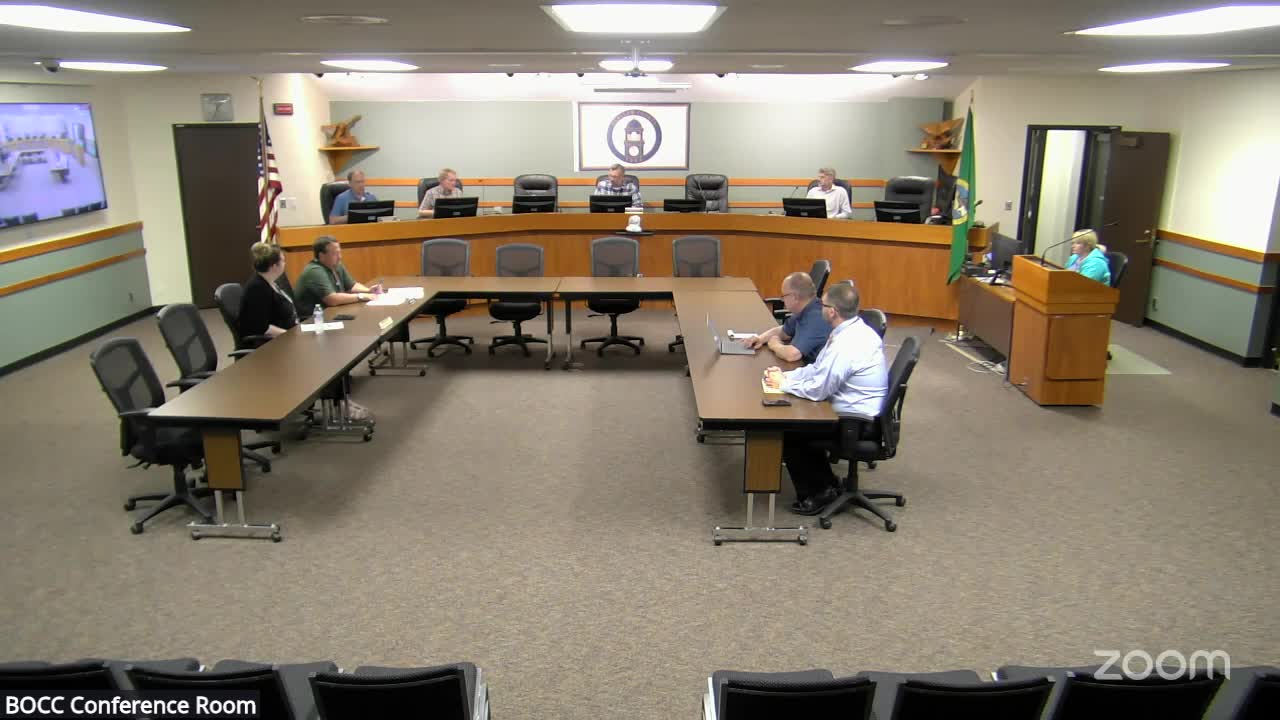
Summary
The Clallam County Board of Commissioners voted to call a July 30 public hearing to consider placing a levy-lid lift before voters, while staff outlined a schedule of budget briefings and a hard August 5 deadline to submit ballot materials.
The Clallam County Board of Commissioners voted Wednesday to call a public hearing for 1 p.m. July 30 to consider a potential levy-lid lift that could be placed on this fall's ballot.
County staff emphasized the July 30 hearing is for discussion and public input only and that no decision has been made to place a measure before voters. The work plan presented to the board lays out a schedule of briefings and a legal deadline: any resolution, ballot title and explanatory statement must be submitted to the county auditor by the close of business on Tuesday, Aug. 5, to allow placement on this fall's ballot.
At the special meeting, an unnamed county staff member said the July 28–29 sessions will provide background and analysis before the hearing: a county-comparison presentation at a work session, a required midyear budget review, a 3-year revenue projection and an evening session presenting options available to the board. “We have not made any decisions with regard to whether to do this or not do this. This is really about being able to have a conversation,” the staff member said. The staff member also described the team’s plan to compare Clallam County with similarly sized Washington counties on population, taxable base and revenues.
Public commentators urged caution and clarity about what counts as “essential services.” Ed Bowen, a resident who spoke during public comment, urged the commissioners to identify which services are essential before asking voters for a tax change. “Roads to me are an essential service,” Bowen said, adding that other services such as trails are treated differently under state law.
Another public commenter, John Worthington, expressed concern about the local tax burden and urged the county to quantify how much revenue it sends to the state and how much it receives back before asking voters to approve more local taxes.
Commissioners discussed possible revenue options the staff will present, including a property-tax levy-lid lift and sales-tax measures. Staff noted one sales-tax option recently passed by the state legislature includes a one-tenth of 1 percent criminal-justice sales tax with a defined list of allowable uses, and a separate $100 million legislative set-aside that counties may access if they meet criteria. Staff said eligibility for the legislative set-aside appears to require meeting training or other thresholds set by the Criminal Justice Training Commission; the sheriff’s office has been asked to confirm whether the county meets those requirements.
Staff also described important differences among sales-tax options: some county sales taxes apply only to unincorporated areas while others apply across incorporated and unincorporated parts of a county. The board directed staff to prepare presentations explaining those nuances, to include projected revenue impacts and assumptions used in the three-year baseline projection (for example, assumptions on state allocations, construction-related new tax base, salary and benefits trends and conservative sales-tax estimates).
A motion to approve the call for the July 30 public hearing was moved by Mr. Myers and seconded; the board approved the call for hearing by voice vote. The motion passed and the hearing was scheduled for 1 p.m. Wednesday, July 30.
County staff and elected officials also discussed outreach to other elected officials and department heads; staff said county cabinet members and department leaders have been informed of the July briefing dates and encouraged to participate. Staff said the July 29 sessions will include time for up to 30 minutes of public Q&A after presentations but that schedule length may be adjusted to allow for commissioner questions.
Staff highlighted that the county’s general fund is heavily affected by salary and benefits, which make up roughly 72–74 percent of the general fund budget; insurance costs and unresolved collective-bargaining items were cited as drivers of future budget pressure. Staff also noted the county has assumed two additional positions in the draft projections: one clinical shared services director and a placeholder position related to coroner services.
Next steps: staff will prepare a county comparison presentation, the midyear review and a three-year projection for the July 28–29 briefings and will present a list of revenue options for discussion July 29 evening; the board will hold the public hearing on July 30 at 1 p.m. Any ordinance or resolution to place a measure on the ballot must be completed and submitted to the county auditor by close of business on Aug. 5 to meet ballot deadlines.