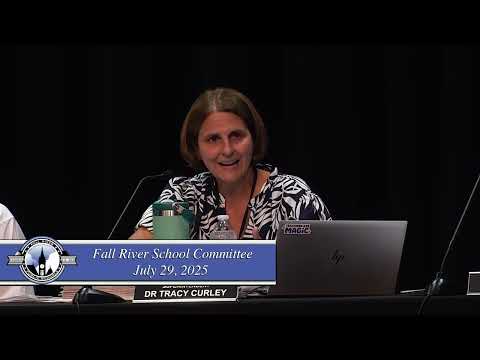
School officials report mixed air-quality findings, outline fixes for mold and HVAC issues
Loading...
Summary
District facilities staff and the superintendent reported recent air-quality and mold testing results, outlined short-term fixes and longer-term HVAC investments, and responded to committee concerns about blocked vents, wet ceiling tiles and upkeep at several schools.
Facilities staff and the superintendent told the Fall River School Committee on July 29 that recent air-quality testing at several schools showed levels below commonly cited thresholds, but also produced school-specific recommendations for repairs and maintenance.
The findings were presented by Mr. Pacheco, a facilities staff member, and Superintendent Dr. Curley, who said the district contracted Common Sense Environmental for air testing at Fonska and LeTourneau and is participating in a Department of Public Health asthma-in-schools study at additional sites. "The schools haven't looked better," Dr. Curley said of the recent test results and noted that most classroom readings were below the acceptable threshold.
The nut graf: the district says many of the problems reported publicly — stained ceiling tiles, noisy unit vents and localized visible mold — are being addressed, while staff and some committee members warned the work will take months and, in some cases, require larger capital investments.
Committee members raised specific concerns during discussion. Committee member Mr. Dias cited images and excerpts of Doran's report showing blocked unit vents, non-operational exhaust vents, corroded rooftop AHUs and visible mold on refrigerator gaskets, and asked how the district is responding. "We have dehumidification going on in all buildings currently," Mr. Pacheco said, adding the district bought 25 heavy-duty dehumidifiers and that classroom set temperatures were adjusted to 71–73 degrees to reduce humidity.
Dr. Curley said the PACE Center roof replacement and skylight removals are complete and that fire-suppression upgrades remain in progress. He described a multi-pronged approach: continuous ventilation when buildings are occupied, targeted removal of water-damaged ceiling tiles and materials, HEPA-equipped vacuuming and wet-wiping to control dust, and longer-term replacement or upgrades of HVAC units where required. He said some remediation work may not be possible during the school year and is likely to continue into the fall and winter.
Facilities staff noted different causes for visible issues: infiltration from heavy rain, paint loss that can look like corrosion on rooftop units and routine shutting off of noisy unit vents by staff. "There's a big difference between 2 or 3 items being singled out and having an epidemic or portraying the buildings to be sick buildings," Mr. Pacheco said, urging context.
Committee members pushed for clearer, school‑by‑school status reports and asked the administration for lists showing which "trouble rooms" or hot-spot spaces have been fully remediated. Dr. Curley said the district will continue work at Spencer Borden and Doran in partnership with the Department of Public Health's asthma study and urged patience for capital-level work that requires grants or other funding.
Ending: The committee directed administration to provide follow-up documentation on remediation steps, specific timelines for problem rooms identified in the air-quality reports, and a brief public summary of recommendations and actions planned for the start of the school year.