Get Full Government Meeting Transcripts, Videos, & Alerts Forever!
Get email alerts on the Impact Fees topic
No spam. Unsubscribe anytime.
Haslet advisory committee unanimously approves minutes, recommends city council accept biannual water and sewer impact-fee report
Summary
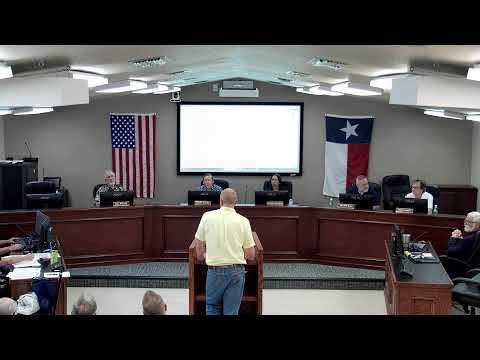
City of Haslet — At its July 29 meeting the City of Haslet Capital Improvements Advisory Committee unanimously approved minutes from the committee’s Jan. 28 meeting and voted to recommend that the City Council accept the biannual water and sewer impact-fee report and use available impact-fee funds for eligible projects.
City of Haslet — At its July 29 meeting the City of Haslet Capital Improvements Advisory Committee unanimously approved minutes from the committee’s Jan. 28 meeting and voted to recommend that the City Council accept the biannual water and sewer impact-fee report and use available impact-fee funds for eligible projects.
The recommendation follows a staff outline of the biannual impact-fee report and a newly completed draft update to the impact-fee study. City staff member Roman described the packet as “a standard, biannual item” and said the report includes supporting documents listing building permits and a summary comparing actual collections to projections. “I will give you a handout of those preliminary study results so you can get a little bit better familiar with it,” Roman told the committee.
Why it matters: Impact fees collected for water and sewer are restricted to projects that increase capacity for future growth. Roman told the committee the fund balance as of the reporting period was about $3.1 million for water and $1.5 million for sewer, for a combined total of roughly $4.6 million. He said those funds can be appropriated only for impact-fee–eligible projects identified in prior or amended studies.
Key details from the presentation and committee discussion: - Collection versus projection: Roman summarized that collections have trailed original projections, with water collections about 10% of what had been projected and sewer collections about 17% of projection figures cited in the packet. He also reviewed a longer-range comparison that showed an earlier projection of roughly 1,996 total building permits versus about 1,807 actually issued to date for the study period. Roman emphasized that the original growth projections date to earlier studies and that forecasting is inherently uncertain. - Study history and timing: The water infrastructure needs study referenced by staff was completed in February 2018; the sewer study was amended in 2021. Roman said a draft update to the impact-fee study was completed this week and staff provided committee members a handout of preliminary results. He recommended the committee review the draft before the full presentation. - Project lists and cost assumptions: The packet includes a draft list of candidate water and sewer capital projects, with an estimated-completion column to indicate relative priority. Roman said eligible portions of upsizing projects (for example, the added capacity of a 24-inch sewer line over an existing 12-inch line) are what can be recouped through impact fees. He said project costs in the draft have been inflated to reflect future construction costs and include estimated bond interest. - Schedule and next steps: Committee members asked for an earlier review of the draft study rather than waiting until the regularly scheduled November meeting. The committee arranged a special CIAC session in August to review the preliminary results; members planned about 45 minutes (30 minutes for presentation and roughly 15 minutes for discussion).
Formal actions and votes: - Approval of minutes: A committee member moved to approve the Jan. 28 minutes “as submitted,” another member seconded, and the committee voted to approve the minutes unanimously. (Individual roll-call votes were not specified in the transcript.) - Recommendation to City Council: A committee member moved that the committee recommend to the City Council that the city use the impact-fee fund balance for eligible projects and approve the draft recommendation letter dated July 24, 2025. The motion was seconded and carried unanimously.
What’s next: Staff will present the full draft impact-fee study at a future meeting after members review the preliminary handout; following committee approval the study and any proposed fee changes would proceed to City Council, which must follow the public hearing and adoption steps required by state law before any fee change is implemented.
All quotes and attributions in this story come from the meeting transcript of the City of Haslet Capital Improvements Advisory Committee meeting on July 29, 2025.