
Cumberland supervisors approve Greenridge landfill conditional use permit and host agreement after lengthy public hearing
Get AI-powered insights, summaries, and transcripts
Subscribe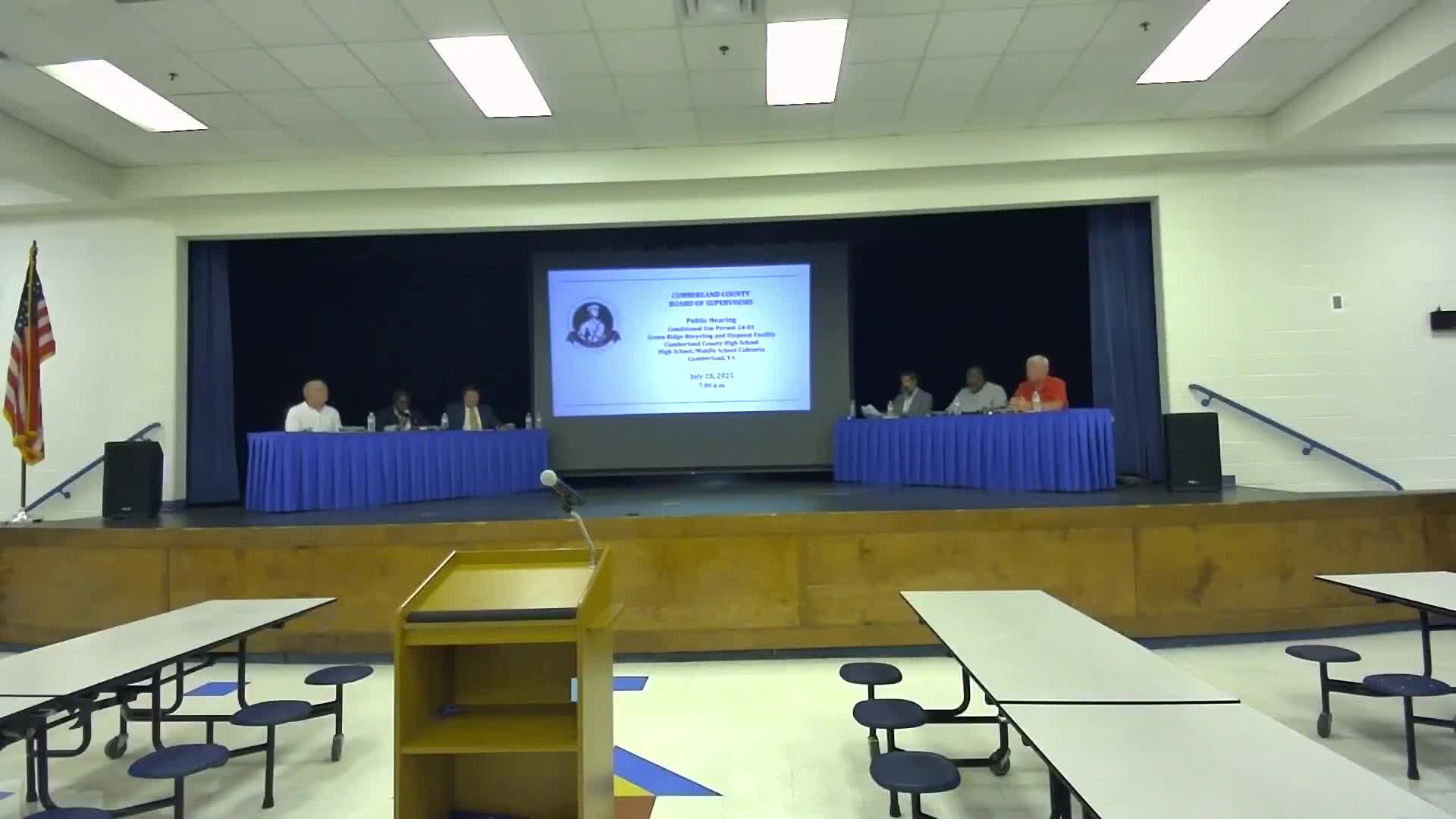
Summary
The Cumberland County Board of Supervisors voted 4–1 on July 28, 2025, to approve Conditional Use Permit CUP‑24‑01 and an accompanying host agreement for the proposed Greenridge Recycling and Disposal Facility, a private municipal solid waste landfill east of Pine Grove Road and north of Route 60.
The Cumberland County Board of Supervisors voted 4–1 on July 28, 2025, to approve Conditional Use Permit CUP‑24‑01 and an accompanying host agreement for the proposed Greenridge Recycling and Disposal Facility, a private municipal solid waste landfill proposed east of Pine Grove Road and north of Route 60 in Cumberland County.
The vote followed a multi‑hour public hearing, presentations from county staff and outside counsel, and a detailed presentation by the project team. Supervisor Hamlet voted no; Supervisors Newman, Tyree, Simpson and Saunders voted yes.
The CUP and host agreement set limits and conditions on size, operations and community protections. Stephanie Johnson, Cumberland County planning director and zoning administrator, told the board the project parcel group covers 15 parcels totaling approximately 1,143.8 acres and that the application, if granted, would replace an earlier 2018 CUP for the site. Will Shoemake, representing Greenridge (Wood Rodgers), described the operator’s commitment to accepting only Virginia waste and to a phased, lower‑scale project compared with earlier proposals. “Greenridge will only take Virginia waste, ensuring capacity for its residents for years to come,” Shoemake said.
Why this matters
The approvals would allow a privately operated nonhazardous municipal solid waste landfill on largely industrial‑zoned land subject to strict local conditions and a contractually required host agreement. The project includes community benefits (a convenience center and payments to the county), long‑term operational and closure obligations, and monitoring and enforcement provisions the county says are intended to protect residents and county interests.
Key terms approved
- Site and footprint: The application covers 15 parcels totaling about 1,143.8 acres. The CUP limits the active disposal boundary to a maximum of 350 acres; the initial phase of active disposal is limited to about 104 acres.
- Tonnage limits: The CUP caps daily deliveries to the Pine Grove Road entrance at 1,500 tons per day. If a future Route 60 entrance is built and approved, the permit allows a higher maximum of up to 3,500 tons per day under expanded, phased approvals.
- Service area and unacceptable waste: The CUP and host agreement narrow the facility’s service area to named Virginia localities and prohibit specified unacceptable wastes (hazardous wastes, sludge, fly ash and other categories listed in the permit language). County counsel and the applicant said the documents are intended to restrict receipts to in‑state waste and to strengthen definitions and inspection requirements.
- Community benefits and payments: The host agreement includes a per‑ton host fee (presented by Greenridge as $1.65 per ton, escalating 3% annually), a minimum annual payment of $400,000 (also escalating 3% annually), a one‑time payment of $200,000 to the county within 90 days of final approval, and an annual payment of $125,000 (escalating 3% annually) to fund a county‑designated landfill liaison/engineer to monitor construction and operations.
- Convenience center and county transfer stations: The CUP requires a convenience center on the site for Cumberland residents to dispose of household waste and recyclables (some items free; tires and certain materials may carry a fee). The host agreement obligates the applicant to service existing county transfer stations and to accept some materials from those stations.
- Environmental and monitoring requirements: The CUP requires DEQ and federal permits prior to major construction activity, groundwater and surface‑water monitoring, leachate management prohibitions in certain areas on the master plan, and a post‑closure monitoring regime that extends for decades. The applicant must post closure and post‑closure financial assurances before operations begin; the CUP’s post‑closure obligations run until DEQ confirms completion of post‑closure responsibilities.
- Buffers, setbacks and visual screening: The CUP includes expanded buffer and setback requirements (including a 300‑foot minimum setback from residences existing at the date of the site purchase, a 500‑foot setback from drinking‑water wells existing at approval, and setbacks from perennial streams identified by the U.S. Army Corps) and requirements for maintained vegetative screening.
- Traffic and roads: The CUP and host agreement require the applicant to construct required improvements to Route 60 or other VDOT‑required work at the applicant’s expense. The CUP limits Pine Grove Road use and requires an agreed schedule to pursue a permanent Route 60 entrance; the applicant must repair any damage to Pine Grove Road caused by construction or operations in coordination with VDOT and the county.
- Community liaison and complaints: The applicant must establish a community liaison to receive and track complaints (odor, birds and similar operational impacts) and upload complaint records to a project data room accessible to the county. The CUP also requires an engineer/liaison for county oversight funded by the applicant.
What county staff and outside counsel told the board
Gentry Locke land‑use counsel (presented by an attorney identified in the hearing as Scott, with Charlie Williams also credited on the review team) described the CUP conditions and the statutory basis for a host agreement under state law. Counsel said the host agreement is a statutorily contemplated, enforceable contract that supplements zoning conditions by addressing financial compensation, traffic, monitoring, limits on daily disposal volumes, and county access for independent verification of environmental sampling.
Counsel said many CUP provisions were negotiated to be more restrictive than the 2018 permit the county previously issued, including a smaller maximum disposal footprint (the new CUP reduces disposal acreage from previously approved figures) and enhanced enforcement, inspection and remediation language designed to provide the county remedies short of prolonged litigation in the event of environmental harm.
Public comment and board members’ concerns
The board heard more than two hours of public comment. Opponents — including residents, the AMMD Pine Grove Project representatives and local preservation advocates — raised concerns about groundwater contamination, property values, traffic, visual impacts, risks to the Pine Grove and Luther P. Jackson historic schools, and long‑term enforcement if the operator changes ownership. Several speakers urged a public referendum.
Supporters — including speakers with experience working with landfills in other counties — said localities often use host fees and tipping‑fee revenue to fund public safety, schools and county services and that modern liner systems and monitoring reduce risks compared with older unlined facilities. The applicant and its consultants argued the design includes advanced double composite liners, gas‑management and leachate systems, daily cover, and DEQ oversight; they pointed to the reduced footprint and other concessions negotiated with the county.
Formal actions and votes
- Conditional Use Permit CUP‑24‑01 (Greenridge Recycling and Disposal Facility): Motion to approve the CUP passed 4–1 (Supervisor Hamlet — No; Supervisors Newman, Tyree, Simpson and Saunders — Yes). Outcome: approved.
- Host agreement associated with CUP‑24‑01: Motion to approve the host agreement passed (vote recorded as Yes by Supervisors Newman, Tyree, Simpson and Saunders; Supervisor Hamlet recorded as dissenting earlier on the CUP vote). Outcome: approved.
Both actions as approved include the full set of conditions and the financial and monitoring commitments described to the board and in the CUP document presented by staff.
Next steps
After the approvals the board set the date of its next meeting (the board indicated an adjournment and the next regular meeting date was listed on the public agenda). The CUP approval does not substitute for state permitting: the applicant must obtain required DEQ and other state and federal permits and post required bonds and financial assurances before constructing landfill cells or commencing operations.
Context and caveats
The board’s approvals are local land‑use and contractual actions. Several elements of the project remain subject to separate review and permitting by state agencies (notably the Virginia Department of Environmental Quality and VDOT for access and road work). The CUP and host agreement contain enforcement and remediation pathways the county says are intended to provide remedies for impacted private property owners, including restoration, negotiated mitigation or a purchase offer at 125% of fair market value in defined contamination scenarios; the CUP also ties some expansions to additional permitting, traffic studies and local approvals.
The public hearing and board debate made clear sharp division among residents: many urged denial or a referendum, while others recommended accepting the financial and service benefits under the strengthened CUP and host agreement. The county’s final ability to enforce environmental protections will depend on the permit conditions, state permitting, and any subsequent legal challenges or changes in ownership of the facility.