
Council opens discussion with Buffalo Sewer Authority on rising sewer costs, requests detailed financial report
Get AI-powered insights, summaries, and transcripts
Subscribe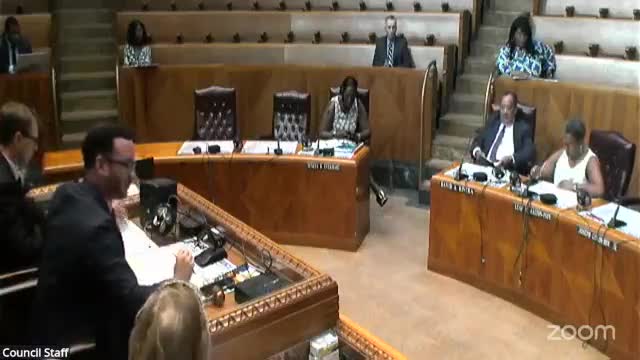
Summary
Buffalo City Council opened a discussion with the Buffalo Sewer Authority on the authority’s finances and rising sewer costs, asking the authority for a detailed financial report and clarification of recent rate changes and capital spending.
Buffalo City Council opened a discussion with the Buffalo Sewer Authority on the authority’s finances and rising sewer costs, asking the authority for a detailed financial report and clarification of recent rate changes and capital spending.
The discussion, introduced when councilmembers removed item 3 from the table, centered on capital projects at the Bird Island treatment facility, deferred maintenance across the combined sewer system, recent rate increases and how state and federal grants have been used.
Councilmember Ryan, who introduced concerns about transparency around the authority’s budget, said councilmembers and residents have been surprised to learn of major cost increases after budgets were adopted and asked the authority to provide more proactive financial briefings. “These costs are going off the chart, and it’s something that’s unmanageable,” Ryan said.
Rosalie Noble, principal sanitary engineer for the Buffalo Sewer Authority, told the council the authority has a combined sewer system with aging components—some dating to the 1930s—and a treatment plant at Bird Island that requires major upgrades. “We are investing a quarter‑billion dollars in making those updates to that treatment facility,” Noble said, adding that parts of the plant were rebuilt in phases and more work remains. Noble said those upgrades and federally and state‑mandated biological (secondary) treatment drive energy and capital needs.
Charles Riley, executive secretary for the Buffalo Sewer Authority, discussed the authority’s capital spending and reserves. Riley said BSA uses reserves for capital projects rather than operating expenses and that recent and upcoming capital work has significantly increased projected debt service. He said debt‑service costs are expected to rise by about $3,000,000 in the current fiscal year compared with the prior year; he added that BSA has used financing through the New York State Environmental Facilities Corporation and seeks grants and forgivable loans to reduce ratepayer impact.
A BSA staff member identified only as Jolene said the authority had not increased rates for roughly 18 years before a recent increase, and that prolonged periods without incremental rate adjustments contributed to spending down reserves. “We went 18 years without a rate increase,” Jolene said. BSA staff said last year’s rate action followed extended flat rates and that inflation, higher energy and chemical costs and long‑term control plan obligations have increased operating and capital costs.
Councilmembers pressed for specifics about reserve balances and program funding. BSA provided the following figures in response during the meeting: the authority reported an internal enrollment of 1,979 residents in its low‑income discount program and 4,453 enrolled in a senior discount program; the authority received $850,000 in an American Rescue Plan (ARP) amendment allocated in July 2023; and some previously designated ARP capital allocations (originally $40,000,000 for a “smart sewer, smart water” buildout split between sewer and water) were partially withdrawn or repurposed, with $11,100,000 and $14,084,808 noted in the discussion as amounts reallocated under successive amendments. BSA staff said reserves exist but were not sufficient to cover the authority’s long‑term control plan obligations; they did not provide a precise current reserve balance on the record and said they would supply those numbers to the council.
On rates and billing, staff said the current fiscal year includes a 3% increase on sewer rents based on water use, which staff estimated would equal roughly $2 per quarter for most ratepayers. Staff also said a levy for sewer rents based on assessed value increased from about $24,900,000 to about $29,900,000 after a citywide reassessment and that, using a median owner‑occupied value, the net effect under the assessed‑value levy component would be a decrease for a typical homeowner because the per‑$1,000 levy rate declined from $1.99 to about $1.02 per $1,000.
Councilmembers noted that Buffalo is surrounded by water but that treatment and sewer system protection have costs: Noble said the system is a large electricity user because biological treatment requires high‑capacity blowers and that upgrades to diffusers and blowers—while capital‑intensive—are intended to improve energy efficiency over time. She cited work at Cornelius Creek and Black Rock Park to prevent river and lake water from overwhelming the sewer system during storm events.
Councilmembers asked for a timeline and more financial detail before future budget approvals. Councilmember Bailey asked specifically whether the sewer authority has reserves and how much, and Riley and other BSA staff committed to providing those numbers. Councilmembers also discussed the authority’s governance: Noble said the BSA board is appointed by the mayor and confirmed by the council, and the board appoints the general manager; since the general manager resigned on Dec. 31, the principal sanitary engineer and the executive secretary are handling technical and financial responsibilities, respectively.
The council opened the item for discussion; a motion to table further action was made during the meeting, and councilmembers later moved to receive and file multiple items including cash‑flow reports. The transcript does not record a final roll‑call vote on the separate resolution requesting a detailed financial report; councilmembers requested that BSA return with the requested financial details and supporting documentation.
Ending
Councilmembers said they want BSA and Buffalo Water to present financial and rate information to the council in advance of future budget or rate decisions so elected officials can review impacts on residents. BSA staff agreed to provide reserve and debt figures, a breakdown of grant and ARP use, and enrollment numbers for affordability programs so the council can review those materials before voting on related budget items.