
Committee approves sending excavation and pavement-disturbance ordinance amendments to full council
Get AI-powered insights, summaries, and transcripts
Subscribe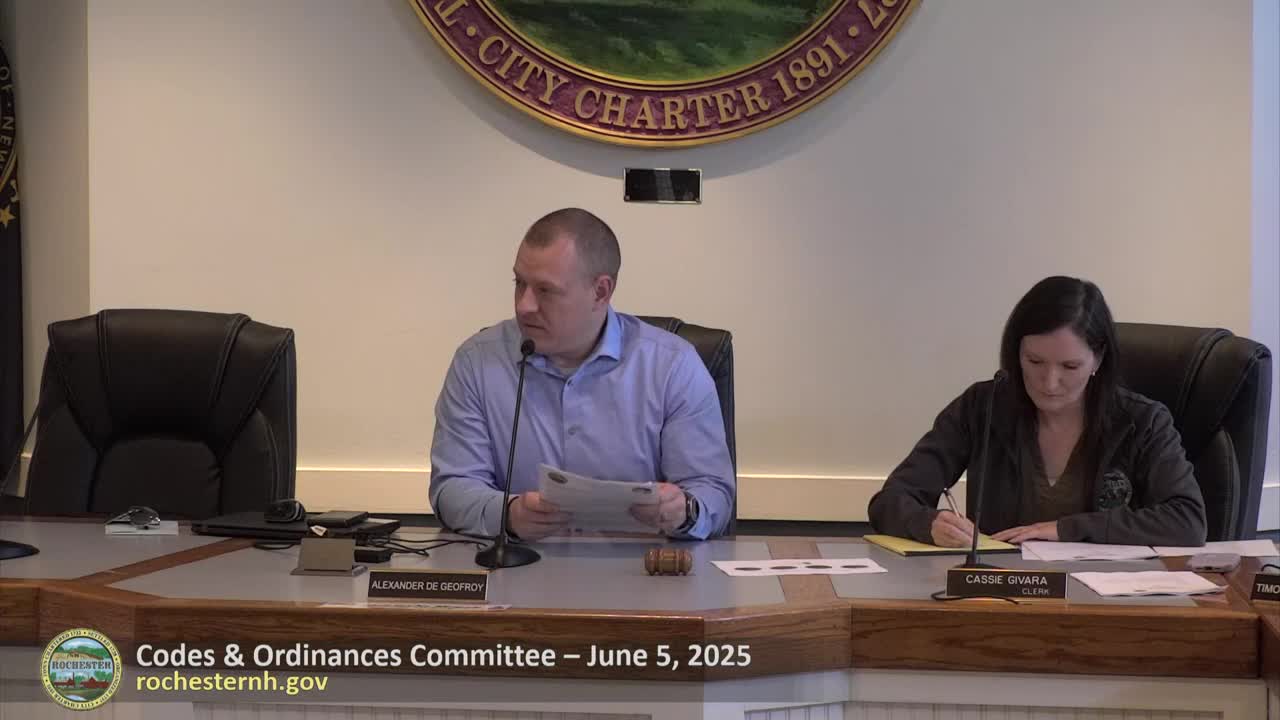
Summary
The Codes and Ordinances Committee voted June 5 to forward amendments that tighten seasonal permit windows, set annual permit expirations, and clarify security (surety) amounts for work in city rights-of-way.
The Codes and Ordinances Committee of the City of Rochester voted June 5 to send to the full City Council proposed amendments to the city’s excavation and pavement disturbance moratorium ordinance, which staff say will better align the written rules with current Public Works practice.
The changes, presented by Deputy Director Gretchen Young of the Public Works Department, are intended to reduce the number of open trenches and pavement restorations that carry over into winter months and to clarify how the city sets financial security for restoration work.
Deputy Director Gretchen Young said the packet proposes four cleanup changes. “Permits will not be normally issued between December 1 and March 31 unless determined solely by the department to be an urgent need,” she said, and added, “All trench restorations must be complete no later than December 1.” Young told the committee the winter restriction reflects the seasonal closure of pavement plants and the department’s limited ability to obtain pavement during those months.
The draft also would make all right-of-way permits expire on December 31 each year so contractors doing multi-year projects must reapply annually; Young said that matches the city’s construction-licensing calendar and “encourages contractors to wrap up before the winter.” The pack also clarifies security (sometimes called surety) calculations: the department currently bases security on average pavement-restoration costs (Young said the working implementation is about $7 per square foot) and proposes a $500 minimum security with a $5,000 floor for work in moratorium-designated roads.
Young said the language would remove a clause that previously guaranteed a delinquent contractor might be granted future permits if they furnished security. “Adequate security is going to be furnished by any permittee,” she said, “and it does not guarantee that a delinquent contractor is gonna be given a license or be allowed to do work just because they posted that security.”
Councilor Hammond moved to accept the amendment and forward it to the full council; the motion was seconded and the committee voted to pass the package. Councilors asked whether staff had consulted major contractors affected by the changes. Young replied she had not run the cleanup language by contractors specifically because the text largely reflects current practice, but said, “the good contractors know that we are looking to finish up the work before the winter, so that makes sense to them.”
The ordinance language will be added to a full council agenda for further consideration.
Less critical details: staff said the permit fee is nominal (about $100) and is charged annually for multi-year work; examples of multi-year projects discussed included large roadway work on Old Gonic where a contractor (referred to as Severino) has returned across seasons.