
Board adopts policy revisions to comply with recent state laws; administrators recommend waiving second readings
Get AI-powered insights, summaries, and transcripts
Subscribe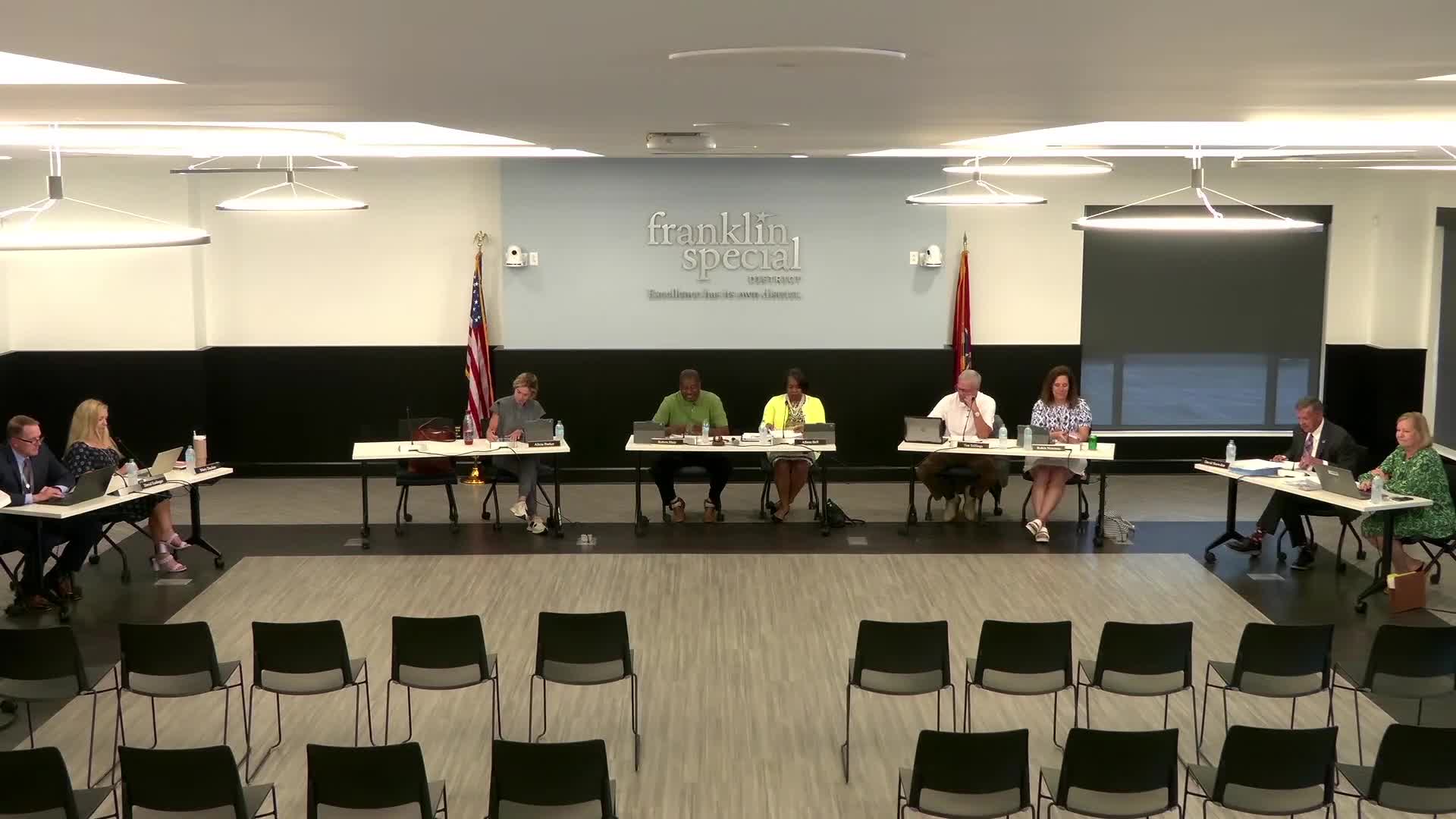
Summary
The Franklin Special District School Board approved first readings of a broad set of policy revisions—many based on new state laws and TSBA model language—including updates on service animals, records access, virtual education, library materials and internet use, and definitions tied to anti-discrimination requirements.
The Franklin Special District School Board adopted first readings for a slate of policy revisions the administration said are required by recently passed state laws and updated model policies from the Tennessee School Boards Association (TSBA).
Doctor Snowden told trustees that legislators passed numerous education-related bills this session and that the district is recommending adoption of policies required by law. He said, “A lot of the policies [are] as required by law, just TSBA's interpretation of what that law means.” The administration proposed adopting required policies on first reading and waiving the second reading for efficiency, while allowing the board to request a full second reading where members preferred.
Policies presented and adopted on first reading included new or revised rules on service animals and a therapy dog program, public records access (removing fax as an allowable submission method per Public Chapter 94), educator diversity and personnel goals (changes tied to Public Chapter 494), charter school application reporting (Public Chapter 275), surplus property thresholds, emergency preparedness and fire-drill requirements (Public Chapter 315), threat-assessment reporting timelines, curricular definitions to include antisemitism (Public Chapter 293), virtual education attendance rules (Public Chapter 484), interscholastic athletics for virtual students (Public Chapter 173), library materials policies related to religious content, the Teen Social Media Act internet restrictions (Public Chapter 195), reporting student progress and screeners (Public Chapter 330), family and medical leave changes (Public Chapter 235), substitute teacher and retiree reemployment rules (Public Chapter 159), search-and-seizure training requirements (Public Chapter 244), wireless device rules, student wellness and recess requirements, and timelines for transferring student records (Public Chapter 156).
Board members asked procedural and operational questions as each policy appeared. On the topic of virtual students and athletics, trustees asked whether the district tracks how many students currently participate in virtual programs; administrators said that number was not known. On internet and social media restrictions, administrators noted district technology systems (for example, GoGuardian) already implemented many of the required content controls.
Why it matters: Many of these revisions are responses to statutory changes and will alter district procedures in areas that include student privacy and safety, curriculum definitions, staff employment practices, and day-to-day operational rules such as recess minutes and fire-drill scheduling.
Process: The administration repeatedly recommended adopting required policies on first reading and waiving the second reading; board members said they could request a second reading if they wanted more time. The administration also flagged areas where legal clarifications (including potential Attorney General opinions) may prompt future policy changes.