Get Full Government Meeting Transcripts, Videos, & Alerts Forever!
Get email alerts on the Property Taxes topic
No spam. Unsubscribe anytime.
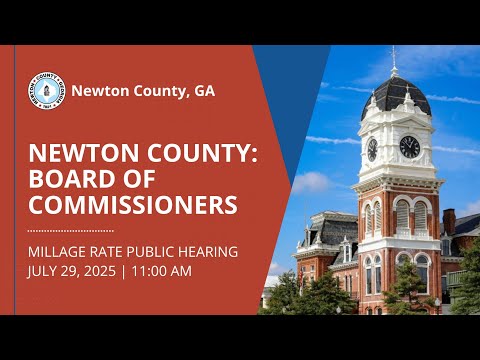
Newton County holds first public hearing on tentative 10.31% property tax increase
Summary
Newton County held the first of three public hearings on a tentative property tax increase after county staff announced a tentative millage rate of 8.567 mills — an increase of 0.801 mills, described by county staff as a 10.31% tax increase.
Newton County held the first of three public hearings on a tentative property tax increase after county staff announced a tentative millage rate of 8.567 mills — an increase of 0.801 mills, described by county staff as a 10.31% tax increase. County officials said the tentative rate would raise about $100.93 in property taxes for a homeowner with a fair-market-value home of $325,000 and about $96.12 for a non‑homestead property with a $300,000 value. The commission scheduled the remaining hearings for July 29 at 6 p.m. and Aug. 5 at 6:30 p.m.
The announcement drew a string of public comments from residents who said the increase would hurt seniors, disabled residents and those on fixed incomes and asked for clearer detail about how the funds would be used. “We don't have no extra money,” said John Dobbs, identifying himself as a Covington resident, adding that Social Security and Medicare increases leave seniors with less disposable income. Several speakers asked why taxes were rising while they said they saw no local improvements to roads or services.
The public questioning ranged from requests for a line‑item explanation of the increase to challenges about assessed values. One resident, identified as Doug, said his county tax bill had increased dramatically since 2017 and compared Newton County to neighboring Henry County, where he said senior homeowners do not pay school taxes. Multiple speakers asked whether relief exists for veterans, disabled people or seniors; Ronald Horn, who identified himself as disabled, asked explicitly, “Is there any relief for the disabled, the veterans, or the senior citizens with these tax breaks?”
Commissioners responded by stressing limits on the county's authority and by outlining drivers for the proposed increase. Commissioner Edwards said the county and the school system are separate taxing entities and that the county does not control school board levies. Edwards also listed budget increases the board had incorporated in the current proposed budget, including a $3,700,000 increase for employee salary adjustments, $1,500,000 for health insurance, $1,750,000 for contingency/new positions tied to SPLOST facilities, $1,000,000 for public bridge work and $750,000 for culvert replacement; she said those figures represented increases over the prior year.
Commissioner Mason referenced state legislation, House Bill 581, and its effect on local revenue. Mason said the law — passed by the Georgia General Assembly on March 28, 2024, and signed by the governor on April 18, 2024 — changed how much local governments can capture from rising property values and creates a cap that limits how much property tax revenue growth the county can realize from valuation increases. Mason described the caps as allowing homeowners to be taxed on only a portion of their property's valuation increase (she said 3% or 4% in the hearing as the applicable cap and asked the audience to correct her if she misspoke), and said that limitation forces incremental millage increases if the county is to sustain services.
Commissioner Long, who said she works in real estate, urged residents to check their property record cards on Newton County’s QPublic site and explained that the Board of Tax Assessors sets property values and the tax commissioner collects taxes. Long also said the commission is exploring whether senior exemption income thresholds should be adjusted so more seniors qualify for relief. Mason and other commissioners said staff would gather additional information about the school board's millage and meeting schedule so residents could address the school board directly.
No formal final adoption of the millage rate occurred at the hearing; the county described the millage as “tentatively adopted” pending the required public hearings and eventual formal action. The hearing closed after public comment and brief commissioner remarks.
The county provided the advertised estimate of the impact: a tentative millage rate of 8.567 mills (0.801 mills higher than the no‑increase rate of 7.766 mills) and an estimated $100.93 increase on a $325,000 home; the county said three hearings are required before final action.
Residents seeking more information were directed to the county’s budget hearings and the tax assessor’s offices and to attend or monitor the upcoming hearings on July 29 and Aug. 5.