
EMS ISD board adopts updated student code of conduct with new phone, discipline and antisemitism provisions
Get AI-powered insights, summaries, and transcripts
Subscribe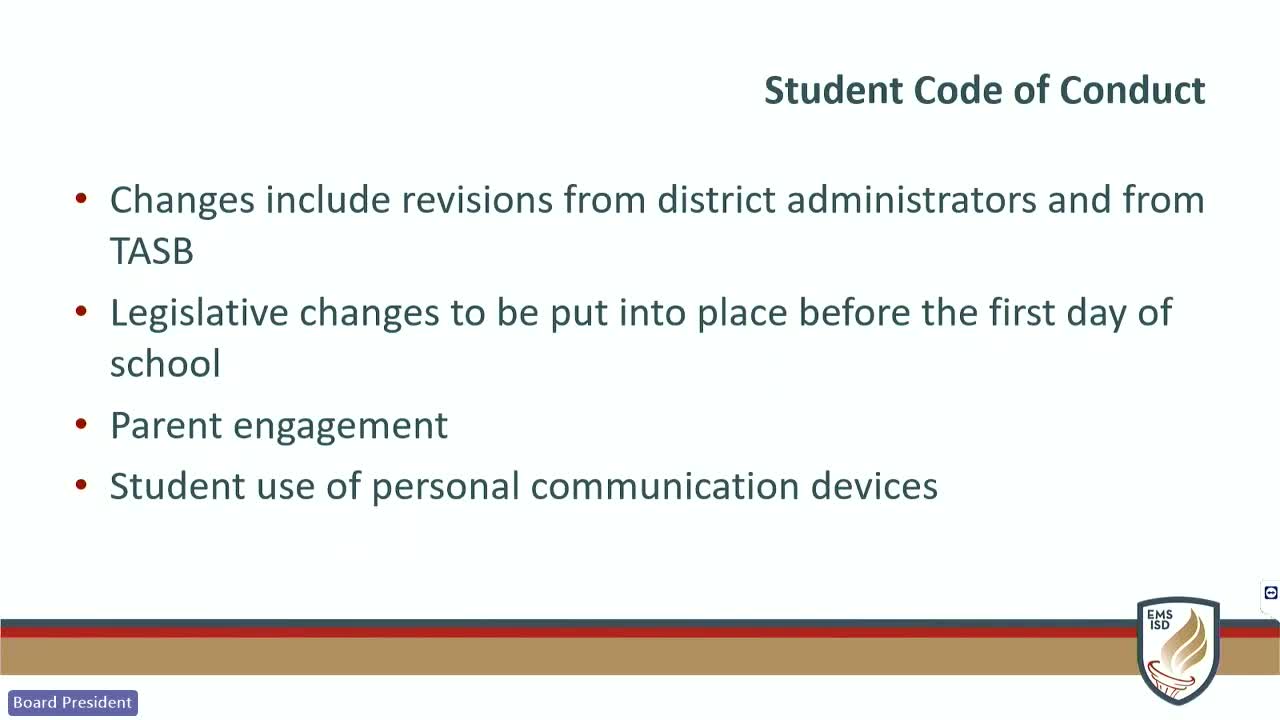
Summary
The Eagle Mountain Saginaw Independent School District Board of Trustees approved a revised student code of conduct on July 28 that incorporates legislative and TASB-driven changes, including a ban on student phone use during the instructional day, new discipline steps for nicotine delivery devices and a definition prohibiting antisemitic conduct.
The Eagle Mountain Saginaw Independent School District Board of Trustees approved a revised student code of conduct on July 28 that incorporates legislative changes and recommendations from TASB.
The code adopted by the board includes new language on parent engagement, a districtwide prohibition on student use of personal communication devices during the school day and the discipline consequences that can follow. “In our district, the students must not use cell phones at school during the school day. They have to be put away during the school day,” Dr. Waters told the board during the education services report.
Why it matters: Trustees and staff said the changes align the district with recent state requirements and with TASB guidance while giving principals and teachers clearer steps for enforcing expectations. School leaders said consistent enforcement across campuses will be a focus as the year begins.
What changed: Presenters identified several specific legislative and administrative changes being added or clarified in the 2025–26 code of conduct. They include: - Student personal communication devices: Students must keep phones and similar devices put away during the instructional day; consequences can include confiscation, and the code explains the process for handling confiscated devices. - Nicotine delivery products: First-offense discipline for possession of nicotine delivery products (electronic cigarettes) no longer automatically requires mandatory disciplinary alternative placement (DAP). - In‑school suspension (ISS): ISS is no longer limited to a fixed number of days; placements longer than 10 days must be reviewed every 10 days. - Out‑of‑school suspension (OSS): OSS is permitted for students below third grade under certain severe circumstances, though speakers emphasized it is not expected to be common. - Assault on a school employee: The code makes assaulting a school employee a mandatory expulsion offense where applicable; prior policy treated this as discretionary in some cases. - Virtual expulsion and online instruction: The code includes language about potential virtual expulsions for remote instruction in appropriate cases. - Antisemitism: The code now includes a definition of antisemitism and a prohibition on conduct motivated by it.
District rollout and enforcement: Staff said the redlined changes will be highlighted when the district sends the student and parent handbook to families and that principals will review significant changes with students and staff in early-year assemblies. Dr. Waters told trustees that schools will use principals’ communications, campus disciplinary meetings and district messaging to emphasize the new device rules and other changes.
Board action: The board voted to approve the 2025–26 student code of conduct as presented. The motion to approve carried 6–0.
Discussion points recorded: Trustees asked how the district will define the instructional day (staff answered it is between the first and last bell for each campus), how the phone rules apply during off-campus trips and athletic travel (staff said the leadership team is defining those logistics), and how the district will notify families about the changes (staff said ParentSquare and other district communications will be used).
What the code does not do: Presenters and trustees were careful to note that the code sets local procedures; it does not create new state law. Where the transcript referenced “legislative changes,” the board’s action reflected the language as forwarded to the district by TASB and by staff.
Next steps: The code will be distributed to families, and campus leaders will review the changes with students and staff at the start of the 2025–26 school year.
Ending note: Board members and staff emphasized the goal of consistency across campuses: trustees said they wanted similar enforcement at each school so families experience predictable application of the new rules.