Get Full Government Meeting Transcripts, Videos, & Alerts Forever!
Get email alerts on the Behavior Policy topic
No spam. Unsubscribe anytime.
Library trustees review updated behavior policy; discussion centers on enforcement, odor and supports for patrons
Summary
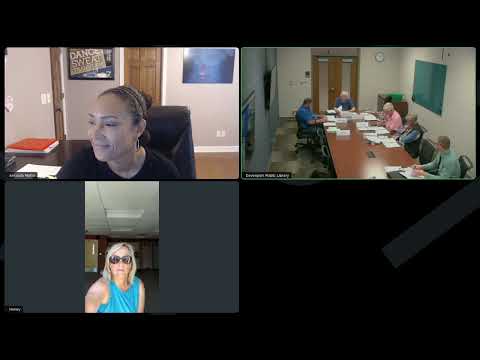
The Davenport Public Library Board of Trustees spent substantial time July 15 discussing a proposed update to the librarybehavior policy, a slated three-year review that staff said is required for accreditation by the State Library of Iowa.
The Davenport Public Library Board of Trustees spent substantial time July 15 discussing a proposed update to the librarybehavior policy, a slated three-year review that staff said is required for accreditation by the State Library of Iowa. Staff described the revised policy as clarifying prohibited behaviors, enforcement steps and appeal routes, and said the updated version expands the number of offense categories from the simplified eight used in prior years to roughly 18 categories.
Jeff (staff member) told trustees that the policy is "one of four core policies that are actually required by the State Library of Iowa, for our accreditation," and outlined enforcement tools: staff notice and coaching on first contact, a graduated range of suspensions (from a day to a year depending on severity), an automatic 30-day ban for incidents involving alcohol or drugs, and referrals to law enforcement when a suspended patron returns and staff request a trespass notice. He said patrons may appeal suspensions to the director or assistant directors and then to the board during a regular meeting if they remain dissatisfied.
Trustees pressed staff on how particular provisions would be implemented. Trustee Julie (trustee) asked how the policy would be applied in the childrenand-family spaces and whether the policy could unintentionally exclude people who rely on the library for basic needs. Jeff said legitimate, brief reasons to be in a childrenarea (for example, checking out a book for a child) would be accommodated; the policy is aimed at preventing behaviors that would put children at risk (for example, grooming or targeted approaches by a registered offender).
Trustees also debated a provision listing strong body odor or scents as a possible cause for staff intervention. Julie argued the odor language could be applied unevenly and might exclude patrons who lack access to hygiene services; other trustees stressed the need to balance access for all patrons with protecting library users when odors are sufficiently strong to prevent others from using the space. Jeff explained staff have been addressing odor under the prior policyand that the updated text is an attempt to give clearer guidance.
Board members asked about unattended belongings; Jeff said unattended items are placed in lost-and-found and retained for 30 days unless they contain hazardous material, in which case staff would follow appropriate disposal or safety procedures. Trustees urged that staff handle such interactions empathetically and offer resource referrals when appropriate. One trustee asked whether the library could restore a social-worker position funded previously by ARPA to help with outreach; staff said that ARPA funds are no longer available and the library does not currently have funding for that role.
On security, staff said the library contracts security personnel at the main library for about 40 hours per week while the building is open roughly 53 hours; staff said they will request additional contracted hours in the next contract renewal. Jeff also noted staff training on customer service and homelessness (including work informed by trainers such as Ryan Dowd) and use of internal reporting tools for conduct incidents.
No formal vote was taken; trustees asked staff to revise the draft (staff acknowledged some typographical errors in the packet) and return with a corrected policy for action at a future meeting.
Why this matters: the policy governs who can use library facilities and how staff enforce conduct rules; changes could affect people experiencing homelessness, caregivers in children's spaces, staff safety and the library's accreditation status. The board directed staff to refine the draft and bring it back next month with clarifications and corrections.
Ending: Trustees did not finalize the policy on July 15 and asked staff to return with corrected text and additional implementation details, including data on how often staff handle odor/cleanliness incidents and proposed security-hours adjustments.