Get Full Government Meeting Transcripts, Videos, & Alerts Forever!
Get email alerts on the Victim Notification topic
No spam. Unsubscribe anytime.
Legislature advances requirement that plea agreements include proof victims were notified
Summary
Bill 106‑38 would require courts to accept plea agreements only when the prosecution supplies documented proof that victims were notified; the committee added a floor amendment to allow either the Attorney General’s crime‑victim response unit or the prosecutor assigned to the case to certify notification.
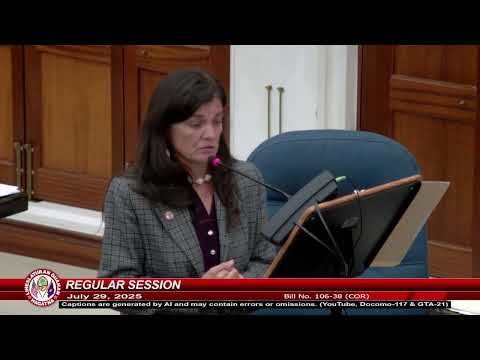
Senator Parkinson (bill sponsor on floor) moved to place Bill 106‑38 on the third‑reading file, describing the bill as amending Guam law to require that no plea agreement be accepted by a court unless the prosecution provides reasonable documented proof that the victim has been notified. Sponsors and supporters framed the measure as a guardrail to prevent victims from being blindsided by plea outcomes and to formalize existing practices used by the Attorney General’s Victims’ Response Unit.
Why it matters: Supporters said victims’ advocates and trauma‑informed practitioners report that victims can be re‑traumatized when they are not informed about plea outcomes or do not have an opportunity to express their views before a court accepts a plea. The bill requires documented proof that either the AG’s crime victims response unit or a prosecutor assigned to the case certified that the victim had been notified or that reasonable efforts were made to notify the victim.
Committee and floor actions: The committee reported extensive hearings and testimony from victims’ advocates, Guam Behavioral Health and Wellness Center and the National Association of Social Workers (Guam chapter). At the committee’s suggestion, the floor adopted an amendment to expand the certification language so the required certification can be provided by either the Attorney General’s crime victims response unit or the prosecutor assigned to the case. That amendment was debated on the floor; a motion to reconsider the body's earlier objection to adding prosecutors failed and the amendment was adopted by recorded voice/hand count.
Supporters urged passage as a measure that formalizes victim notification practices and that would add a certification requirement to the plea process. Some committee testimony and floor discussion emphasized the role of trained victim advocates in communicating with victims, especially those with trauma, language or cultural barriers; proponents said the bill does not prevent victim advocates from being involved.
Outcome: The bill was ordered to third reading as amended in committee and on the floor. The floor adopted the amendment specifying that certification may be provided by the AG’s crime victims response unit or by the prosecutor assigned to the case.
What’s next: The bill will return for final consideration on third reading; if enacted, courts and the Attorney General’s office would need to adopt or document procedures for producing the required proof of notification before plea acceptance.