Get Full Government Meeting Transcripts, Videos, & Alerts Forever!
Get email alerts on the Unclassified Employment Transparency topic
No spam. Unsubscribe anytime.
Legislature advances bill requiring biannual public reports on use of unclassified government hires
Summary
Bill 16‑38 would require all branches, agencies and public corporations of government to report twice a year on unclassified hires occupying classified positions, including position title, pay grade/step, salary and justification why the merit system was impracticable; sponsors framed the measure as transparency to protect the merit system.
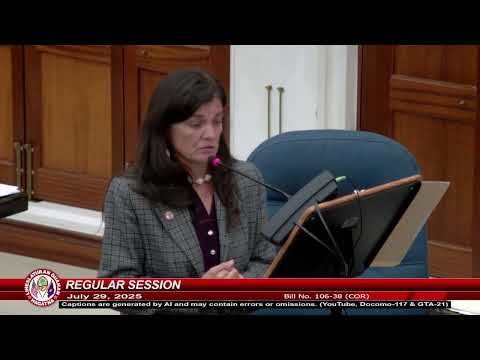
Senator [author present on floor] moved to place Bill 16‑38 on the third‑reading file and described it as a transparency measure requiring biannual public reporting on the use of unclassified employment across government. The bill would require branches, agencies, autonomous agencies, instrumentalities and public corporations to report: position title and number; pay grade and step; salary; and the reason(s) why it was not practicable to use the merit system for a given post.
Why it matters: Sponsors said the measure protects career (classified) employees by ensuring that agencies justify when they hire non‑competitive, unclassified personnel for roles typically filled through the merit system. Supporters referenced Guam’s Organic Act and a history of administrative and legal disputes over classification that have produced costly settlements.
Floor supporters — including members who chaired oversight hearings and the public auditor’s office — described the bill as a tool to identify patterns of noncompetitive hiring, deter abuse of unclassified appointments, and restore morale among classified staff. The public auditor’s earlier testimony was cited in committee as a key reason to require regular reporting.
Concerns and questions: Several senators noted the Department of Administration did not testify at the committee hearing and that the fiscal and operational impact on DOA was not fully addressed in the committee report. Senator Perez asked whether DOA had been consulted about implementation; the sponsor said the committee had sought DOA input and awaited its presence. Other senators suggested aligning the new reporting requirement with existing staffing‑pattern reporting in the budget law rather than creating duplicate or inconsistent obligations.
Outcome: The Legislature ordered Bill 16‑38 to the third‑reading file without objection. The bill remains subject to later debate on the floor and possible technical amendments to address DOA implementation and penalty or enforcement provisions.