Get Full Government Meeting Transcripts, Videos, & Alerts Forever!
Get email alerts on the Good Samaritan Immunity topic
No spam. Unsubscribe anytime.
Guam Legislature advances bill expanding Good Samaritan immunity to ambulance transport and bystanders
Summary
Legislators voted to move Bill 76-38 to third reading after debate and on‑the‑floor amendments to clarify that immunity applies only when emergency care is provided in good faith and without compensation; lawmakers discussed scope for private transport, obstetrical care and existing Guam statute protections.
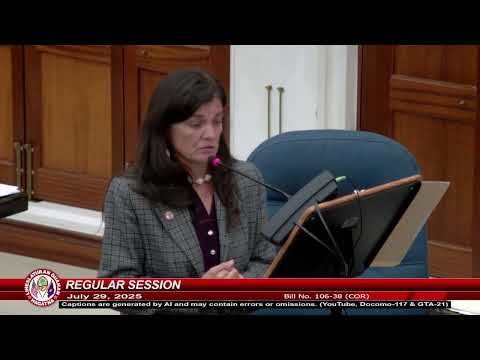
Speaker Frank Blasch, the bill’s author, moved Wednesday to place Bill 76-38 — a proposal “to add a new subsection 2104.1 to article 1, part 1, chapter 2, title 20, Guam Code Annotated relative to emergency care immunity from liability” — on the third‑reading file and opened floor discussion. The measure would expand civil immunity for people who render emergency medical assistance in good faith, including bystanders, CPR‑trained individuals and emergency responders, and would explicitly extend protections during transport to medical facilities.
Why it matters: Supporters said the change reduces hesitation to offer life‑saving aid and fills a gap they say exists in local law for care rendered while a patient is in transit. Opponents and some agency witnesses cautioned the bill’s language could unintentionally shield regulated private companies or medical providers who operate for pay.
On the floor, Blasch said the bill “provides immunity, protection from liability, for primarily those individuals that provide and render emergency medical assistance in good faith,” and he emphasized the expansion to cover care “during transport” as the central change. He also said the definition of good faith in the measure is tied to the absence of gross negligence: “good faith is the absence of gross negligence,” he said, adding that he had consulted the Criminal Law Revision Commission and the Attorney General’s office on that definition.
Senators supporting the bill pointed to examples in other U.S. jurisdictions and urged protections for volunteers and trained responders. Senator Tietaly said federal and state analogs “provide immunity from emergency medical aid and AED … assistance must be given without the expectation of compensation.” Senator Cowell said the bill “does not protect reckless or malicious behavior” and called it a balance between encouraging aid and protecting the public.
Several senators raised concerns about breadth. Senator Trelahi and others questioned whether the bill might apply to private ambulance companies or clinics that normally carry insurance and operate for compensation. The author and supporters responded by moving two floor amendments inserting the phrase “without compensation” in key subsections so that protections would clearly apply to unpaid aid; the amendments were adopted on the floor. Senator Law and Senator Chilayi asked whether amendments should instead expand the existing 20 GCA §2104 (the statute on persons rendering emergency assistance) rather than create a separate subsection, to avoid unintended coverage changes.
The Guam Fire Department and Department of Public Health and Social Services had testified during earlier hearings that some protections already exist under current law and departmental protocols; proponents of the bill said the measure clarifies coverage for modern EMS practice and for advanced lifesaving techniques applied in transport. Blasch cited operational gaps and emergency response capacity on the island, noting there were “only 6 ambulances” and referencing National Fire Protection standards that would call for more vehicles.
Outcome: On a motion by Speaker Frank Blasch, with no recorded objections on the floor, the Legislature ordered Bill 76‑38 placed on the third‑reading file as amended. The bill as amended adds the words “without compensation” in specified subsections and includes additional technical clarifications adopted on the floor; cosponsors were added during debate.
What’s next: The bill moves to third reading for final floor debate and a roll‑call vote. If enacted, agencies such as the Department of Public Health and Social Services and the Guam Fire Department would continue to play a role in implementing and interpreting standards for EMS care and transport.