Get Full Government Meeting Transcripts, Videos, & Alerts Forever!
Get email alerts on the Sheriff Oversight Committee topic
No spam. Unsubscribe anytime.
Riverside supervisors decline to form ad hoc civilian oversight committee for sheriff after heated public comment
Summary
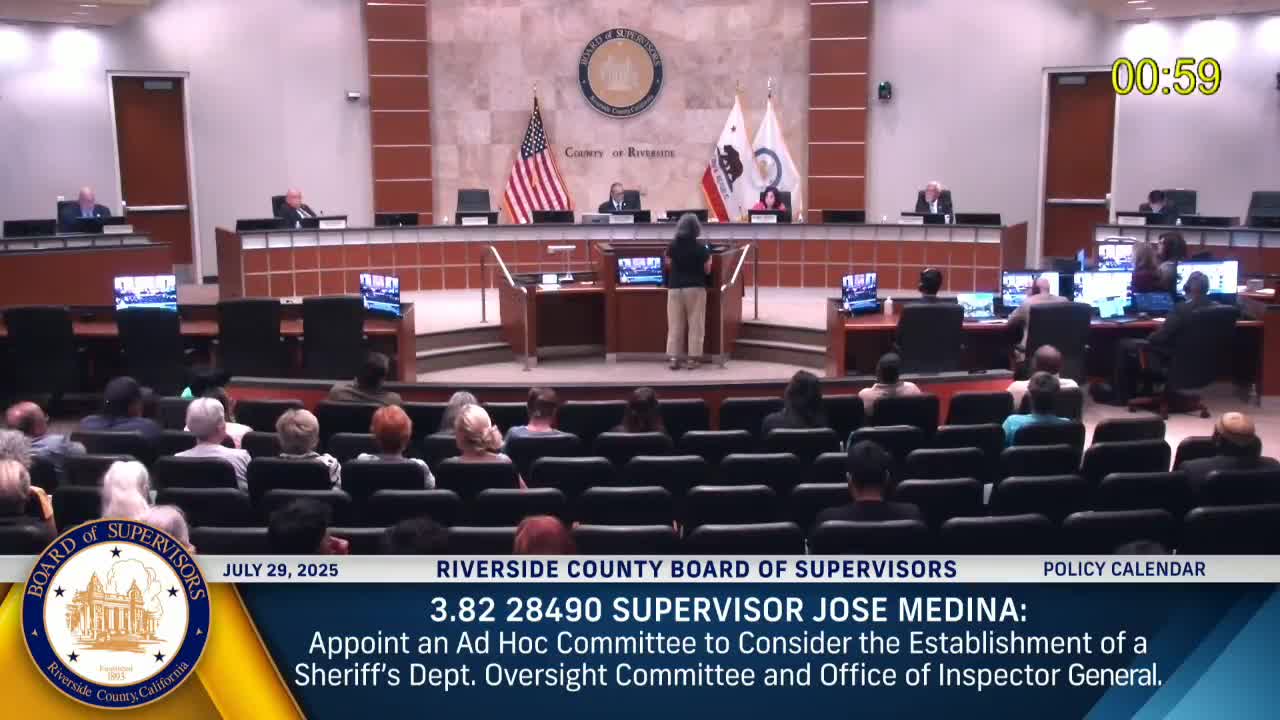
After hours of public testimony both for and against civilian oversight of the Riverside County Sheriff's Department, a motion to create an ad hoc committee died for lack of a second. Supporters urged accountability after numerous in-custody deaths; the sheriff and allied speakers warned of politicization and existing oversight.
A motion to form an ad hoc civilian oversight committee to study and recommend oversight structures for the Riverside County Sheriff's Department failed on the Riverside County Board of Supervisors on a voice check when no supervisor seconded the proposal following several hours of public comment and board discussion.
Proponents said the county needs independent review after what they described as a string of in-custody deaths and other incidents. "Oversight is a system of checks and balances that result in better law enforcement," said Deborah Wong during public comment. "I support the call for an ad hoc committee." Emma Lee, addressing the board as a community member, told supervisors: "We deserve and we demand real accountability and oversight, and you, the board of supervisors, can make this happen." Natalia Sacco, identified as the regional policy advocate with CHERLA, said immigrant communities fear disproportionate policing and called item 3.82 a step toward restoring trust.
Supporters cited local in-custody death figures and long-standing community distrust. Chris Castoreno, speaking from Banning, said "Since 2019, 68 people have died in our county jails, including 6 ruled homicides," and argued that an ad hoc group with clear authority is required. Brian Sanchez of the Inland Coalition for Immigrant Justice told the board that an oversight body could help rebuild trust so immigrant residents are willing to report crimes without fear.
Opponents, including the sheriff and several speakers representing or allied with the sheriff's office, described the motion as politically motivated and unnecessary. Riverside County Sheriff Chad Bianco told the board the county's law enforcement agencies face oversight from multiple existing entities and called the proposal a partisan effort. "There is a very specific reason that I am different from all of you. I am elected by the entire county for the specific and sole reason of providing law enforcement service to our residents that is completely free of politics and more importantly, political influence," Bianco said. He also disputed some numbers cited by commenters and defended the department's partnership with Riverside University Health System in providing inmate care.
Other commenters and several supervisors raised procedural and scope questions. Supervisor Karen Spiegel and Chairman Perez said they would have preferred more community and stakeholder engagement before forming a committee. Supervisor Spiegel asked about budget, subpoena powers and composition; she said she had not been consulted and noted the proposal appeared to have been finalized before broader outreach. Supervisor Jose Medina, who introduced the motion, said the ad hoc committee was intended to create a forum for discussion about structure, membership and goals, and he encouraged colleagues to join the panel.
Several law enforcement and union-affiliated speakers argued existing oversight mechanisms are sufficient. Ryan Sherman of the Riverside Sheriff's Association referenced state-level reforms, noting AB 1185 in Sacramento and listing federal and state oversight channels that can review jail practices. Members of the Riverside Sheriffs Community Advisory Committee and people who said they serve on local advisory groups also spoke in opposition or urged incremental approaches.
With discussions continuing among supervisors on whether more community outreach or different structures were needed, the board asked for further conversation rather than immediate formation of the ad hoc committee. When the chair asked for a second to Supervisor Medina's motion, none was forthcoming. "Seeing none, the item dies," the chair said, and the clerk recorded "Motion not carried." The board then moved to other business.
The item drew large public turnout: dozens of in-person and phone callers addressed the board, representing immigrant-rights groups, the NAACP youth council, family members of in-custody deaths, advisory-committee members, union representatives and other county residents. Speakers pressed a range of positions that supervisors cited in their deliberations as evidence the county is divided on how best to pursue accountability and transparency.
The board did not adopt any formal change to the sheriff's oversight structure at this meeting. Several supervisors said they wanted additional stakeholder conversations before taking action; Supervisor Medina said the issue would not disappear if the motion failed. "This issue will not go away," he said.
Votes at a glance: No formal vote on the motion occurred because the motion received no second and was declared "not carried."