Get Full Government Meeting Transcripts, Videos, & Alerts Forever!
Get email alerts on the Local Government topic
No spam. Unsubscribe anytime.
Supervisors trim planning appeal fee, eliminate online building fee and set mobile food truck/cart inspection rates
Summary
The board reduced the planning appeal fee to a minimal, flat amount intended to preserve public access to appeals, removed a separate online building‑permit fee schedule, and approved full cost recovery inspection fees for mobile food trucks while granting a 50% fee reduction for mobile food carts.
Butte County supervisors on July 29 approved changes to the county master fee schedule that cut the planning appeal filing fee for most routine appeals, eliminated a separate online permit fee schedule for building permits and set inspection fees for mobile food operations.
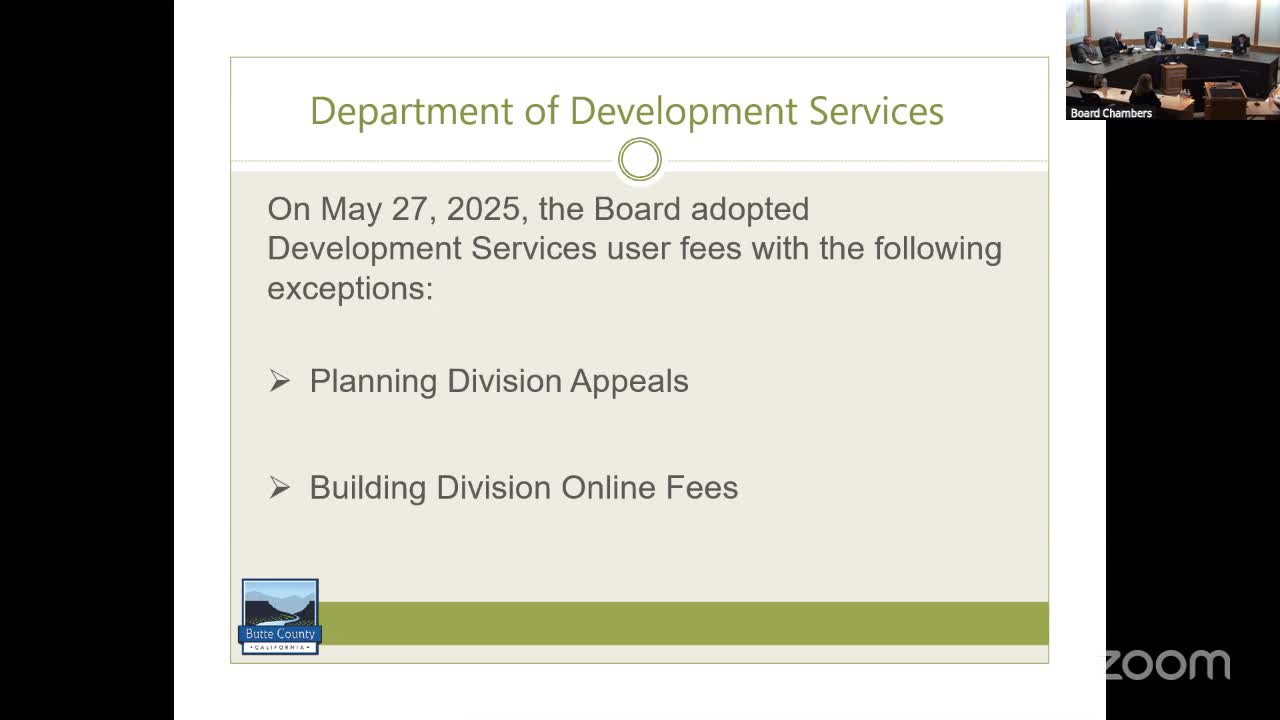
The Department of Development Services had presented data showing the average staff cost for processing planning appeals was about $4,700 when controversial projects requiring extra analysis were included. After board discussion, staff recommended — and the board approved — a lower, “bare minimum” fee ($16.72) intended to keep appeals affordable for neighbors and members of the public on simple cases while recognizing that more complex appeals can require far more staff time. Board members and county counsel discussed mechanisms to require additional deposits or hourly billing if an appeal’s actual costs exceed the initial payment; staff said the board can revisit the fee level after one year.
On building permits, county staff told the board the separate online fee schedule was originally set as an incentive to encourage digital submissions, but no reliable data showed online submissions consistently save staff time. The board voted to delete the separate online fee tier and adopt a single building fee schedule to reduce ongoing software maintenance costs.
Public Health presented a separate proposal to set inspection fees for mobile food operations. Environmental Health Director Elaine McFadden said the department requests full cost recovery for mobile food trucks because their equipment and menu types create inspection work comparable to restaurants. For mobile food carts, which have limited food preparation and equipment, the department proposed a 50% fee reduction to support economic inclusion. The board approved the Public Health resolution for mobile food operators.
Board members asked staff to return in a year with data showing how often appeals exceed the low fee and how frequently staff incur additional costs on appeals. Supervisors also emphasized that the lower appeal fee preserves public access to the appeal process while acknowledging the county’s general fund may absorb the incremental costs of higher‑complexity appeals.
The approved fee changes become effective Oct. 1, 2025. The board directed staff to update fee documents and provide an annual report on appeals, online submittals and mobile food operator compliance.