
Edmonds planning board backs most tree-code amendments but withholds support for fee formula and 20‑year replacement clause
Get AI-powered insights, summaries, and transcripts
Subscribe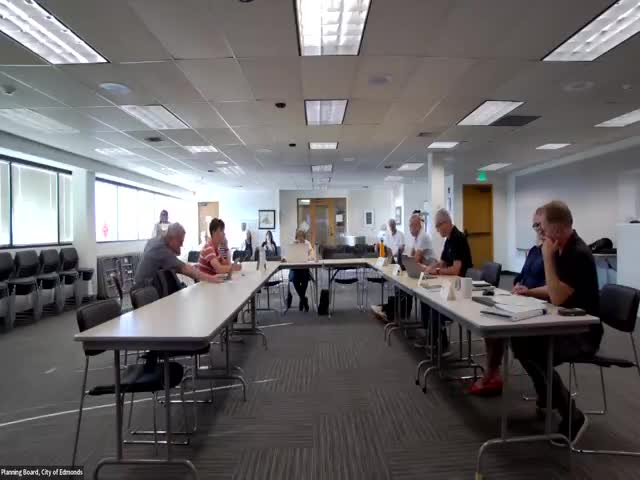
Summary
The Edmonds Planning Board unanimously recommended most minor amendments to the city's tree protection code after lengthy public comment, but delayed endorsement of a provision that ties mitigation calculations to a 20-year replacement expectation and a $2-per-square-foot cap on fee-in-lieu payments pending further information.
The Edmonds Planning Board on Aug. 6 recommended most of a package of minor tree-code amendments but unanimously withheld a recommendation on a single, substantive provision that would guide how the city calculates tree mitigation and caps fee-in-lieu payments.
The board voted to forward the draft code changes to the City Council while excluding paragraph 23.10.080(f) from its endorsement until staff provides further background about how the 20-year replacement expectation and the $2-per-square-foot fee cap were derived.
The issue attracted several public commenters and extended board discussion. Kathleen Sears, who identified herself as a resident and representing the citizen group Friends of Edmonds Trees, urged clearer, less vague language and proposed four specific edits to the draft. “The qualified professional must quantify their findings to the fullest extent feasible in support of the alternative calculation,” Sears read from her suggested wording, and she urged that peer review “shall undergo peer review” rather than be merely discretionary.
Residents also pressed the board about the fee-in-lieu, the composition and use of the city's tree fund, and whether peer reviewers would be hired by the city or by applicants. Planning staff explained the city maintains a tree fund (referenced in the draft code as ECC 3.95) and said the fund's balance is currently over $100,000 and may be used for vouchers, professional tree services, preservation and acquisition of wooded lands, planting on city properties and other tree-related initiatives. Staff also explained that certified arborists hired by applicants typically prepare on-site evaluations while the city contracts for peer review when needed; the cost of peer review is borne by the applicant.
Board members and public speakers raised specific concerns: - How the draft's mitigation math was derived, including a clause that would require a plan to show that 50% of the “environmental value” would be replaced on-site within 20 years; several board members said they needed the provenance of that 20-year timeframe and the formula used to reach it. - The effect of the $2-per-square-foot cap on fee-in-lieu payments, which staff said has been in place for several years and can, in practice, substantially reduce the fee compared to appraised tree value. - Whether fees that accumulate in the tree fund are being spent in a timely way on planting or otherwise remediating lost canopy.
Planning staff (Brad) told the board that the provision requiring on-site planting as an option had been removed because the city lacks a mechanism to direct off-site planting without an urban forest planner on staff. Staff also said they had adjusted wording that had previously asked qualified professionals to “make some effort” to quantify impacts; the new wording appears in the draft as quantifying findings “to the fullest extent feasible.” Staff reported the city is actively recruiting an urban forest manager and the city's retained arborist or urban forest manager would be the likely peer-review authority once that position is filled.
Board member Judy Gladstone said she was uncomfortable recommending the 20-year replacement expectation and the fee cap without further research, noting that the fee-in-lieu has in other cities been set so low that paying the fee can be cheaper than designing around trees. Planning staff agreed to seek the ordinance history and supporting analysis for the 20-year and $2-per-square-foot provisions and to return that information by email; the board agreed its conditional recommendation would proceed without paragraph 23.10.080(f) pending those answers.
Outcome and next steps: the board voted unanimously to recommend the draft amendments with the exception of paragraph 23.10.080(f), and asked staff to supply background on the 20-year replacement basis and the origin of the $2-per-square-foot cap. Staff said the revised draft was scheduled for city council review in August and September; the board asked staff to request a short schedule delay if necessary to allow the planning board to review the additional information. The board's recommendation will be transmitted to council with an explanation that more work is needed on that one paragraph.
Why it matters: Tree-code rules affect how private development can remove or retain trees, how mitigation payments are calculated, and how the city spends collected funds to preserve canopy — matters that influence neighborhood character, stormwater management and urban forest benefits such as cooling and carbon storage.
The city's tree-fund statute and the draft amendments cited the city code section ECC 3.95 and other provisions in chapter 23.10 of the municipal code; planning staff said they would provide the specific ordinance citations and council minutes that explain the derivation of the 20-year and $2-per-square-foot items.
The planning board's packet and the public comments submitted by Friends of Edmonds Trees and other residents are expected to accompany the board's recommendation to council.