
Longview staff: dropping curbside recycling saves little short term; 2030 state law and contract changes complicate shift to drop-off sites
Get AI-powered insights, summaries, and transcripts
Subscribe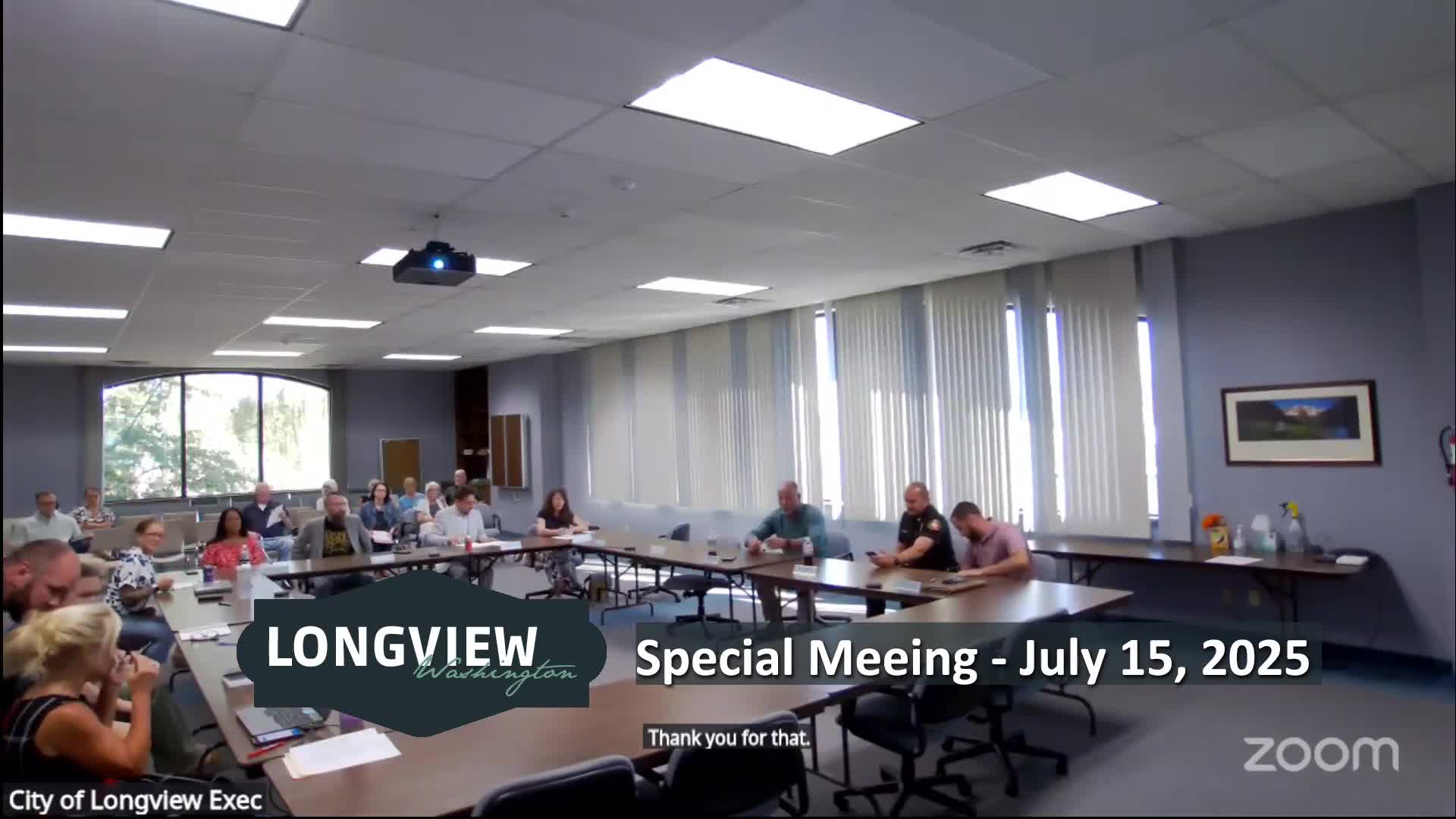
Summary
City staff presented an analysis showing modest near-term savings if Longview ends curbside recycling and replaces it with three drop-off sites, but said state law changes requiring curbside service by 2030, contract capital investments and site development costs make the change complex and likely only a short-lived option.
Nick, a city staff member, told the Longview City Council at a workshop Monday that switching from curbside recycling to municipal drop-off centers would yield some near-term operating savings but would not eliminate rate pressure and would require significant capital and contract work.
The presentation, billed as an analysis of solid-waste rates and options for the coming years, examined a baseline assumption of three drop-off locations with four containers each (glass, cardboard, mixed paper and metal), a 50% reduction in recycling volume after removing curbside service and a resulting 20% increase in garbage disposal volume. Using those assumptions, staff estimated annual hauling, rental and maintenance costs for the three sites of about $491,000; an estimated metal recycling credit of roughly $10,000 per year; a reduction in sorting costs (about half of 2024 sorting costs under the 50% assumption); and a net, across-the-board annual savings in the ballpark of $180,000 compared with current operations, after accounting for higher disposal costs.
Nut graf: The fiscal picture is complicated. Staff said the savings from ending curbside recycling are limited once increased landfill/disposal costs, the contractor’s capital investments, the cost to develop drop-off sites and equity/access concerns are included — and that Washington law and upcoming contract negotiations will shape any final decision.
Among the factors staff highlighted: the city’s solid-waste fund balance scenarios; the role of the current contractor, Waste Connections; and state-level policy changes. Staff presented three fund-balance scenarios: if the city makes no rate change and keeps curbside service, projected ending fund balances were shown as about 5.5% for 2025 and negative 7.8% for 2026; a roughly 15% rate increase combined with no change to recycling produced staff estimates of ending balances nearer to the low double digits; and eliminating curbside while not raising rates improved the 2025 ending balance to about 8.7% but still produced a deficit in 2026, according to staff slides.
Nick emphasized statutory and contract constraints. He said the city is governed in part by the Cowlitz County Solid Waste Management Plan, which currently lists residential curbside recycling as the recommended minimum level of service in designated urban areas; to remove curbside service the city would either have to develop its own city solid-waste management plan or the county would have to amend its plan. He also summarized state-level changes in the Revised Code of Washington (RCW) implemented by a recent senate bill (bill number not specified in the presentation) that staff says will require curbside collection by 2030. "However, as of 2030, we will be required to collect curbside, recycling," Nick said, noting that the RCW amendment also creates a tiered reimbursement to providers (50/75/90 percent) that would begin in 2030 and is designed to offset net recycling costs through Producer Responsibility Organizations (PROs).
Contract and capital complications were a frequent theme. Staff said Waste Connections has made capital investments in recycling-specific trucks and other equipment; some of the contractor’s fleet and containers (the city has about 11,000 curbside recycling tubs) would be difficult or costly to repurpose or store. Staff also said the city does not know the cost to acquire and develop suitable drop-off sites — rough estimates cited in discussion ranged from about $100,000 to $200,000 per site depending on needed improvements — and that higher-use sites would produce concentrated heavy truck traffic on a few road segments rather than distributed truck traffic across the city.
Council and public members raised access and equity concerns. Several council members and residents asked who would be able to use drop-off sites (seniors, people without cars and apartment residents were cited as vulnerable groups) and warned of likely increased contamination if residents had to transport materials to centralized bins. One resident said, "I'm just not keen to increase rates again and again and again every single year," reflecting council and public reluctance to repeatedly raise rates.
Policy alternatives discussed included: negotiating an earlier contract with Waste Connections (staff recommended beginning negotiations well before the current contract expires in 2027), moving to a franchise/UTC (Utilities and Transportation Commission) rate model (which would set rates by UTC and could include a franchising add-on), pursuing a city-level solid-waste plan, or standing up in-house collection (staff said that would require very large capital investments). Several council members suggested surveying ratepayers about a modest, temporary rate increase (staff referenced roughly a $3/month figure) to shore up the fund balance ahead of contract renegotiations.
No final action or vote was taken at the workshop. Staff framed the analysis as a tool for future policy and contract discussions; council members asked for more detail on site counts and costs and emphasized public outreach.
Ending: Staff said the short-term fiscal benefit of dropping curbside appears limited and that the city will confront a requirement to provide curbside recycling in 2030 under state law. Staff recommended the council consider early contract negotiations with Waste Connections and additional public engagement before pursuing any switch away from curbside service.