
Gateway COG plans free fiber trunk to connect Artesia; costs, timelines and local options discussed
Get AI-powered insights, summaries, and transcripts
Subscribe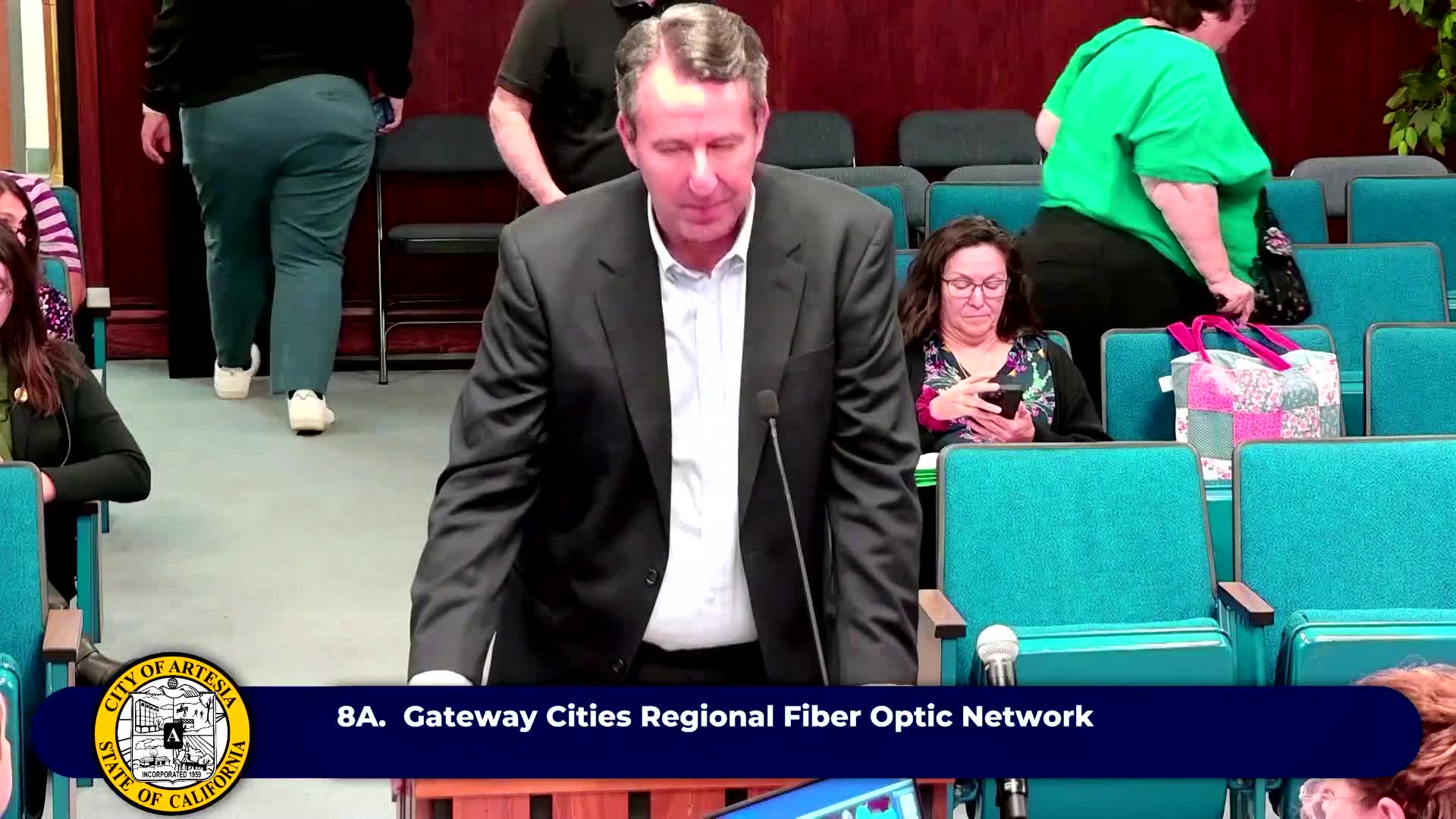
Summary
Gateway Cities COG officials told the Artesia City Council on July 14 that a state‑funded middle‑mile fiber project will bring free dark fiber to Artesia City Hall and other municipal buildings and will leave two strands of dark fiber for the city to use.
Gateway Cities Council of Governments officials told the Artesia City Council on July 14 that a state‑funded middle‑mile fiber project will bring free dark fiber to Artesia City Hall and other municipal buildings and will leave two strands of dark fiber for the city to use. The executive director of the COG said the program is paid with roughly $104 million from two state grants and must be completed by December 2026, and he described the connection as a “trunk line” that cities can extend at their own expense. The network, he said, will increase available capacity and competition for Internet service providers, and could cut long‑term connectivity costs.
Why it matters: The network is intended to tie 24 Gateway Cities into the state middle‑mile and give each city municipal connectivity for free while lowering local operating costs over time. Council members framed the project as a potential lever for public‑Wi‑Fi at parks, improved municipal IT redundancy and economic development choices for private sector and city use.
Place and scope: The presentation, given by Hector Dela Torre, executive director of the Gateway Cities COG, described a route that follows Pioneer Boulevard and 180th Street through Artesia and ties to the statewide middle‑mile. Artesia officials were told the route would be placed underground in many segments; some cities will have a partial overhead build where cheaper. For Artesia, Mr. Dela Torre said two dark‑fiber strands will be delivered to city facilities and the route will make future branch connections possible to parks, commercial corridors or other municipal assets, at the city’s choice.
Timeline and required approvals: The COG representative said the grants require construction to finish by December 2026 and that construction in Artesia could begin as soon as August or September; installation across all participating cities will happen in overlapping phases. He asked Artesia staff to consider a right‑of‑way agreement so final fiber routing and construction permits can be coordinated. City staff said they will review project maps with the COG and work on placement and restoration standards before any digging begins.
Cost and operating questions: Mr. Dela Torre said the installation is paid for by the state grants, but “lighting” the fiber — i.e., paying for Internet service and active electronics — is not free. He described an expected Internet‑service provider (ISP) procurement that will operate and maintain the network and suggested the ongoing ISP fee should be substantially lower than comparable commercial rates because the 24 cities will jointly own the infrastructure. Council members pressed for a city‑specific breakdown. Mr. Dela Torre said he did not have a city‑by‑city cost split at the meeting but pledged to provide the Artesia segment budget; later in the meeting staff said they would receive that Artesia estimate “tomorrow morning.”
Operational choices for the city: Council members asked whether the city could deliver low‑cost or free resident service. Mr. Dela Torre emphasized choices are local: the COG will deliver a trunk (the main fiber lines) and leave two dark‑fiber strands for each city; cities may then “light” those strands and decide whether to connect schools, parks, businesses or residents. He noted some cities use grants to pay for last‑mile or Wi‑Fi projects, or to build community broadband, and that additional funding sources exist for local extensions.
Other technical details: The COG representative said the project will provide redundant paths to each city hall (two incoming routes) for resiliency, 10‑gigabit capability where needed, and the option to add local branch drops. He described typical construction techniques including conduit and directional boring instead of open‑trench digging for long stretches.
Next steps: The COG asked Artesia to consider a right‑of‑way agreement and to approve routing maps. City staff said they will coordinate with the COG on final maps and restoration specifications and will share the Artesia segment cost with council members. No formal city council vote or contract award for this item was taken at the July 14 meeting; the presentation was followed by a question‑and‑answer session and staff follow‑up commitments.
What to watch: The grants require completion by December 2026. Council members asked for a written city estimate of the Artesia portion of construction and future ISP costs; staff said they would provide those figures to the council. If Artesia chooses to pass connectivity through to parks or residents, additional capital or operating funds — or new grant applications — will be required.
Ending note: Council members generally praised the idea and asked staff to seek the detailed cost breakdown and to coordinate a right‑of‑way agreement so the network build can be scheduled with minimal disruption to local streets and utilities.