
Pinole police present six‑month traffic report; cite equipment, staffing gaps and two grant awards
Get AI-powered insights, summaries, and transcripts
Subscribe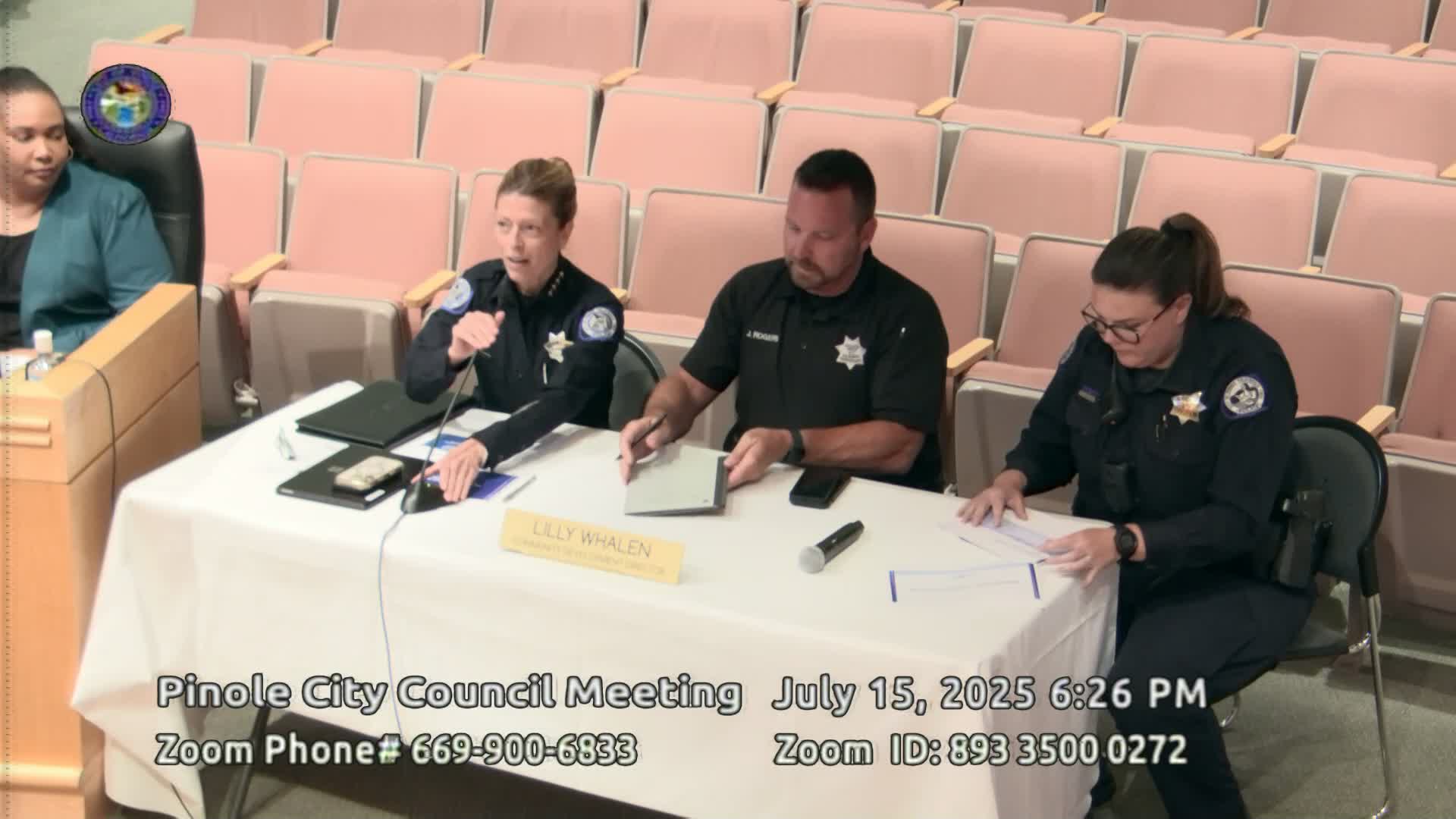
Summary
Police reported 64 collisions from Jan. 1–June 30, 2025, 12 DUI arrests, 10 DUI collisions and gaps in speed‑enforcement capacity; department won two grants but expects fewer than requested DUI checkpoints.
Traffic data and enforcement needs were the focus of a lengthy Pinole Police Department presentation Tuesday night, with the department reporting 64 traffic collisions from Jan. 1 through June 30, 2025 and outlining equipment, staffing and funding shortfalls that limit speed enforcement.
The department’s report, led by Police Chief Melissa Clavoon, summarized collision counts, primary collision factors and enforcement activity for the six‑month period and described two grant awards intended to fund training, equipment and outreach. “Most of the data…comes from our RIMS CAD system,” Clavoon said, adding the department wants to publish this report twice a year to track trends.
Why it matters: the presentation tied local collision patterns to enforcement capacity and to proposed uses of grant funding. Council members pressed for more demographic reporting on traffic stops and for clarity about when and where enforcement will be concentrated.
Clavoon told the council there were 64 collisions during the period, with 26 occurring at intersections and a concentration on San Pablo Avenue and other major corridors. The department logged 12 DUI arrests and — after a correction noted in the briefing — 10 DUI collisions in the six‑month window. The primary collision factors the department reported were unsafe turning movements, DUI and unsafe speeds.
Traffic officer Amy Eubanks described enforcement capacity limits: "We have 3 handheld lidar devices," she said, and the department has one outdated radar unit "from 2001" that is not operable. Clavoon and staff said only a small number of officers are trained on lidar and radar, and the traffic trailer used for speed display is out of service. Those constraints, the department said, reduce its ability to issue speeding citations.
Clavoon described grant applications the department submitted and the award outcomes. The Office of Traffic Safety (OTS) grant requested roughly $130,000 and the department received an intent to award of $50,000; the department is rescaling that budget and expects to fund fewer than the three DUI checkpoints it had sought. A separate cannabis‑tax grant request for just under $100,000 received an intent to award for the full amount and will fund one DUI checkpoint to be run jointly with Hercules Police Department, training, community outreach and a new traffic motorcycle.
The department also reported enforcement numbers: officers conducted 1,355 traffic stops during the reporting period and issued 584 citations (about 43% of stops). Officers wrote 92 parking citations during those six months. Clavoon said hit‑and‑run collisions are mainly minor property‑damage incidents in parking areas, and vehicle‑vs‑pedestrian collisions reported in the period involved no transport‑level injuries.
Council members pressed for additional data and context. Council member Murphy asked for a “more thorough report and comprehensive audit” of RIPA (racial and identity profiling) data and whether officers’ perceived‑race entries match DOJ reports; Clavoon said the department records perceived demographics at the point of contact and transmits that RIPA data to the state. "We do have the ability to pull that data," she said, and agreed to return to council with additional RIPA‑related reporting and with more specific traffic‑stop breakdowns.
Council member Martinez Rubin asked for day‑of‑week and time‑of‑day breakdowns and whether age is available in collision reports; staff said time‑of‑day can be added to future reports but age requires case‑by‑case review of reports and is not in an easily extractable dataset.
On speed enforcement, Clavoon said most active enforcement has focused on San Pablo Avenue and other corridors where collisions cluster. The department said it will prioritize officer training (two to three more officers on lidar/radar), equipment replacement and using the awarded grant funds to resume more frequent DUI checkpoints and community outreach.
The department also demonstrated a public, web‑facing data tool (Citizen RIMS) that lets residents view collisions and arrests on a map. Clavoon said citizens can use tutorials on the police website to view collisions and related heat maps.
Ending: The department said it will return with the requested RIPA traffic‑stop breakdown, time‑of‑day collision data and a plan for expanding lidar/radar training and enforcement as grant funding and staffing permit.